In the beginning there was marijuana, ganja: and it was good. It was used by Native Americans, Mexican shamans, and a host of ordinary, regular folks who just plain liked the way it made them feel. Then, in the 1920’s, along came Uncle Sam who deemed cannabis illegal, immoral and just plain bad for young folks since it caused “Reefer Madness.” We look back now, almost a hundred years later, and the road(s) to legalization have been paved with good intentions, but marred by potholes large enough to overwhelm an 18 wheel semi.
Medical cannabis is offered in 37 states and recreationally in 18. Will Federal legalization happen soon? No one knows, and the acceptance and buy-in of the “average American” is not an easy one. One of the biggest issues is the lack of standardization.
How much THC can that average American handle? And how do you gauge dosage?
And then there’s CBD with it’s varying configurations and the fact that CBD by its very nature is designed to NOT be hallucinogenic, yet chemists and geeks have manipulated the elements to get Delta 8, HHC, and a few other alphabetical abominations. Granted, they can be–and are– good for many, but for novices dipping their feet into the cannabis family waters, it can be scary.
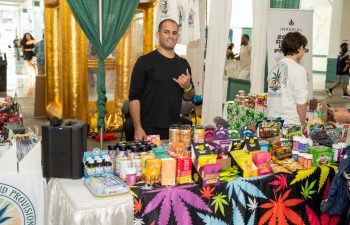
At a recent event I met Chris Fontes, founder of Trojan Horse, who had an interesting product with a unique dosage: a 2 mg capsule of THC, designed to allow the user to find their “sweet spot,” and avoid their Danger Zone.
“I come from a techie/ programmer background and have had several C-level positions at different companies. At Project Hemp Flower we broke down the Delta 8, Delta 9, CBD percentages, along with the specifics of where and how it was grown. We didn’t go big time into the Delta 8 pool and had concerns, so tried to come up with different ideas,” Fontes said.
“Instead we went back to a former model, the edible Delta 9, and Trojan Horse was formed.”
The name implies the analogy of the mythical Trojan Horse. It innocently gets you in the door and sometimes surprises you on the other side.
Fontes and I spoke about what could be one of the biggest challenges as cannabis becomes more acceptable and potentially develops into an “every day habit.” The potency of cannabis is much higher than decades and even years ago, so how does the average user protect themselves?
“That is one of the biggest concerns,” Fontes admitted, “how does the end user find the right product and the right potency to give them the sensation they are looking for? Dispensaries historically are not good at educating their customers, and instead offer recommendations of which strain to use. Dispensaries opinions of ‘how much is too much’ may be skewed since they are dealing with (mostly) more experienced users. When they say that 10 mg is a micro dose, then we know their scale is way off.”
“We’ve had more success teaching CBD wellness and smoke shops,” he concluded.
CBD has been part of the cannabis flower almost forever, but has in many cases been bred out. What you have is heavy THC and light CBD products. That has been unfortunate since CBD can dampen down some of the negative side effects of higher dosage THC.
He shared the commonly accepted scale of type I, II, and III, which grades the ratio of THC/CBD. Type I is heavy THC, little CBD; type III, is the reverse, and type II is a balance of both. Their 2 mg “Micro Mints” tabs are about 10:1 THC/CBD so it stays pure and the user is able to find their comfort zone. If you know that four mg is about “right” then you can seek out products with that potency.
James Moore is the owner of Uplift and offers a cornucopia of CBD and THC infused products. “It gets to be rather confusing,” he confessed. “There’s always something new coming up and we never know what we need to respond to and what to ignore. We started with CBD in the ‘original’ form, but the demand for Delta 8 got us in that game, too.”
“Many of our customers get requests from THEIR customers, so we respond to their needs. We started with D8 which we considered to be more ‘manageable’ through the day since it wasn’t designed to mess you up. THC-O came out of customer demand and we offer that as a sativa or indica blend, and people would use either depending upon what mood they were in or what their bodies reacted most favorably to. HHC is the new kid on the block and was developed to address hemp bans and is a hemp-derived cannabinoid, so is legal in all states. It gets pretty messy,” Moore admitted.
“No question, these products have infringed on the dispensary business. Unless someone wants to get really fucked up and they want that 20 percent or higher THC content, in most cases these products will do the job.”
The cannabis plant is amazingly complex, which both gentlemen made clear. Have we tapped into “most” of the different combinations of THC/CBD variations? The answer will continue to evolve with every new alphabetical permutation.