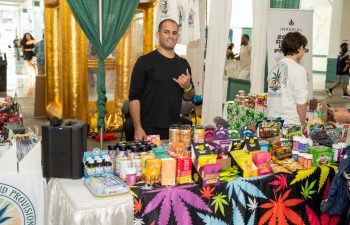
The founders of LEVIA took opposite paths after selling the brand. What they learned on either side of the deal eventually brought them back together.
When Eric and Kristin Rogers built LEVIA, they were not exactly entering a market that was begging for another cannabis beverage. They were laughed out of rooms.
Then came 2018 and the “Summer of White Claw,” when hard seltzer went from novelty to cultural phenomenon. Suddenly, the idea of a cannabis-infused seltzer had a frame consumers already understood. LEVIA could offer a similar format without the alcohol, calories, or sugar. The early signal was hard to miss. Before the first production run was even in the can, the sales team had sold through the drinks. Then the reorders started coming.
“Fast forward to launch and pre-selling every drink in the dead of winter was a good indicator we were on the right path,” Eric said. “What was exciting was how quickly the re-orders started coming through. By the 6-week mark we knew we were on a rocket ship!”
The rocket eventually became something else: a company large enough to be acquired.
When the Ayr deal closed in 2022, the founders went in different directions. Kristin stayed inside the MSO, while Eric stepped away as the build had taken a toll and the family needed his attention. It was an unusual position for two people who were married, business partners, and founders of the same company. They were now learning what LEVIA had become from opposite sides of the same transaction.
For Eric, watching from the outside made the changes especially difficult. Kristin had a different view. She was inside the machine, watching an entrepreneurial brand become one small piece of a much larger public company.
“Decisions that make complete sense for an MSO don’t necessarily make sense for an individual brand, its consumers, or the people who built it,” Kristin said.
Still, the years inside Ayr taught her something she couldn’t have learned by staying outside.
“I learned what parts of LEVIA were truly scalable, what consumers were actually loyal to, and which parts of the brand couldn’t be compromised without changing what made it special.”
That difference became the foundation for the next chapter.
“I think Eric learned from the outside that LEVIA had become bigger than us,” Kristin said. “I learned from the inside that it still needed the two of us.”

The Market Moved While They Were Apart
The most consequential shift wasn’t happening inside LEVIA. It was happening around it. In late 2023, Eric traveled to Nashville on what he describes as a fact-finding trip. Hemp beverages were exploding, and he kept hearing about cannabis lounges operating in a state where cannabis itself wasn’t legal. The contradiction was the point.
After visiting the market, Eric saw a beverage category reaching consumers through a completely different retail infrastructure. Hemp beverages could show up on-premise and in liquor stores, while regulated cannabis companies had spent years investing enormous sums in dispensary networks. For a publicly traded MSO, that created an obvious structural problem.
“It’s not that MSO’s didn’t see where the market was going, they had to try and protect the infrastructure they already built,” Eric said. “At that moment in time, this was a threat to the MSO business model.”
Eric and Kristin brought the idea of leaning harder into hemp to Ayr in late 2023. It wasn’t well received. But the “no” created an opening. If LEVIA couldn’t pursue the opportunity the way its founders believed it should, another question emerged: What would happen if they got the company back?
Buying Back the Brand Meant Starting Over
The easy version of the buyback story is that the founders missed their company and wanted their baby back. The reality sounds considerably less sentimental.
“There wasn’t one dramatic moment when I said, ‘We have to buy LEVIA back,’” Kristin said. “It was a thousand smaller moments.”
The problem wasn’t that the brand had stopped existing. It was that the qualities that had made it entrepreneurial were getting harder to preserve inside a much larger organization. LEVIA had originally moved quickly. The founders listened closely to consumers and retailers, changed what wasn’t working, and chased opportunities when they appeared. Inside an MSO, that kind of speed and autonomy became harder to maintain.
“Over time, innovation slowed,” Kristin said. “Opportunities we believed were important weren’t always priorities at the corporate level.”
Hemp became the clearest example of the difference in perspective. To the founders, it represented a new route to consumers. To a company that had invested heavily in regulated dispensary infrastructure, it presented a very different calculation. The buyback, then, wasn’t about recreating the company they had sold.
“The market had changed, consumers had changed, and we had changed,” Kristin said. “We wanted the ability to build the next version of LEVIA.”
That meant bringing back the entrepreneurial engine first. Then came innovation, relationships, a broader product pipeline, and the ability to pursue opportunities across regulated cannabis and hemp. Most of all, they wanted to bring back experimentation.
“LEVIA started because people told us cannabis beverages wouldn’t work,” Kristin said. “We don’t ever want to become the company that stops doing something because someone tells us, ‘That’s not how this industry works.’”

Making Cannabis Easier to Understand
That willingness to challenge industry assumptions was present from the beginning. LEVIA’s founders deliberately built the brand around effects rather than asking consumers to navigate a maze of strain names. Eric’s marketing background pushed the company toward a traditional consumer packaged goods framework rather than simply copying cannabis branding conventions.
The goal wasn’t to declare sativa, indica, or hybrid obsolete. It was to make the shopping decision less dependent on whether a consumer could keep track of a constantly changing catalog of strain names.
“The strain name game is confusing and hard to track how strain A vs B will make you feel,” Eric said.
LEVIA instead wanted to build what he describes as curated experiences around anticipated effects and outcomes, while using full-spectrum oil in its drinks to capture a broader range of cannabinoids. That created its own challenge: convincing consumers that consistency was possible in a category where the experience can be considerably more complicated than a single-substance product.
The founders’ answer was to do more of the work behind the scenes and make the consumer experience simpler on the other side. This philosophy runs through the brand’s larger story. LEVIA’s founders have repeatedly been willing to question the assumptions surrounding how cannabis products are made, sold, and understood.
That doesn’t mean every bet has been easy.
It means they’re willing to make the bet.
The Safety Question Gets Personal
For Kristin, the expansion into hemp comes with a particularly complicated responsibility.
Before LEVIA, she spent more than 15 years working in mental health and substance-use treatment. Her professional background makes the industry’s loose edges difficult to ignore, particularly when THC products appear in retail environments alongside ordinary convenience-store goods.
Her answer isn’t to pretend the category shouldn’t exist. It’s to demand that the companies entering it take responsibility for what they put into the market.
“My concern has never been that hemp-derived THC products exist,” Kristin said. “My concern is how they’re made, how they’re marketed, where they’re sold, and who has access to them.”
LEVIA’s approach, she said, is to treat hemp beverages as adult beverages and focus on adult-oriented retail environments and age-gated channels.
“We’re also bringing the standards we learned in regulated cannabis with us,” she said. “We don’t suddenly forget those principles because a product is being sold through a different regulatory channel.”
For Kristin, regulation and growth aren’t opposing ideas.
“I’m incredibly bullish on hemp beverages,” she said. “I’m equally bullish on regulating them like the adult products they are. Those two positions can, and should, exist together.”
That philosophy also informs another part of the founders’ work: education.
Sometimes Normalization Means Asking Better Questions
Years ago, Kristin could walk into a senior center and find two people waiting for a cannabis education session. Now, she says, the rooms are full. The questions have changed, too. They’re not necessarily asking whether cannabis is dangerous. They’re asking practical questions about what they’re considering and what they don’t know. One question has stayed with her because of what it represents.
“Am I allowed to want to feel better without the side effects?” older adults have essentially asked her.
For Kristin, the answer isn’t to persuade someone to use cannabis. It’s to make sure someone who chooses to use it isn’t deciding based entirely on stigma, fear, or misinformation.
“My background in behavioral health makes those conversations especially meaningful to me because education is harm reduction,” she said. “I’m not there to convince a 75-year-old to consume cannabis. I’m there so that if they choose to, they’re making that decision with accurate information rather than stigma, fear, or something they heard from a friend.”
That may be the most revealing piece of the LEVIA story. The founders aren’t returning to the company they built in 2021. They are returning with the scars, market knowledge, and perspective that came from losing control of it.
The first LEVIA proved cannabis beverages could find an audience when plenty of people thought they couldn’t. The second version has a different problem to solve: figuring out how far that idea can go without losing the instincts that made it work in the first place.
For Eric and Kristin, the answer seems to be the same one that got them here. Keep experimenting. Stay close to the consumer. And don’t confuse the way the industry has always done something with the way it has to be done next.
Photos courtesy of LEVIA
Sponsored Content Disclosure: This article was produced by High Times in partnership with LEVIA as part of a paid commercial arrangement. Statements regarding LEVIA’s products, business history, market strategy, and anticipated consumer experiences are based on information provided by the company and its founders. Cannabis experiences vary by individual, and references to anticipated effects should not be interpreted as medical claims.
<p>The post LEVIA’s Founders Sold Their Company. Then They Bought It Back. first appeared on High Times.</p>