Ryan Rosburg
What makes a good burger?
“I like the classic — American cheese, onions, tomatoes, lettuce, mustard, ketchup, and mayo,” says Ryan Rosburg. “It’s perfect and delicious.”
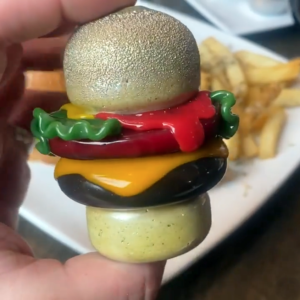
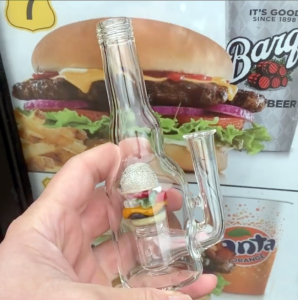
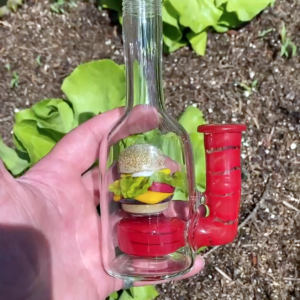
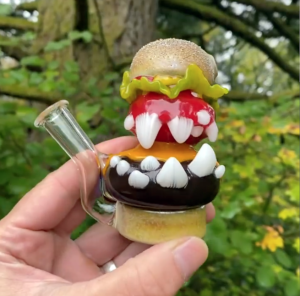
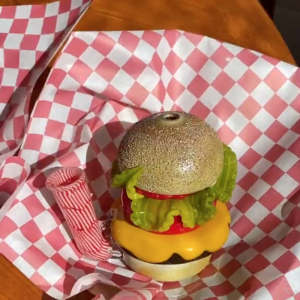
As a glass blower, Rosburg has turned his passion for food, particularly the all-American hamburger, into functional works of art.
“I’ve always been a good cook. I’ve made some nasty things too, for sure,” says Rosburg, whose kitchen and studio are in Portland, Oregon. “Once you learn how different ingredients works together, you can play with your creativity and make something that’s totally your own.”
It’s the same with glass, says Rosburg.
“You’re really just a student of the medium and the material, and you’re always learning,” he says. “When I started blowing glass, I came up with these ideas that were things that you weren’t supposed to be able to do. You tell yourself that if you try it, the glass is gonna fail and it just won’t work out. The things I used to think were impossible are what I do now every day in my work.”
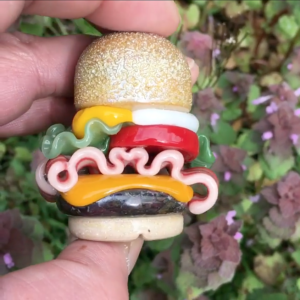
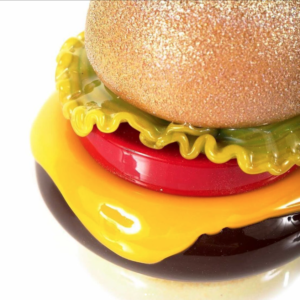
Rosburg’s hand-sized bubblers and rigs, and carb caps, terp spinners, and pendants, may look like miniature burgers, but the beauty of the sculpted sandwich is that it lends itself to so many unique variations. Some of the burgers are stacked with bacon and fried eggs, others are real monstrosities with teeth and tongues. There’s even a burger with “sausages” appropriately dubbed the “HIMburger.”
“It never really gets old. If people are excited by the pieces, I’m excited, and it’s usually recipe for a good time,” Rosburg says. “I always jump on a funny concept because there’s enough humor in the world these days.”
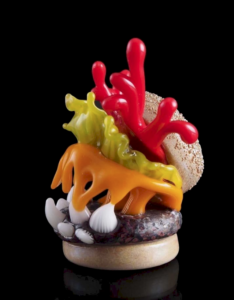
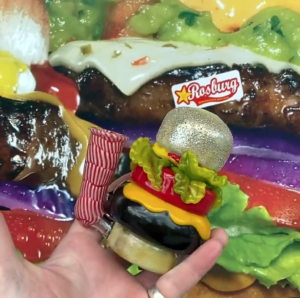
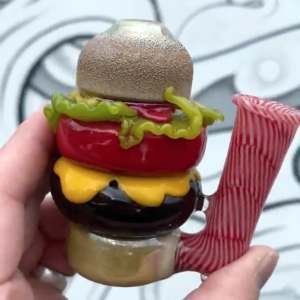
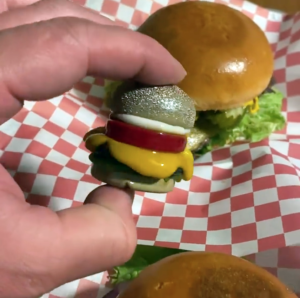
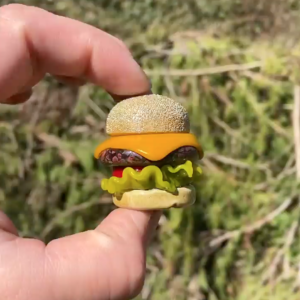
Rosburg’s process for building his burgers starts with tons of prep — stack of bacon strips, and onion and tomato murrini chips ready to go. Chefs refer to it as “mise en place,” a French culinary concept that translates (loosely) to “put in place.” If you’ve seen a cooking show when the chef has a set of tiny bowls with ingredients ready to go before they start cooking, you’ve got the idea.
A burger wouldn’t be complete without a sesame seed bun. Rosburg accomplishes that two ways; drawing them on individually with dots and smashing them into shape and frosting the buns with frit to create the texture.
“You start with a bun, you put the patty on and smash it, you melt the cheese, and then you stack everything on top of it,” he says.
“You have to keep everything really hot the whole time and just ride the edge of failure,” he adds. “It’s a good day when I open the kiln and pieces are not exploded or cracked.
“Glass is an incredible material; and glass blowing is an infinite media. The sense of accomplishment is amazing when you execute an idea and it’s something that you struggled to pull off. Being able to make a living by being creative and building something with my hands is really fulfilling.”
Instagram: rosburgglass