

@Julieriggsglass
Julie Riggs is an Aries, a perfect zodiac symbol for a glass blower, as it is a fire sign, and those born under this star are full of passion. Aries just need a bit of fuel, and they can spark into amazing creative endeavors.
Riggs has her studio in a big barn in the country outside of Eugene, Oregon. She’s been at the torch since back in the late nineties when she first heard about glass blowing classes at a community college in her hometown of Virginia Beach, Virginia — unfortunately, every time she signed up, they canceled the class. Asking for apprenticeships at local head shops brought strange looks, and one glass blower was even bold enough to tell her that, “Girls don’t usually do this ‘cause they’re afraid to burn themselves.”

Undeterred, Riggs bought prefabbed shed from Home Depot, some glass blowing supplies, and set up her own studio in her grandma’s backyard. Her first teachers were VHS instructional tapes. Over the next few years, she attended formal classes at the Penland School of Craft, in North Carolina, and the Corning Museum of Glass.
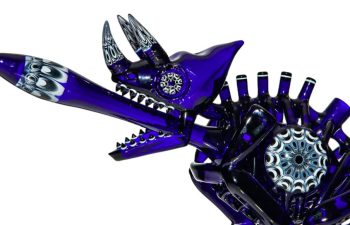
It’s fitting that Aries is astrologically symbolized by ram horns as Riggs has become known for her sculpted pipes combining horns and skulls.
“I have an obsession with skulls. Halloween is my favorite holiday and I’ve got skulls all over my house and my shop and even all the way along a black wrought iron fence,” Riggs says. “Some people would consider my style goth, but Im really a happy person and more into hippie music and bluegrass.”

“I use a lot of solid sculpture on the hollow pieces, and that’s definitely the most challenging because you have to keep the heat even throughout the solid and the hollow. You keep it too hot, then you’ll mess up the hollow and if it’s not hot enough then you’ll crack the solid,” she explains. “I started using Bunsen burners to keep the piece hot and that’s helped me take my work to another level”
Look closely at the Aries constellation and you can also see how it resembles the outline of the female womb and fallopian tubes. Also akin to many of Riggs’s pipes and pendants — and even a boro derby car, that incorporate the female form.
Speaking of body parts, Riggs is also a master at making lifelike eyeballs, which she works into spoon pipes and pendants. It’s an old school technique she learned in Lauscha, Germany where prosthetic eyeballs originated back in the 1800s.

“It’s a super-secret soft glass technique that’s usually only passed down from generation to generation,” Riggs says. “They make the colors that match people’s eyes right there in Lauscha at their factory. We don’t have the same colors in borosilicate, so I have to make my own colors and I like using colors that aren’t typically found in nature.”
All Aries want to succeed, but there’s always a bit of insecurity nagging at them — in a good way because like Riggs they’re never satisfied with just good enough.
“I don’t feel like I’ve ever mastered anything. You can always improve and learn new things.

Everything’s a challenge. Glass blowing it the first art form that I tried that I wasn’t instantly good at, that actually pushed me, and still does every day,” Riggs says.
“Besides being a mom, blowing glass is my greatest passion in life,” she adds. “The fact that people want to own my work just makes it that much better.”