



By Steph Sherer
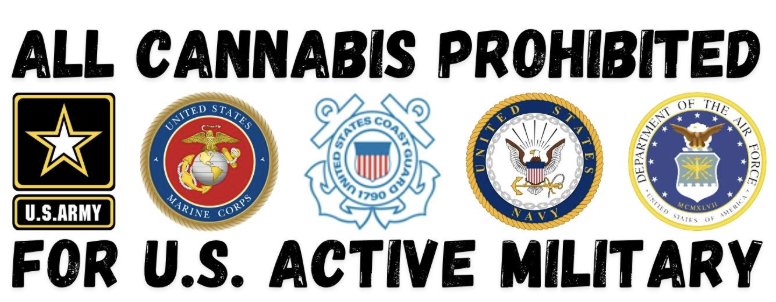
For the millions of Americans who serve or have served in the armed forces, the discipline and sacrifice of military life come with strict rules. One of the most unyielding is the blanket prohibition on cannabis use for active-duty service members — even when that use is legal under state law and medically recommended by a doctor.
This isn’t just about recreational use. It means that service members with chronic pain, PTSD, traumatic brain injuries, or other service-related medical conditions are barred from using medical cannabis, even if it is the most effective treatment available to them.
The Law: Article 112a of the Uniform Code of Military Justice
Federal law — specifically Article 112a of the Uniform Code of Military Justice (UCMJ) — makes it a criminal offense for active-duty personnel to knowingly use, possess, or distribute marijuana or marijuana-derived products, including CBD.
Article 112a, UCMJ:
“The knowing use, possession, or distribution of marijuana and marijuana-derived products, including CBD, is prohibited at all times and in all locations. Violations are punishable under Article 92 of the UCMJ.” 10 U.S.C. § 912a
Penalties for violations “Article 92: Failure to Obey Order or Regulations” can range from reprimands and forfeitures of pay to confinement, discharge, and loss of benefits, depending on the severity of the offense and the court-martial findings.
In practice, this means there are no exceptions — not for a doctor’s recommendation, not for state-legal medical cannabis use, and not for service members stationed in jurisdictions where cannabis is fully legal.
Branch-Specific Enforcement Policies
While the UCMJ sets the foundation, each branch issues its own regulations reinforcing the prohibition:
Army (AR 600-85)
The Army’s Substance Abuse Program explicitly bans cannabis and all cannabinoid products:
“Soldiers are prohibited from using hemp or products containing hemp oil … [and] synthetic cannabis, including synthetic blends using CBD oil.”
AR 600-85 — Army Substance Abuse Program
Air Force (DAFMAN 44-197, § 1.2.2.1)
“The ingestion of products containing or derived from hemp, including … cannabidiol (CBD), is prohibited. Failure by military personnel to comply … constitutes a violation of Article 92(1), UCMJ, and may also constitute a violation of Article 112a, UCMJ.”
DAFMAN 44-197 (Sept. 5, 2023)
Navy & Marine Corps (ALNAV 057/19)
“Sailors and Marines are prohibited from knowingly using products made or derived from hemp … including cannabidiol (CBD), regardless of the product’s THC concentration … or whether such product may lawfully be bought, sold, and used under the law applicable to civilians.”
ALNAV 057/19
Coast Guard (ALCOAST 308/20)
“Coast Guard members are prohibited from knowingly using products made or derived from hemp, including cannabidiol (CBD), regardless of the product’s THC concentration … or whether the product may be lawfully bought, sold, and used under the law applicable to civilians.”
ALCOAST 308/20
The Human Impact
This policy leaves service members facing an impossible choice: endure ongoing pain or symptoms without the medicine that works best for them, or risk career-ending disciplinary action and potential court-martial.
- A Navy corpsman with combat-related PTSD may find that traditional pharmaceuticals are ineffective or cause harmful side effects — yet cannot try medical cannabis without ending their career.
- An Air Force mechanic suffering from chronic pain after an injury may be stationed in a state with legal medical cannabis but still be barred from using it.
- Even non-psychoactive CBD oil is banned, despite its legality under federal law for civilians after the 2018 Farm Bill.
The result is a two-tier system: civilians and veterans in many states can use medical cannabis, but active-duty members — even those in severe medical distress — are left without access.
Why Only Federal Legislation Can Fix This
Military regulations are rooted in federal law. The UCMJ and each branch’s rules all flow from cannabis’s classification as a Schedule I controlled substance under the Controlled Substances Act (21 U.S.C. § 812).
Even if a state passes military-specific protections, they cannot override federal military law. The Department of Defense takes its orders from Congress.
That’s why only federal legislation — like the Medical Cannabis and Cannabinoid Act (MCCA) — can:
- Authorize the Department of Defense to create a medical cannabis access program for active-duty personnel under medical supervision.
- Remove medical cannabis use from the definition of “unlawful drug use” for the military
- Protect service members from adverse action solely for using medical cannabis consistent with state and federal guidelines.
____________________________________________________________________________________
What’s at Stake
This is not just a policy issue — it’s about the health and readiness of our armed forces.
Our service members deserve access to the best possible medical care, especially when they are facing pain, trauma, or injury as a direct result of their service. Denying them access to medical cannabis is denying them a potentially life-saving treatment.
As long as cannabis remains federally illegal, Article 112a of the UCMJ and branch-specific bans will remain in force.
Military policy leaves no room for exceptions: cannabis is banned, even for those with legitimate medical needs. A strong military depends on healthy service members. Outdated cannabis policies undermine both health and readiness. Our armed forces deserve the same medical options and protections as the citizens they serve. This is a fix only Congress can make. It’s time to pass the MCCA.
Take Action Now: www.safeaccessnow.org/take_action











