While the THC-A-focused company may be new, Becker navigates the industry with a steady hand. He picked up the business years ago, cutting his teeth on some of the cannabis industry’s best-known brands after stints in marketing and street fashion. Working out of downtown Los Angeles, he’s always picked up underground trends before they break mainstream. Thanks to some visionary ideas, he’s readying Sacred Stoned, already in 12 states, for major expansion.
“They all come with a message in them, like a fortune, to get you started on your journey. All the art is created with intention and energy. It’s just a more thought-out product line, as opposed to the normal products that are out there,” he says. “I just want to stand out, be different, see if we can be entertaining and at the same time instigate some thought, question reality, think about what’s real, what’s not, all those fun concepts that I grew up on.”
With flavors named after unexplained phenomena, such as Alien Apples, Blackberry Shaman, and Strawberry Sasquatch, the brand nudges users toward mystical ideas that were once regularly associated with cannabis.

“The names aren’t just about flavors; they’re experiences,” Becker explains. “They’re reminders to think outside the box, expand your mind, and stay open to the journey. Every product we put out is designed with intention, not just as something to consume, but as something to enhance the way you see and interact with the world.”
His turn toward the unexplained represents a departure from his previous cannabis brands, both of which were highly successful, which focused on the “counter” part of the counterculture.
“I used to have a streetwear brand called RZST (read: resist), and it was an anti-establishment company catering to the counterculture, you know, to the core, street art skateboarding and, and all that good stuff,” he said. “But Obama took office, and nobody was really resisting anymore. Everybody was just kind of down with the system; that just didn’t work for us. We didn’t know how to put the twist on it.”
If political agitation against the George W. years provided RZST with moxie, the chaos of the present order calls for a more uncommon solution. To capture the zeitgeist, Becker needed to understand the hidden desires of his base. He looked inward, and like the Buddha under the Bodhi tree, was struck by divine inspiration.
“I ended up just taking multiple mushroom trips and just kind of getting really into it and taking lots of notes, and it just came to me,” he says. “I like Sasquatch and UFOs and anything sacred. At the end of the day, everything is sacred. If it’s something that you’re passionate about, it’s sacred to you. At this point, it’s like, what else do we have left but to dig deeper into the sacred?”
A Focus on THC-A
Becker has always been a man of the moment. He lived with Jonathan Davis of Korn just before the band got big. Years before the modern cannabis sector took shape, he worked in sales and marketing for Tradecraft Farms—a founding father of the industry—and served as the creative force behind the innovative Sticke Vape.
It’s not a coincidence that his pivot to a more singular, mystical dimension occurs as the cannabis industry faces multiple threats from both inside and outside. As states threaten to crack down on hemp-derived cannabinoids, Becker has bet big on THC-A. It’s the closest thing to real THC, he says and provides his company the best legal chance to give the people what they want.
It’s a firm strategy, but he’s prepared to change up if things get hot.
“I’ve aligned myself with some pretty amazing manufacturing partners, and they’re—knock on wood—always at the forefront of what the next loophole is going to be,” he says. “I just want to keep building a brand and making contact with people.”
Toward that end, Becker has flexed his marketing muscles. The brand’s latest gadget is a single-use rig that comes preloaded with THC-A. 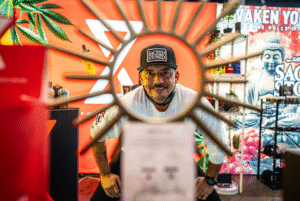
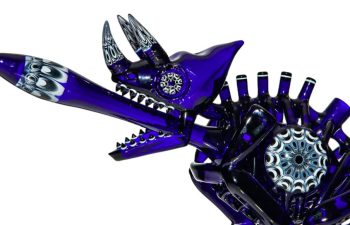
“We’ve created this wonderful ready-to-use concentrate dab rig. We call it the Sacred Stone because it looks kind of like a stone, and it’s got hieroglyphics all over it. It’s an all-in-one, ready-to-use dabber with THC-A batter in it. It’s been a really exciting product,” he says. “Every store we ship to gets super cool posters and P.O.P. and all that good stuff to go with it.”
Stores aren’t the only ones. As part of its marketing efforts, Sacred Stoned makes use of Becker’s connections to the music industry. The team is already a fixture at the Golden State’s festival scene.
“Music is everything. We’re friends with bands like Sublime, Stick Figure, Matisyahu, Deftones, Korn, and so many more—artists who represent different sounds but share a common spirit. Cannabis and music have always been connected—it’s about vibration, creativity, and shared experiences,” Becker says. “But Sacred Stoned goes beyond music. It’s about all sacred passions—skateboarding, surfing, motocross, yoga, street art, fine art—anything that fuels the soul. If you dedicate yourself to something, it becomes sacred. Cannabis is part of that ritual, whether it’s sparking creativity, focus, or just grounding yourself in the moment.”
Check out the Sacred Stoned All-In-One Disposable Dab Pods on our website HERE!