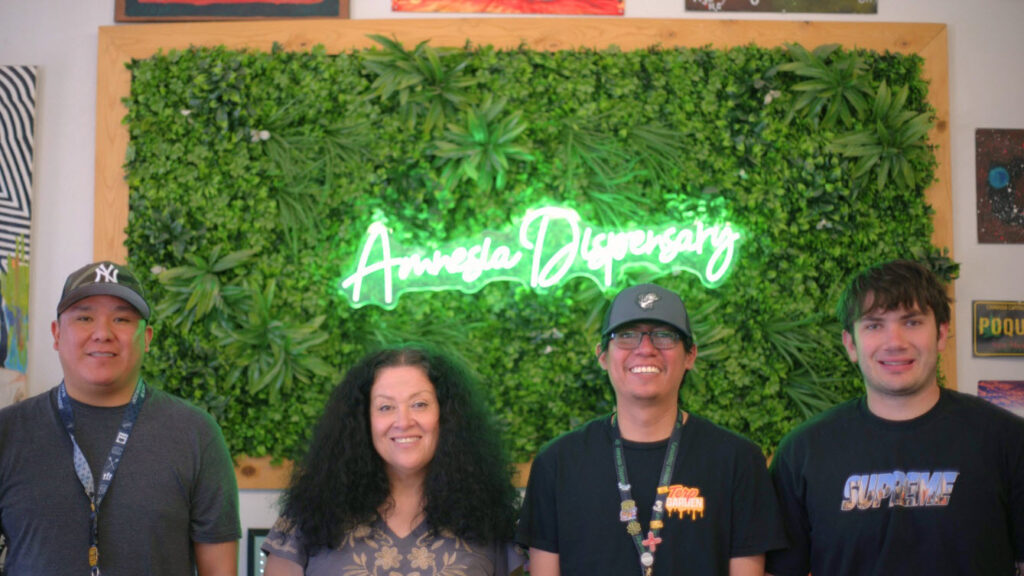
To understand why the independent dispensary Amnesia has succeeded in the most oversaturated market in the nation, head to its bathroom.
Inside, there’s material that changes lives. Owner Julietta Neas stocks the stalls with information on where to find free meals and mental health treatment, numbers to call if you’re experiencing suicidal ideation, and places that can help those caught in violent domestic situations.
“I was a social worker for 11 years, and this is kind of the same thing,” she says. “Once you’re a social worker, you carry it no matter where you go. We’re all human, and humans have needs.”
Many stores claim to care about their customers; few have this level of compassion. It’s what drives her to operate the only Latina-owned dispensary in Albuquerque, and what makes Amnesia unique.
Better than an MBA
Since recreational sales began in April 2022, dispensaries have exploded in New Mexico. The Regulation and Licensing Department has issued more than 3,070 licenses for a state with 2.1 million people. That means the state has roughly five times as many dispensaries per capita as Colorado, and the boom happened in one-third the time. To complicate matters, New Mexico doesn’t have the kind of residency requirements or social justice mandates that other states do. Anyone, including non-residents, can open a shop. In that kind of environment, independents don’t stand much of a chance. They have to compete against veterans from outside with more experience and big money behind them.
 Amnesia survives by paying close attention to both the details of the market and its customers.
“I knew that I wanted to make it affordable to the common person. That’s something that I was seeing in the market, that it wasn’t affordable for everybody, so I knew that that’s the way that I was going to go about it,” Neas says. “My stores are known for their affordability, and I always advocate for my customers.”
“I think that our products need to be high in quality. I noticed that a lot of the medical clientele are people who are on fixed incomes, and this is their medication—and it’s not like it’s covered by insurance. So what they’re able to afford is not necessarily the best, and to me, it was really important that they’d be able to afford high-quality medication. Many of my customers are on Social Security, a lot of them are disabled, a lot have cancer, I could go on and on. I saw that, and I thought, ‘How is this fair? How can we make it fair? How can everybody get what they need?”
Although she was trained as a social worker, Neas is a shrewd businesswoman. Just six months after starting Amnesia, she opened a second location. A third and fourth soon followed—she bought out two independent stores that cratered under the competition. Unable to secure a loan for a weed business, Neas sold her house and moved in with her sister, Julianna, who’s also her business partner. The added retail space gave Neas leverage to negotiate with vendors and secure lower prices for her customers.
She attributes her business acumen to a hard-charging immigrant work ethic. Neas moved to the U.S. with her mother and two siblings from Mexico at age 9. By 13, Neas had a job bussing tables at a restaurant, and she hasn’t stopped working since. To this day, she’s at her stores every day, doing everything from scrubbing toilets to managing the till.
“We moved here for the American Dream,” she says. “But I started realizing that the American Dream is working really hard and overworking yourself if you want to get anywhere. And it’s becoming less and less manageable. But also, I think it’s fun. I’m like, give me more hell because the more hell you give me, the more stubborn I become. And then we just got a farm, so we’re going to start farming as well. So I’ve been working hard at that farm, and I’m sunburned, and I’m tired, but I think that in the end it’ll be worth it.”
People First
Neas understands that she’s in the people business. So she treats everyone right, starting with her staff. Her workers earn good money and get daily support from their boss. Neas believes that if she treats her employees well, they will, in turn, extend that kindness to customers.
 “One of my main things is to always be friendly and to realize that we don’t know what people are coming in with,” she says. “We don’t know what they’ve been through or what they’re going through. You’re gonna have people that come in, and they’re super fun, and then you’re gonna have people that come in, and they’re grouchy. And the grouchy ones, you don’t know if they haven’t had their medicine, or they’ve been throwing up all night, or they have nausea because they have cancer. You never know what people are going through. And so that’s like our main thing is to be kind to everybody that walks in that door.”
But even that’s not enough. She’s also accessible to both her staff and her customers nearly 24/7.
“When you walk into my stores, there’s a sign that says, ‘Where Complaints are Compliments,’ and it has my phone number. Anyone can call me directly,” Neas says. “And they do. I’ve gotten more complaints than compliments, but I’ve gotten nice things, too. People will tell me that an employee did great or that our bud tenders are so knowledgeable, little things like that.”
Facing the firehose of customer feedback makes her better at her job, she says. She’s not afraid of criticism.
“When I first wanted to do this, everybody thought that I was nuts. But here we are, you know? I mean, and everybody was like, ‘What are you going to do? What if you don’t make it?’ And to me, you either give it your all or you don’t. I told them – relax, I was a social worker. I know where to get free food. I’ll be fine.”
Check out their Instagram to stay up to date on their current deals and offerings!