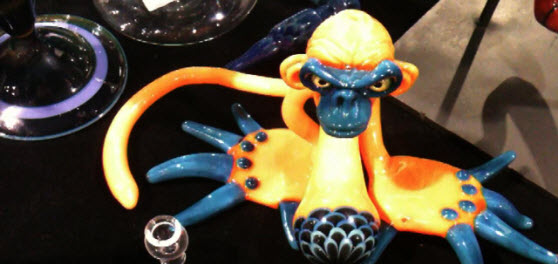
There are objects Americans buy because they need them, and objects Americans buy because they let them be a certain kind of person. A perfectly functional version exists, usually for a fraction of the price. But the other version comes with a name, a story, and a reason to pay extra.
That is the divide in your glass case: products that offer functionality versus those that offer identity. People who buy American glass want to be part of the community. They want to support the scene that comes infused with specific ideals—ingenuity, independence, pride—that define the counterculture.
And nothing does that better than American glass. It’s the worldwide standard because of its high quality and its inventiveness. Glassblower Brandon Damopoulos, who works under the handle @dmopglass, describes the American scene as a craft on improvisation, experimentation, and shared knowledge.
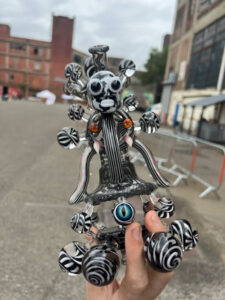 “We carved the first path, you know?” he said. “If you think of it like skateboarding, American glassblowers are the guys skating backyard pools and building the first ramps, finding out what works and what doesn’t. We laid the groundwork.”
Two pipes can share the same silhouette and occupy different realities. One is used and forgotten; the other becomes a display piece. It’s a feeling that veteran pipe maker Ralph Richie (@takoglass) can understand. After decades in the craft, he turned a passion for functional art into a living and then into a community.
Richie came up at the last possible moment when learning glass meant being physically near the people who knew how to do it.
“There was no internet to look up how to blow glass,” he said. “We were teaching ourselves everything. We had a book, called something like ‘Intro to Glassblowing 101,’ and that’s how we taught ourselves to do it. There was a lot of trial and error, but it was fun. Our goal was to have something new to smoke out of every day when we came to the shop.”
Today, Richie is known for two things. The first is Purple Nebula, a signature deep violet hue that changes with use. The second is takoglass.com, a direct-to-consumer storefront that widened into a kind of community hub. Richie originally launched the shop to supplement his sales. But he quickly sold out of his own work, so he added his wife’s pieces (@beezyglass). Soon, the shop started carrying works from his friends and peers he’d known for years.
“Now we support 200 American glass blowers,” he said. “These are people I’ve known for years, people who have families. And this helps support them. It’s helping them buy diapers, pay for Little League, and put gas in the car. They’re doing the work, but it feels good to support other American families who get to work out of their garage and still be home with their kids and create art.”
Passing the Flame
Today’s younger artists have more options. Instead of studying books, they can take advantage of formal programs. Thirty-one-year-old Dmop cut his teeth in trade school, studying scientific glassblowing at Salem Community College in New Jersey. Officially, the school instructs students in the fine art of making laboratory apparatuses, such as distillation units and condensers. In practice, the skills are directly transferable to pipe making.
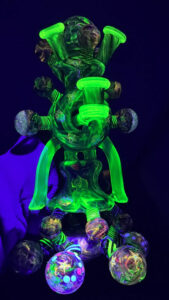 “A lot of my work reflects the knowledge I learned there,” he said. “I cater to the scientific aspect of things… I focus on the form and the function of glass.”
After completing his studies, Dmop moved back to Columbus and began to spread his newfound skills across the scene.
“There’s a certain flame called an annealing flame that engulfs the entire piece and warms it up in a soft way to keep it from cracking. It’s very common in the scientific field, but when I came back to Ohio, nobody knew it. Everyone called it the Dpop flame for a while because they’d never seen it anywhere else. That felt really cool, being 21 years old, and I got to teach these dudes who were 15 years older than me and had been in the game for a long time, I got to teach them new stuff.”
The knowledge transfer from maker to maker keeps American glass evolving, especially as the market changes.
“Legalization definitely affected us. Ten years ago, there were random people that were making a living selling weed, and now that’s few and far between. And those people had extra money to go spend $1,000, $2,000, or $5,000 on a bong. Now there’s just less of those people out there, and that money’s tied up in the corporations. So we’re selling to a different crowd,” Dmop said. “I think of it this way: a majority of people like Bud Light, they don’t like craft beers. There is a smaller percentage of people that like craft beers. When it comes to my glass pipes, they are not the Bud Light of glass pipes. Mine are like the special heady IPA that there’s only 20 of.”
Bright Lights, Small Cracks
Societies can be judged by the art they create and celebrate. Collectors use “Team Japan” as shorthand for a loose confederation of Japanese makers whose work leans into finely honed detail and disciplined craftsmanship. American glass, by contrast, earns its reputation through a more diverse aesthetic and looser, more inventive execution. Its defining features are high-quality glass and vibrant colors.
 Richie puts the practical version of that difference in blunt terms.
“What we call ‘import glass’ is thin. They’re using cheap colors that are not as vibrant as, like, the USA colors. The color work isn’t blown in and not melted all the way together, and so it makes the glass not as strong, so it breaks really easily,” he said.
The consequences of bad build quality arrive late, usually after the sale. A hairline rupture your customer couldn’t see under display lights shows up with a vengeance a week later. Colors that never truly fused split on the first hard clean.
Pipe glass has long carried a stigma that many buyers wear like a badge of honor. The people who stay in it for decades aren’t doing it because it’s easy; they’re doing it because the work still feels like building something that’s greater than the sum of its parts.
“I really think pipe makers are, in a way, true patriots,” Dmop said. “We are doing work that benefits society and benefits the individual creatively. Regardless of the stigma, we’re trying to find happiness and live an abundant life. People want to express themselves and be proud of their work. That’s the American dream.”
“We’re manifesting art out of nothing. You know, it’s just this blank, blank tube glass, and it’s our imagination and our energy, artistic energy, turning those into, like, one of a kind, glass pieces every day.” —Ralph Richie (@takoglass)