
It’s time for smoke shops to admit something. Your industry is screwing up. You’ve let a proud legacy flounder, and you’re going to pay the price.
There aren’t many niche outlets that have survived since the 70s. Smoke shops endured despite police crackdowns, moral panic, and rising taxation by clinging to a core identity that has all but been abandoned. Now, with more shops than ever, the industry is somehow close to disaster.
Once a hub for counterculture thought and action, smoke shops have become corporate bodegas: identical stores selling identical products. They were gathering space for those that weren’t welcome elsewhere, and little by little, those groups grew larger, fought the system, and (somehow!) won. But the price for legalization was its soul.
The industry has embraced a profits-over-people approach, which has eviscerated what kept it afloat through the decades. Market forces may have thrust some of this upon you, but they won’t save you from what’s coming.
Smoke shops have become Starbucks. Market saturation has set in. The only way to go is backwards, and the bad stores will drag others down with them. If smoke shops are going to survive in a critical mass, it’s time to relearn the lessons that have been forgotten.
What We Lost
In decades past, the centerpiece of any smoke shop was a giant, ornate glass pipe. It stood proudly in the middle of the store, expensive, impractical, and beautiful. It never sold, but it wasn’t supposed to sell. Its shine drew customers by reflecting a set of values that most of today’s outlets ignore.
Cannabis can help heal the mind and body, but its real power lies in building fellowship. Extravagant glass pieces are made to be admired by groups. Their size and detailing convey reverence for the ritual of the smoke session—a practice that grew out of hallowed traditions, such as when the Lakota Sioux circulated finely carved ceremonial pipes to seal alliances and cement deals.
Today’s glass doesn’t descend from such heights. Modern shops give priority space to technology-forward pieces designed to maximize individual experiences. Even worse are the mid-range pieces. They’re not blown by artisans, unique and admirable. They’re cheap trinkets that prize function over form, trumpeting a clear message: cannabis is not a community organizer; it’s an agent to dull the pain.
The Road Well Traveled
Smoke shops, like invasive lanternflies, began to proliferate in America thanks to a combination of global events. The pandemic shuttered storefronts, leading landlords to reduce rent just as scientists discovered cannabinoids and figured out how to stuff them into disposable delivery systems.
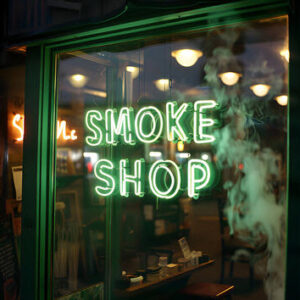 With low overhead, high margins, and the ability to operate out of small spaces, smoke shops proliferated. The operation is almost too easy. New products and flavors bring in customers, eager to sample a taste of novelty.
Researchers call the sudden appearance of similar shops “cloning.” It happens when a specific location becomes home to stores offering nearly identical products and services and compete for highly similar market segments. Cloning is common across many industries, and it usually signals troubles ahead.
When an industry reaches a cloning stage, it metastasizes until it’s unsustainable. The abundance of similarities makes every shop replaceable. Once market saturation hits, shops begin to fail. As closing stores liquidate, they push prices lower, causing more to crater. The cycle is unwavering. The only way out is not to play. Successful shops must provide something beyond the same 10 stock items to stay afloat.
Forecasters see a bleak economic outlook ahead, especially for industries affected by tariffs. As consumers cut back on non-essential items to pay for higher-priced groceries, rents, and medical bills, smoke shops will compete for a smaller market share. Only the smart will survive.
Things You Can Do
The internet is awash in asinine business advice. Diversify, add value, innovate. Good ideas all, and practically useless. Differentiation is hard. It requires business acumen, creativity, and an almost preternatural understanding of a customer base. For most shop owners, gambling on new strategies carries significant costs, especially if they’re independent.
Chain stores have built-in advantages. They buy products at reduced rates and can run experiments at one location that won’t affect sales in others. But single-owner outfits have one distinct advantage: authenticity. Luckily, research shows customers value the authenticity of independent businesses over the sanitized feel of chains. What does that look like? It looks like building around your values. Ask yourself: what drove you to open a shop? What do you love about the counterculture? Whatever you answer, find a way to give that feeling to customers.
The right mindset goes a long way. Americans define themselves, in part, by what they buy. Smoke shops that offer a sense of identity will be well-positioned to withstand the reckoning. That means offering useful services, fostering human connections, creating an inviting atmosphere, and providing a hint of discoverable joy. Admittedly, that’s easily said. But it’s also vital.
What’s at stake is more than products. Gas stations and dispensaries will happily stock their shelves with pipes, disposables, and incense sticks. Smoke shops started a revolution by connecting people to products and ideas that mattered. They’re still at the vanguard of the counterculture. If we lose the smoke shops, we lose the fight.