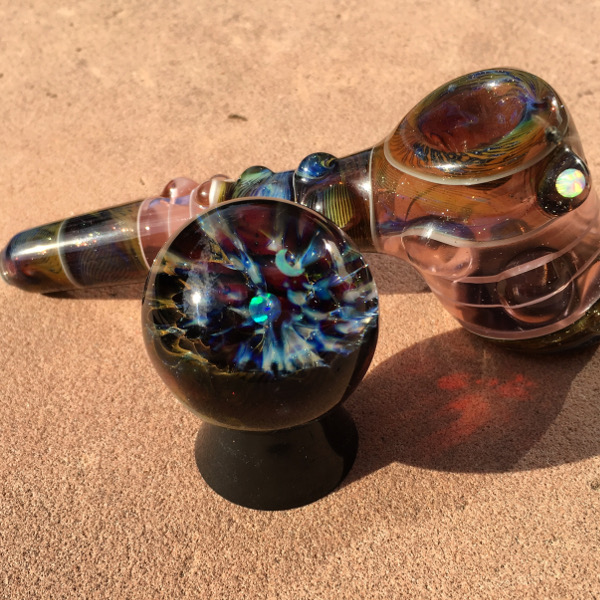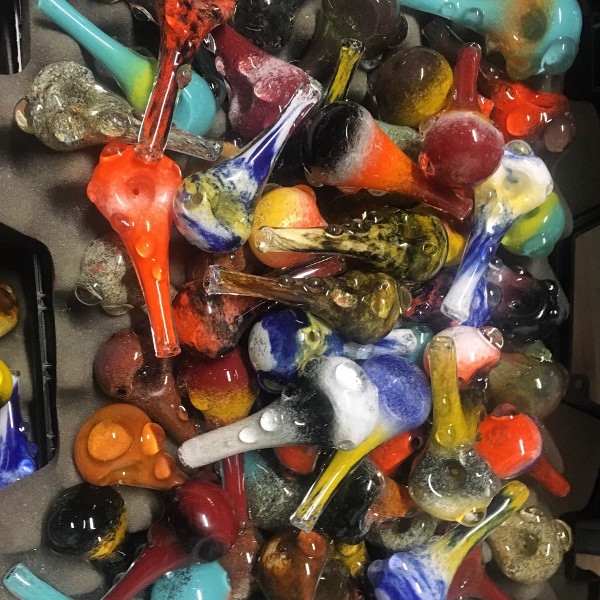
Spinning a glass marble around in your fingers is an exercise in discovery as the spherical shape of the object itself magnifies the wonders within. The swirling colors and endless vortexes bring to mind psychedelic visions, and that’s only fitting for glass artist Benjamin Cornwell who was introduced to glassblowing and marble making by a friend he knew from going to Grateful Dead shows.
“He was making tinky-wink glass sculptures, and we’d always trade —- I’d give him a bag of weed and he’d hook me up with a really cool marble,” Benjamin says. “We were at a tribute show, and having a little more fun that we should’ve, and he looked at me and said it was my time to learn how to make marbles.”
“It took me like three hours to make my first marble,” Benjamin confesses. “It was perfectly round but with a little nipple. I never made another round one for four years after that. I understand why pipers don’t like making marbles — the parameters with making it round can be really frustrating.
“I learned early on that it’s not how well you perform the action, but how well you hide your fuck ups.”
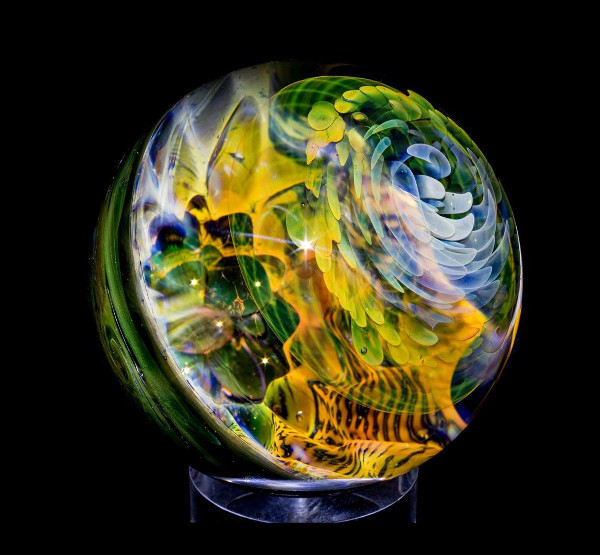
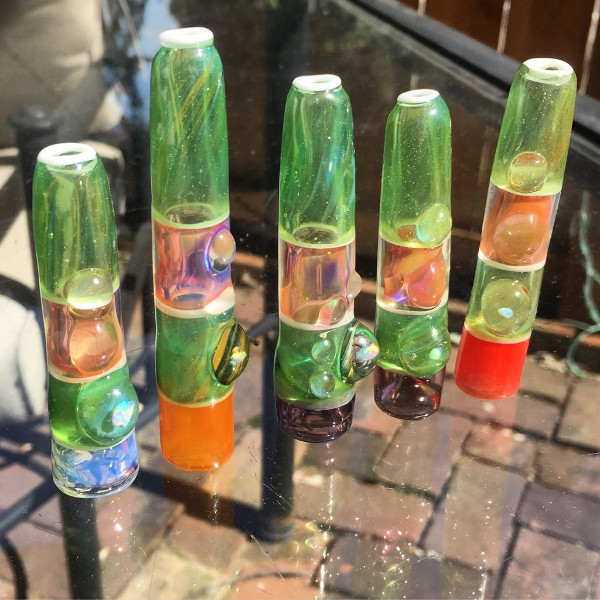
Benjamin, who lives in St. Louis, Missouri, has been creating marbles, jewelry and pipes for 14 years. He named his signature style of marble a “Cornwell,” and why not? It’s a fusion of a vortex, implosion and honeycomb that he came up with himself.
The other style for which Benjamin is known, he calls a “Color Balance.” Aptly named because it incorporates two stacked halves separated by a band of contrasting color.
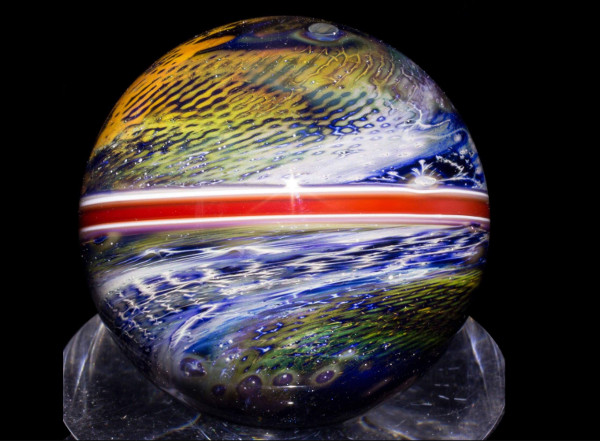
“It’s a whole bunch of juggling to get it from a tube to being round and also keeping the halves even,” Benjamin says. “As the halves form, they will fold on each other if not handles just right.”
Benjamin is now working on a series that combines both of those styles. He’s planning to drop the new marbles at the Moon Marble Company show, in Kansas, and The Michigan Glass Project, in Detroit, later this coming year.
Marbles are Benjamin’s passion, but he loves how functional and art glass styles are gaining so much mainstream popularity. “It’s like the difference between New York and Chicago style pizza — there are differences, sure, but it’s still fucking pizza.”
You’d think smoke shops, where glass collectors pay big bucks for glass pipes and pendants, would be the perfect showcase for marbles. But most often, when Benjamin peddles his pipes to a smoke shop, and also shows off his marbles, buyers are like, “What the heck am I supposed to do with that?”
Benjamin admits that it wasn’t long ago that he thought he’d “fucked up picking marbles as a career choice.” But over the last 5-10 years, he’s seen a new generation of young collectors, who recall seeing glass marbles and paperweights on their grandparent’s curio shelves, getting into the scene.
Think there’s nobody willing to shell out headie prices for a marble? Recently, a tiny 5/8″ diameter marble made by Christensen & Son Company sold at auction for somewhere around 20 grand!
“Marbles don’t know a culture,” Benjamin says. “Everybody loves marbles, even if they don’t know they love marbles, and they’re starting to be cool again.”
Benjamin Cornwell
@BCGlassWorx