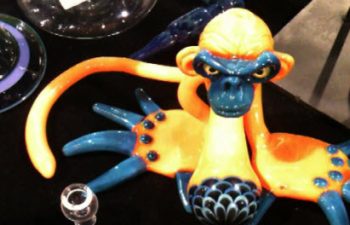
The world is generally attuned to the perception that bigger is better. A larger car, a wider television screen, a longer — well, you get the idea. When Minnesota glass artist Derrick Strouss makes one of his creations it starts off big, and by the end of the process, is delightfully small. That’s how it is with murrini, a technique of layering different colors of molten glass around a core, then heating and stretching it into a cane, which when cool, is cut into cross-sections with each slice displaying an intricate pattern or image.

“I can’t draw stuff as well as I can doing it in glass. With murrini, I can actually take a caliper and know precisely where a piece of the puzzle needs to be,” Strouss says. “You’ve got one shot at it. You might be working on one side and the other side might get too cool, so you’ve got to be sinking a ton of heat into this thing and really keeping it hot at all times. There’s a risk to it that draws me in — if a piece breaks or cracks, it makes me want to do it even better the next time.”
Depending on the complexity of the planned image, each piece can have thousands of individual canes. A scene featuring characters from King of the Hill was more than three pounds and measured eight inches in diameter before being stretched down to just a few inches. Still every little detail was visible.
Strouss turns his murrini into pendants, marbles and attachments on functional pipes. It might be Ween’s Boognish demon face logo or an outer space scene like the one that earned him People’s Choice in the millie category at Glass Vegas. What he enjoys most are free-form kaleidoscope designs.

“Sometimes I’ll throw together different colors and get a completely different image than what was originally in my head,” Strouss says. “It’s fun to be surprised at the end product when you take it out of the kiln and saw it open.
“The more complex you go, the more chance there is of drowning out the details. It’s a very fine line and you have to find a design that people are going to connect with,” he adds. “The variety is one of the things that I like best abut murrini — it’s an art form that’s ever-changing.”
Derrick Strouss
@slickrickglass