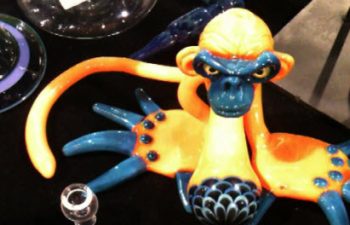
Most people start blowing glass after meeting vendors at music festival or watching their friends melting glass at the torch. Heather Durbin began her glass blowing career for a more practical reason — she needed diaper money.
It wasn’t long after Durbin began making and selling glass beads and compression flower pendants, that the medical law passed in her home state of Arizona. She turned her talents towards functional pieces for medical patients, and as she became immersed in the culture, she was inspired by the amazing artistic creations that could be made with glass.

“I enjoy meeting other artists and listening to what they say about glass and sharing my own glass adventures. I love everything about the community. I don’t think I could ever do anything besides blow glass,” says Durbin, whose HD Glass Art studio is in Prescott Valley, about 80 miles north of Phoenix.
“It really boils down to the medical marijuana community for me,” she adds. “I like making quality pieces that people will actually use.”

Living in the desert, you might assume Durbin draws inspiration from cactuses, wildflowers and rich sunsets. You certainly wouldn’t expect sealife to be her thing.
“I’ve never lived by the ocean, but I do love it,” Durbin says.

Durbin makes beautiful spoons for everyday smokers, but her headier pieces (amazingly affordable, starting at just a few hundred dollars) pay homage to the fascinating and unique octopus. She calls them “Octolocks” because they’re functionally a Sherlock.
“When it comes to my art, I like to be very flowy. You can do anything with an octopus really because it’s got tentacles,” Durbin says. “I try to make intricate pieces with as much detail as possible. The pieces fit in your hand and are so tightly put together that there is no open space inside of them.”

UV reactive amber purples are Durbin’s favorite colors.
“Whenever you stick amber purple inside the kiln at a higher temperature than you would normal glass, it starts to grow silver crystals on top of the amber, and the chemistry of the amber and the silver crystals causes it to turn more purplish,” she says. “Why I like it is because the color that you see, it’s not always what you get.”
“Every piece I’ve ever made is an experiment,” she adds. “One of the things I like most about blowing glass is that no two pieces are ever exactly the same.”

Diapers are no longer Durbin’s concern. Her daughter, Lilly Ann, in fact, just turned 11 years old, and got her first pair of safety glasses so she can join mom in the studio on her own artistic journey.
“My being a glass blower has given her the opportunity to have stay at home mom, which most children don’t have,” Durbin says. “She’s a good kid and she’s really the whole reason I do this.”
HEATHER DURBIN
HD GLASS ART
@hdglassart