

“The growing spread of rumors, misinformation and disinformation … is putting patients and consumers at risk,” The Food and Drug Administration (FDA) warned in January. “Don’t believe the rumors. Don’t pass them along,” the agency added. “Get health information from trusted sources.” This is indisputably good advice, but what happens when ostensibly “trusted” sources disseminate misinformation?
That’s a question smokers who want to quit have been forced to grapple with as the FDA and other major health institutions continue to deny the benefits of nicotine vaping. The only sensible answer seems to be that consumers have to develop a keen sense of skepticism and apply it even when listening to recognized medical authorities.
Experts spread misinfo—often
If you Google “vaping,” one of the first results you’ll find is this article from Johns Hopkins School of Medicine. “Although they’ve been promoted as an aid to help you quit smoking,” the author asserts, “e-cigarettes have not received Food and Drug Administration approval as smoking cessation devices.” As I’ve written previously, these sorts of denials are all too common—from the American Cancer Society, American Lung Association, Truth Initiative and many others.
It’s technically correct to say the FDA hasn’t approved any nicotine vapes for smoking cessation. However, that statement is still badly misleading because it wrongly implies that vaping doesn’t help smokers quit. The FDA knows that, too.
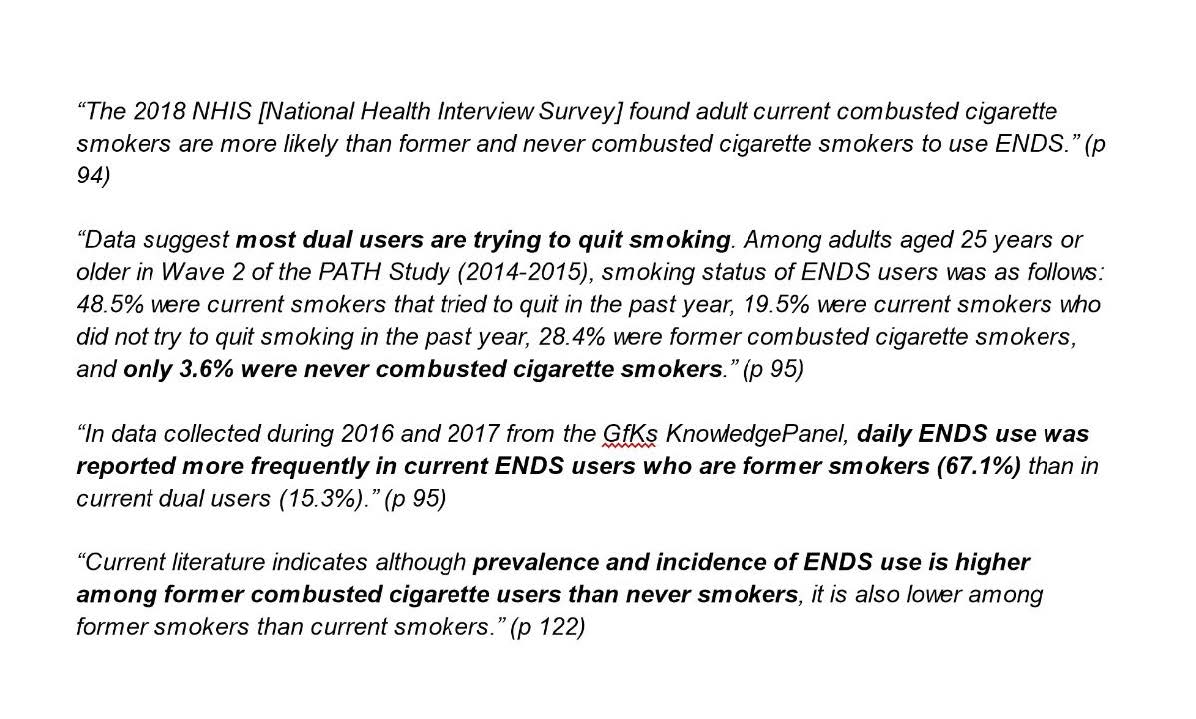
Last month, my organization, the American Vapor Manufacturers (AVM), acquired a 193-page review the FDA completed in March 2020. It covers every piece of evidence the agency could find on vaping, including its potential to help smokers quit.
Citing a series of studies published between 2014 and 2018, the FDA explained that “Current literature indicates although prevalence and incidence of [vaping] is higher among former combusted cigarette users than never smokers, it is also lower among former smokers than current smokers.” Moreover, “only 3.6% [of adult vapers] were never combusted cigarette smokers,” the agency said of a study conducted between 2014 and 2015—a full five years before FDA completed its review. In other words, the primary market for vaping products consists of exsmokers and smokers who want to quit.
With this evidence in hand, the agency continues to tell smokers that “[t]here are other proven, safe, and effective methods for quitting smoking,” discouraging them from switching to e-cigarettes.
What’s the solution?
There’s no easy answer to that question, unfortunately. The best solution seems to be: brush up on your science fundamentals and learn to spot the examples of experts getting the facts wrong. Although this can be a challenge, it works quite well. I mentioned in a previous column that the only study to ever link nicotine vaping to cancer in humans was recently retracted. But that only happened because critics began calling attention to the study’s critical flaws online.
The more important point is that spotting expert-endorsed nonsense could save your life. Smoking kills an estimated seven million people every year, and large segments of the medical establishment simply refuse to tell the public that vaping could prevent many of those deaths. The facts are still out there. But you can’t rely on anyone else to find them for you.