Cannabis and comedy go hand-in-hand. After all, who hasn’t smoked a joint and immediately caught a case of the giggles? Who hasn’t taken a huge bong rip, only to have your best smoking buddy crack a joke as soon as you inhale?
I recently sat down with Andrew Haddad, the mastermind behind CannaLaugh, to discuss our mutual love for the comedic arts, his current project that is taking Chicago by storm, and where his cannabis comedy show might end up next.
“After my first event, I didn’t break even, I didn’t go negative, I didn’t make a profit, and anything I did make I donated it to charity. Like 5% of whatever I earned from tickets was donated to charity, and everybody else got paid out—the comedians, the vendors—everyone was happy.” Andrew said when speaking enthusiastically about his new project.
Introducing CannaLaugh
CannaLaugh is the brainchild of Andrew Haddad. Appropriately enough, he came up with the idea while smoking a joint and watching comedy online.
“I was smoking a joint late at night, and I was really stressed out about coming up with my next idea. What am I going to do to provide for myself and my family? And I was watching YouTube shorts of this comedian named Akaash Singh, and I was cracking up. I was like, This is so funny. I wish I could go to his show and just smoke right there. It was the perfect setting. And then I was like, wait a minute, why don’t I just do this? Why don’t I just give it a try? What’s the worst that could happen?” He explained.
But Andrew wasn’t really a part of the local cannabis industry at that time, and, although he had made a few Hollywood connections from his days working in cigar lounges and smoke shops, he wasn’t a part of the comedy scene, either.
“I started off as a budtender, and I kind of took it from there. I took all my connections from the tobacco industry, and I was like, hey, what do you think about this? Would you do this with me? Do you want to do a show? And they literally flew out to Chicago the very next week to talk to me about it.”
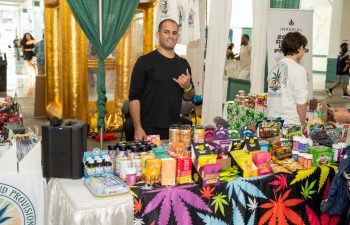
All of his shows thus far have been successful. Featuring comedians, musicians, glass-blowing, cannabis vendors, and giveaways, and with some venues even allowing on-site cannabis consumption, his late-night idea has since turned into a reality.

Remembering His Roots
Andrew has lived in and around Chicago his entire life, so the city was a natural fit for the launch of CannaLaugh.
“A lot of people either still haven’t heard about it or have heard about it and are trying to do what I’m doing, which is fine. I love that. You know, there’s McDonald’s, Burger King, Wendy’s, there’s a lot of choices in fast food, and there’s going to be a lot of choices in cannabis and comedy in the future, too. I just happen to be one of the first to actually go through at this level with it. And, you know, I put a lot of my own money into it as well.”
“I would like to mention someone. He hosted my first show for me. His name is Ray Grady, and he’s a comedian. He lives in LA now, but he’s a Chicago native. He’s a great guy, and he deserves the recognition for helping me.” Andrew said.
The Changing Face of Comedy
Let’s face it—the standup comedy scene has changed drastically over the past 10 or 20 years. With the rise of social media, along with streaming sites like YouTube, a great comedian can now attract a nationwide following quicker than ever before.
“A lot of comedy is now on Instagram and YouTube,” Andrew said. “Because most comedians on SNL now they’re coming from YouTube and going to SNL instead of starting on SNL and going to do their own thing. So I saw this pattern.”
Not only did Andrew pick up on the pattern, but he’s capitalizing on these newer trends, too.
“I’m planning on releasing a podcast called CannaLaugh podcast, and then I’m going to actually put it on my website. I’m going to do like a $1 per month subscription to kind of just fund the company. So I’m going to stream each show like an episode, so people can watch it if they can’t make it out to a show.”
Making People Laugh Beyond the Windy City
While Chicago will always be the official home of CannaLaugh, Andrew already has plans to take his show on the road.
“I’m planning a show in May 2026, or maybe earlier, depending on my funding situation, for Michigan. I’m planning one for New York. And I do want to expand nationwide, so any legal state is up for consideration. Minnesota is getting really hot right now. I want to do a comedy festival out there, so it’ll be like a three-day CannaLaugh event. And I’m working with someone that does those kinds of events right now to help me through that process.”
Andrew is also working with Natural Genetics to come up with his very own strain of CannaLaugh cannabis. Whether it’s at a local comedy club, online, or within a dispensary, Andrew and CannaLaugh are determined to make people chuckle in Chicago and beyond.
Post Publishing Notes
Andrew extended a warm “Thank You!” to his wife, mother and my team for all the support in my life and the path forward to expanding CannaLaugh.
There is a show scheduled for March 28, 2026 in Chicago.