“Winter rain
Now tell me why
Summers fade
And roses die.”
– Bob Weir, “Weather Report Suite”
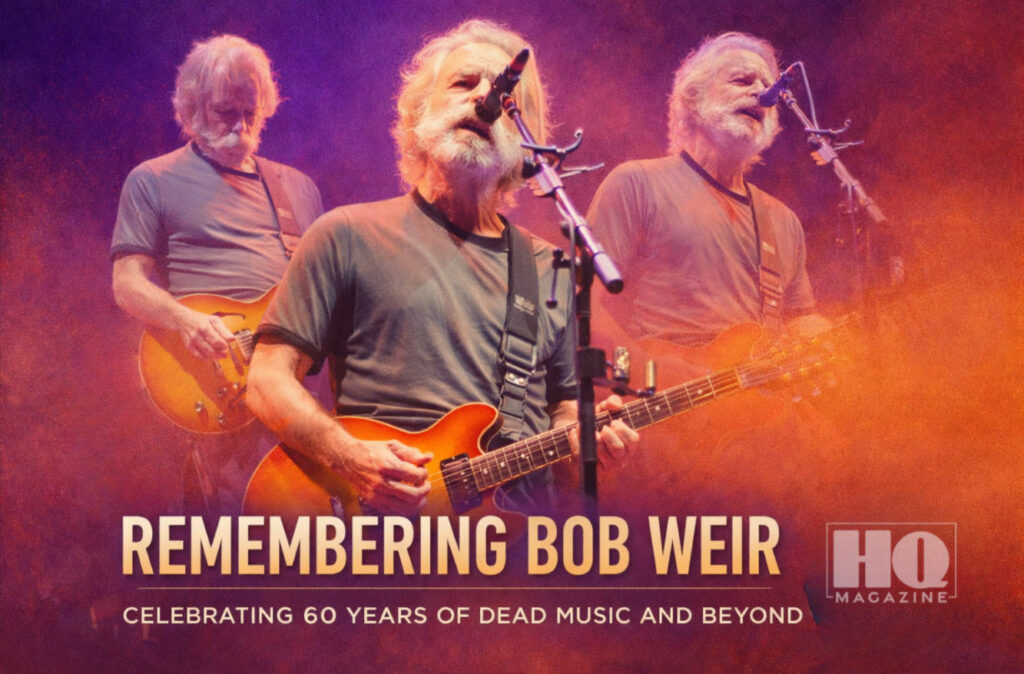
Born Robert Hall Parber, most people knew him better as Bob, Bobby, or Ace. He played with numerous bands over the years: Further, The Other Ones, Ratdog, Dead & Company, Wolf Bros., and many more—but almost everyone knew him best as one of the original co-founders of The Grateful Dead.
He was only a teenager when he joined up with the likes of Ron “Pigpen” McKernan, Jerry Garcia, Phil Lesh, and Bill Kreutzmann to form the band in 1965, but, even at such a young age, Bob Weir was already well on his way to becoming the quintessential rock star.
“Nobody called him Bob Weir; it was always Bobby. He didn’t become Bob Weir until Jerry died, and then all of a sudden, he was referred to as Bob Weir. But in The Grateful Dead days, it was always Bobby. He was the kid, you know, and Bob is an old guy’s name,” said Jodi the Jedi, a long-time Grateful Dead fan and a local legend in the jamband community.
Filling the Void
“Some folks trust to reason
Others trust to might
I don’t trust to nothing
But I know it come out right
Say it once again now
Oh, I hope you understand
When it’s done and over
Lord, a man is just a man.”
– Bob Weir, “Playing in the Band”
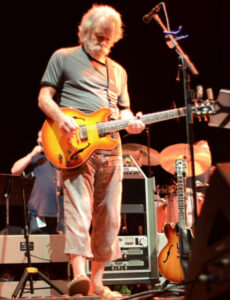
If the young Bobby Weir was an up-and-coming, eager-to-learn minstrel, then the older Bob Weir was a well-practiced and aging troubadour who took delight in passing the proverbial torch and teaching others the tricks of the trade. Not only did he play guitar and sing, but he had a hand in writing some of The Dead’s most iconic songs, including “Truckin,” “Jack Straw,” “Sugar Magnolia,” “Cassidy,” “One More Saturday Night,” and many others.
 “The Grateful Dead experience, for me, all of it from start to finish, has been more of a religious experience than any of the organized religion that I’ve been a part of in all my years—and I was raised Catholic! I’m not devoid of religion, but The Grateful Dead and their community has done more for me in growing my person than any other organization that I’ve come in contact with, whether that be political or religious or scholarly. The single biggest influence in my life has been the Grateful Dead and what Bob Weir helped to create with Jerry Garcia, Ron McKernan, Mickey Hart, Bill Kreutzmann, Phil Lesh, and all of the different keyboard players that they had,” said Jodi the Jedi.
Although he took somewhat of a backseat to Jerry, especially in the earlier years, there’s no denying the impact Bob Weir had as a member of The Grateful Dead. After the unexpected death of his mentor and muse, Weir was given the monumental task of carrying the band’s music for another 30 years. For those of us who never had the opportunity to see a show with Jerry at the helm, Bob represented the spirit of The Grateful Dead in a way that few others could. And he did so with all the style and grace you’d expect from a musician of his caliber.
Carrying the Tune
“Fare-thee-well now
Let your life proceed by its own design
Nothing to tell now
Let the words be yours, I’m done with mine.”
– Bob Weir, “Cassidy”
 To say that The Grateful Dead community was saddened when Jerry died would be an understatement. At the age of 53, he wasn’t exactly young—but he wasn’t really that old, either. It was the unexpected nature of his passing that had the most profound impact amongst Deadheads around the world.
While I don’t think anybody necessarily had Bob Weir’s passing on their 2026 bingo cards, he was 78 years old at the time of his death. Bob Weir lived a full life and, more importantly, he spent it exactly how he wanted to.
“He was rock solid and became the main guy after Jerry passed. He carried the legacy and did some killer solo music. My favorite was seeing him do the Blue Mountain / Campfire Tour with the Campfire Band at the Fox Theater in Oakland, California, in October 2016. It blew me away, and I was not expecting to be wowed in any form. His rendition of Peggy-O still lives with me. I liked it better than any of Jerry’s versions,” said Mark M, who has been seeing The Grateful Dead since the late 1970s.
More recently, Bob Weir was regularly touring with the latest incarnation of The Grateful Dead. Known as Dead & Company, his bandmates included the likes of John Mayer, Mickey Hart, Jay Lane, Jeff Chimenti, and Oteil Burbridge. The group, amongst others, had just celebrated the 60th anniversary of The Grateful Dead in San Francisco in August 2025.
“His last years with Dead & Company just didn’t impress me. The cadence got too slow for me, and the pricing got out of hand, in my opinion. So I haven’t seen The Dead in any form since COVID. Instead, I’ve fallen for a number of local and Bay Area cover bands that are just fantastic at keeping The Grateful Dead spirit alive and well,” Mark M continued.
Where Do We Go From Here?
Nobody knows for sure what will become of The Grateful Dead’s music from here, but their legacy will undoubtedly live on for ages. Bob Weir himself believed that their influence would continue for another 300 years, and some can envision it lasting even longer than that. Whether it’s Dead & Company choosing a new guitarist, another band working with Bob’s blessings, someone else picking up the ball and running with it on their own, or simply through the hearts and minds of their fans, one thing is for certain: our love for Bob Weir and The Grateful Dead will never fade away.
Interested in a more unconventional perspective on the Grateful Dead’s cultural footprint? Be sure to check out our previous feature exploring unexpected (satirical) historical parallels HERE