




With a last name like hers, it’s only fitting that Liz Grow ended up in the cannabis industry. Born and raised in Texas, Liz returned to her home state almost a decade ago to start Grow Haus Media with her husband, producer Patrick Pope. However, her personal journey with cannabis started back in 2011.
At the time, Liz was living in San Francisco, where she worked at a tech startup. In the hyper-competitive “boy’s club” of Silicon Valley, she was also under extreme emotional and mental stress and desperate for some relief. “I didn’t want to just get prescribed antidepressants or medications that were typical for women in their 30s,” Liz says, and self-medicating with alcohol wasn’t working either. “I was trying to white-knuckle it until the only other woman at the startup noticed I was suffering and took me under her wing.”
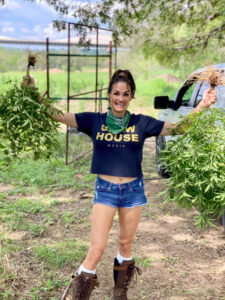 This coworker, Heidi Hudson, brought Liz to her husband Ryan’s dispensary—the first one Liz had ever set foot in. A new cannabis convert, Liz, started to see improvement in her mental and emotional well-being almost immediately. While she continued to work in the tech space, Liz began intentionally and holistically integrating cannabis into her personal life. “[Cannabis] helped me be more compassionate to myself,” Liz recalls. “It unlocked something in me, reminding me it’s okay to enjoy myself and have fun.”
As Liz started to share more openly about her experience, she realized her circles were full of “canna-curious” people also looking for help and relief, be it physical, mental, or spiritual. “When it comes to hemp and marijuana, there’s no higher mission than to promote this plant and everything she does for us,” Liz says. This gradual cannabis awakening led her to start Grow Haus in 2018, a media agency that blends a passion for storytelling with a passion for the plant, elevating cannabis brands to tell their stories in approachable, accessible, relatable ways.
Shortly after launching her business, Liz and her husband premiered Grow House on High Times TV, a video series where they traveled across the U.S. to talk with cannabis farmers, producers, and business owners, educate viewers, and celebrate all the people involved in bringing cannabis from seed to table. Also with High Times, Liz worked with veterans and chronicled their journeys trying to access medical marijuana to treat PTSD. Unable to access cannabis medicine in their home state, these Texas natives crossed the border to Oklahoma, where Red River Farms invited them to experience their grow operation and work with the plant firsthand. “It was a mind-opening, very impactful project,” Liz says. “We need to be sympathetic to vets and give them the care they need.”
In addition to her work at Grow Haus, Liz is also the co-founder of Lucy’s Rock, a plant-powered lifestyle brand created by women, for women. Still, really, it’s for everyone who’s tired of the “bro-brands” and “ready for something more beautiful, more expressive, and more real.”
Liz met Lucy’s co-founder and “Chief Visionary Officer,” Miranda Cummings, through her Grow Haus work, and the brand is a passion project and true collaboration between the two women, allowing them to combine their years of varied expertise and experience in the industry. “Cannabis is a creative plant, and it deserves a brand that honors that spirit,” Liz says. “Lucy’s is about storytelling, beauty, and bringing people together—especially women who’ve felt left out of the conversation.”
 Liz is quick to point out the irony of the cannabis industry being traditionally so male-dominated. “Being a woman in the space feels great, because it’s a female plant that gives us all the beautiful cannabinoids we seek,” she says. She’s also quick to note there are a lot more women in the industry now than there used to be. In fact, she interviewed 86 of them on her podcast Feminized, which ran from 2022 to 2023. “I only talked to women [on the podcast], and that was amazing,” she laughs. However, Liz remains steadfast in her conviction that cannabis is for everyone, regardless of gender. “Every person, every human: this is for us,” she says. “Maybe I use it for my period cramps; you might use it for something else. This plant helps us all.”
As a result of her work in cannabis spaces, Liz has also become deeply involved in public policy—in fact, she views it as an essential extension of her storytelling work. “[Patrick and I] are heavily into advocacy, because we have to be,” she says. “If you’re enjoying the product, you should be involved too. Get down to the Capitol!” For the sixth consecutive year, Grow Haus covered the Texas Cannabis Policy Conference, a convening that Liz looks forward to every year.
 In Texas and beyond, the fight for legalization is far from over. “There’s a lot of clickbait about hemp being banned in Texas,” Liz says about the state’s attempts to recriminalize hemp. She’d love to see the industry move toward greater access, greater equity, and greater support for small businesses. Instead of feeling hopeless, though, Liz wants us to feel empowered. “As a member of the public, you have a say,” she reminds us. “It’s so important to be a part of the rule-making hearings, but if you can’t take time off work to be there in person, you can submit written testimony or email your representatives right now. Make your voice heard. Don’t be disheartened. Keep going. This plant isn’t going anywhere.”
Do you know a powerhouse woman making waves in the cannabis industry? Whether she’s leading, innovating, advocating, or inspiring, we want to hear her story! Our Women in Cannabis spotlight celebrates the trailblazers, changemakers, and unsung heroes shaping the future of the industry. Nominate someone who deserves the recognition—because their work deserves to be seen! Submit your nomination here.











