Benjamin Cornwell

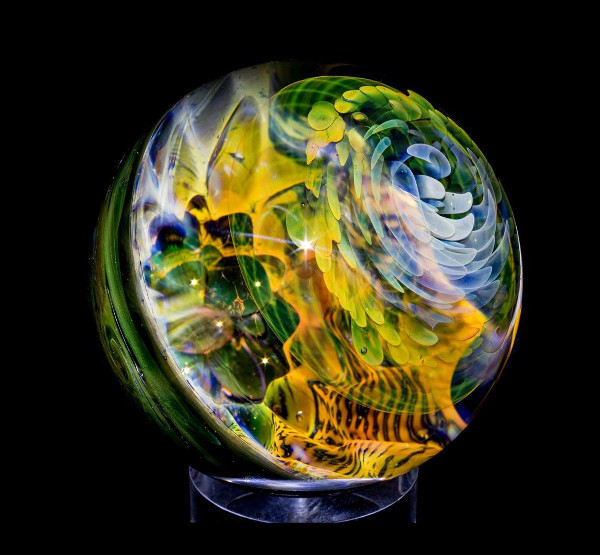
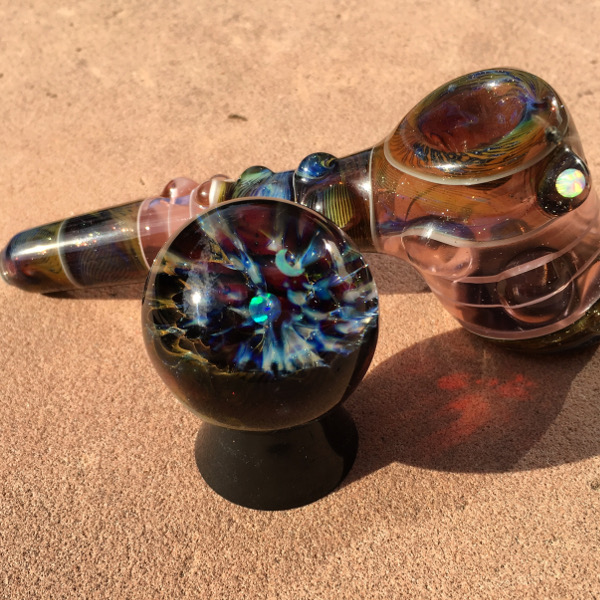
Spinning a glass marble around in your fingers is an exercise in discovery as the spherical shape of the object itself magnifies the wonders within. The swirling colors and endless vortexes bring to mind psychedelic visions, and that’s only fitting for glass artist Benjamin Cornwell who was introduced to glassblowing and marble making by a friend he knew from going to Grateful Dead shows.

“He was making tinky-wink glass sculptures, and we’d always trade —- I’d give him a bag of weed and he’d hook me up with a really cool marble,” Benjamin says. “We were at a tribute show, and having a little more fun that we should’ve, and he looked at me and said it was my time to learn how to make marbles.”

“It took me like three hours to make my first marble,” Benjamin confesses. “It was perfectly round but with a little nipple. I never made another round one for four years after that. I understand why pipers don’t like making marbles — the parameters with making it round can be really frustrating.
“I learned early on that it’s not how well you perform the action, but how well you hide your fuck ups.”

Benjamin, who lives in St. Louis, Missouri, has been creating marbles, jewelry and pipes for 14 years. He named his signature style of marble a “Cornwell,” and why not? It’s a fusion of a vortex, implosion and honeycomb that he came up with himself.

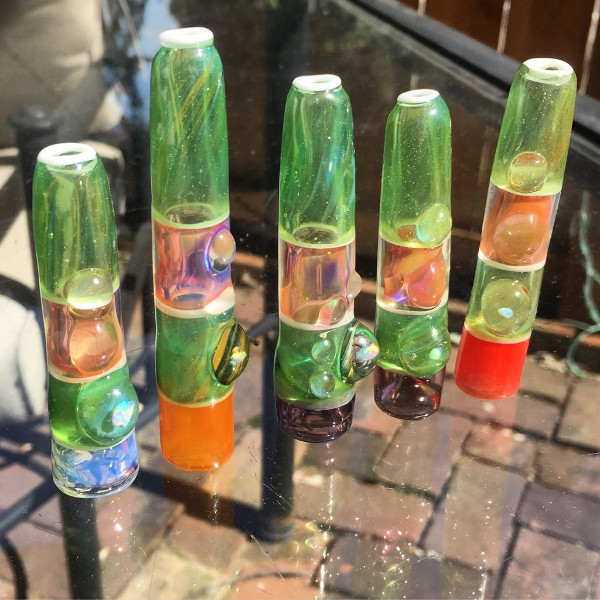
The other style for which Benjamin is known, he calls a “Color Balance.” Aptly named because it incorporates two stacked halves separated by a band of contrasting color.
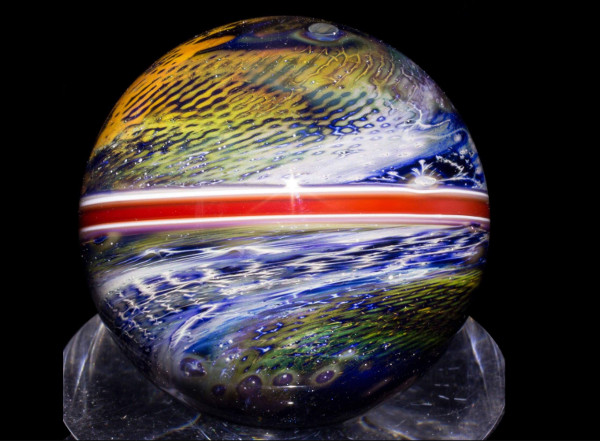
“It’s a whole bunch of juggling to get it from a tube to being round and also keeping the halves even,” Benjamin says. “As the halves form, they will fold on each other if not handles just right.”

Benjamin is now working on a series that combines both of those styles. He’s planning to drop the new marbles at the Moon Marble Company show, in Kansas, and The Michigan Glass Project, in Detroit, later this coming year.

Marbles are Benjamin’s passion, but he loves how functional and art glass styles are gaining so much mainstream popularity. “It’s like the difference between New York and Chicago style pizza — there are differences, sure, but it’s still fucking pizza.”

You’d think smoke shops, where glass collectors pay big bucks for glass pipes and pendants, would be the perfect showcase for marbles. But most often, when Benjamin peddles his pipes to a smoke shop, and also shows off his marbles, buyers are like, “What the heck am I supposed to do with that?”
Benjamin admits that it wasn’t long ago that he thought he’d “fucked up picking marbles as a career choice.” But over the last 5-10 years, he’s seen a new generation of young collectors, who recall seeing glass marbles and paperweights on their grandparent’s curio shelves, getting into the scene.

Think there’s nobody willing to shell out headie prices for a marble? Recently, a tiny 5/8″ diameter marble made by Christensen & Son Company sold at auction for somewhere around 20 grand!

“Marbles don’t know a culture,” Benjamin says. “Everybody loves marbles, even if they don’t know they love marbles, and they’re starting to be cool again.”

Benjamin Cornwell
@BCGlassWorx
Recent Articles

I went home and told my girlfriend, who, after Googling the name of the business I bought it from, told me that, yes, it was technically weed. But it was CBD. She started laughing, telling me I had been ripped off.
State-sanctioned medical and recreational cannabis programs benefit the average user in many ways. Still, they remain a double-edged sword for dispensary owners, greenhouse growers, and others who earn their living from the cannabis industry. There are plenty of profits to be had, sure, but how exactly are you expected to secure your cash or process electronic transactions when banks refuse to work with you?
Aubrey Amatelli wants to help dispensaries and cannabis retailers navigate one of the toughest parts of the industry: money. When the company she worked for right out of grad school was acquired by JPMorgan, Aubrey entered the complex world of payments and has stayed there for her entire career.
There’s a paradox to business conferences. The best ones manage to swing from buttoned down to wildly unscripted—sometimes seconds apart. For attendees, it’s the combination of personal connections and professional development that makes regular trips to conferences worthwhile. And in an industry like this one, pulling that off is harder than it looks.
Your shop is not only a smoke shop; It's also a hangout spot and a community hub. It is a place where the regulars know your staff by name, and your staff knows what the regulars need. That's the secret sauce that the big-box chains can't replicate, and it starts with who you put behind the counter. A well-staffed smoke shop is an operational strategy, but it's also a community. In lean economic times, that community is what keeps the lights on. When people feel like your shop is their spot, they don't stop coming in when money's tight. They prioritize it. It all starts with Hiring.
Dr. Macias first fell in love with science while studying at Howard University, where she completed her undergraduate studies and later earned her PhD in cellular and molecular biology. While at Howard, she became especially interested in cancer research due to personal ties. Growing up in a Creole family and predominantly Black community in Louisiana, Dr. Macias watched many women around her battle breast cancer, so at Howard, she decided to focus her research on the BRCA1 gene.
It’s almost amazing that the same institutions that brought us the 2008 financial crisis have a problem with selling glass pipes. Almost. The truth is that an industry's past sins are only held against it when the money isn’t right. Big banks were willing to risk cratering the U.S. housing market because the profits were too good to ignore. But the cannabis industry rolls a different kind of paper, so instead of a slap on the wrist, it gets a surcharge.
Smokeshop and counterculture enthusiasts enjoy discovery as part of the experience. Customers enjoy browsing. When they walk into a shop, they don't simply grab a product and leave. They look for something new. This is the main reason flyers and posters still work. Smokeshops and dispensaries are highly visual environments. You want to see bold artwork, psychedelic graphics, and street-style posters that naturally capture attention.