Justin Wilson on Piece of Mind and Keeping His Eyes Wide Open All the Time
“It’s funny . . . I’d figured I would join corporate America.
Investment banker was one of the ideas. I knew I’d either own and operate a business or work in the investment banking field—or both, even—but I didn’t expect this path until we’d opened our first stop. I started loving it and it started taking off.”
Justin Wilson is right. It is funny. But it’s not Kyle Kinane or Demetri Martin funny where there’s a punchline that forces involuntary belly laughs. Nor is it Jeff Dunham funny, which—well—isn’t funny at all. It’s funny in the fact that it’s peculiar. It inspires the proverbial chin scratch and causes you to question your perspective on social norms. You might chuckle, but if you do, it’s more inquisitive than amused, and the curiosity of the spectacle only grows upon further inspection.
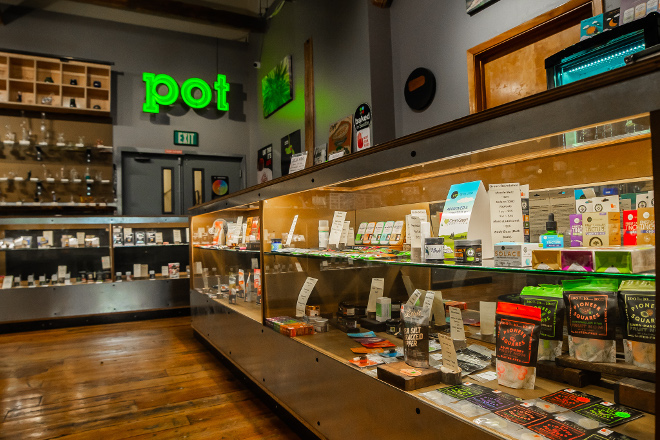
If you were able to peer inside Justin’s mind, you’d see a near-exact reflection of the cannabis industry and related trades’ current sociological landscape. As already alluded to, there’s the savvy and overly-educated, white collar business magnate with a head for numbers and a heart for profit looking to stake his fortune on the good herb. But now flip the coin. There’s the other side; the high-minded former pot dealer/countercultural enthusiast who found his life’s path after purchasing a Snodgrass piece from a Dead lot blanket in 1995 while peaking on LSD.
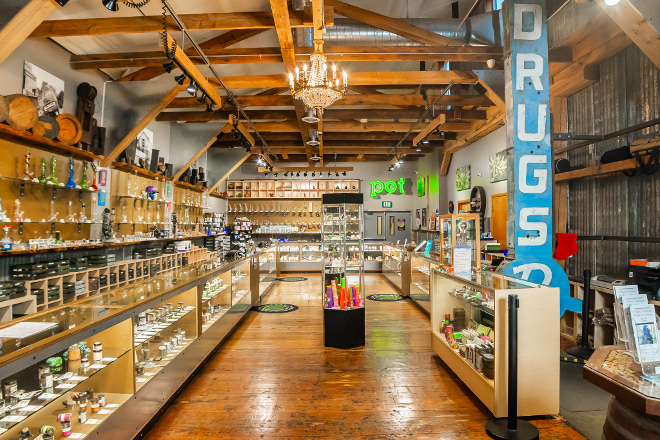
“I stared at it all damn day,” he says with a snicker. On that blanket, Piece of Mind was born, the fledgling Spokane head shop that would eventually become a chain; a chain that would eventually become the foundation of a multifaceted cannabis conglomerate.
Now, flip that coin back over. At the time of his epiphany, our protagonist was finishing up a bachelor’s degree in finance and economics. Two years later, when Piece of Mind opened in earnest, he was in grad school, pounding out an MBA focused on entrepreneurship and marketing.
The education obviously helped him get his footing, but the most tangible benefit of his college experience at the time probably would have been the $5,000 student loan he somehow managed to convert into an upfront investment. Chalk it up to that finance degree.
He was all in from the beginning. For the first year, he lived in the store to cut costs. “I was the guy on the couch,” he laughs. The ‘OG’ pride in his voice is palpable. I can’t resist the urge to ask him if he embraced the Stephen Wright character from Half Baked in the process, always snoozing, occasionally rousing from slumber to deliver sage advice.
“Close,” he responds, “but not quite. I did have staff wake me up a few times, but it was because I’d overslept and didn’t open the store on time.” The coin stands on its edge.
Fast forward 22 years. Piece of Mind is now more than just a shop. It’s a brand, the prominence of which extends from Bellingham, Washington down to Newport Beach, California, and all the way across to Missoula, Montana.
It hasn’t been all success. Justin’s seen his share of losses along the way. The list includes five stores, two of which fell prey to “acts of God,” as they call them (one fire, one earthquake), while the other three were casualties of legalization.
They were “very successful stores that were in great locations,” he recounts, “but they had to be shut down because of rec dispensaries selling pipes.” The setbacks became nothing more than learning experiences, chances to grow. Through these experiences, he has come to more envelop the character of the sage on the couch—except there’s no time to sleep, only to create. Yes, create. He’s bored of the numbers side, college education or no. Luckily, he has his partner, Quinn Sharpe, for that.
“He is the reason this engine is still running,” he says. “Without someone like Quinn keeping the army marching forward, things would unravel fast.”
The lessons of his losses have since guided his steps, inspiring the formation of Satori, a now-established rec dispensary with a high-end head shop vibe that he plans to grow and expand as he did with Piece of Mind. And by the time this article has gone to print, he’ll have launched a third brand, SeKaya, at CHAMPS Vegas, an entity he describes as a “more hollistic, healthy, sophisticated, more feminine, upscale retail experience,” for cannabis consumers.
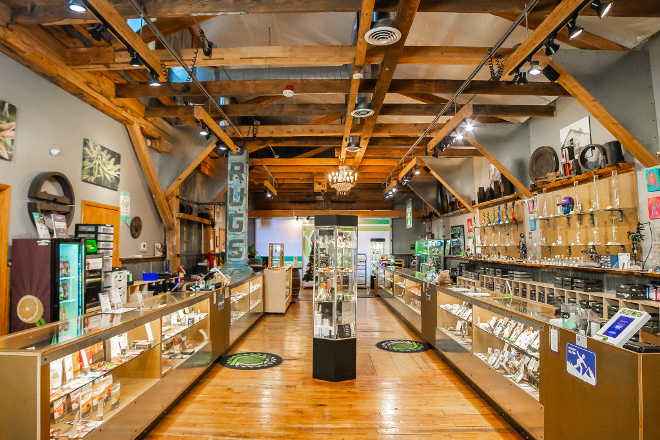
If there’s a lesson we can learn from Justin’s career of more hits than misses, it’s that it’s time to prepare. Or, as he puts it, “Get your fucking shit organized already.” Full legalization, by all estimates is eminent and when it happens, all bets are off.
“The writing is on the wall,” he says and he should know; he learned the hard way. The winners will be those who can maneuver, who are able continually reinvent themselves to accommodate the shifting landscape. The losers will be those who sit still. Justin isn’t one of those. In fact, in addition to his new endeavors, he’s also spearheading the new dispensary section at CHAMPS.
“I’ve found a way to create a whole new world within a trade show,” he says excitedly. I can’t help but note the peculiarity of his left brain/right brain dichotomy all over again. I ask him how he pulls it off and his reply is nearly flawless.
“Maybe that’s why I wear all black like Johnny Cash. I walk the line.”
http://www.satorimj.com/welcome-to-satori-north.html