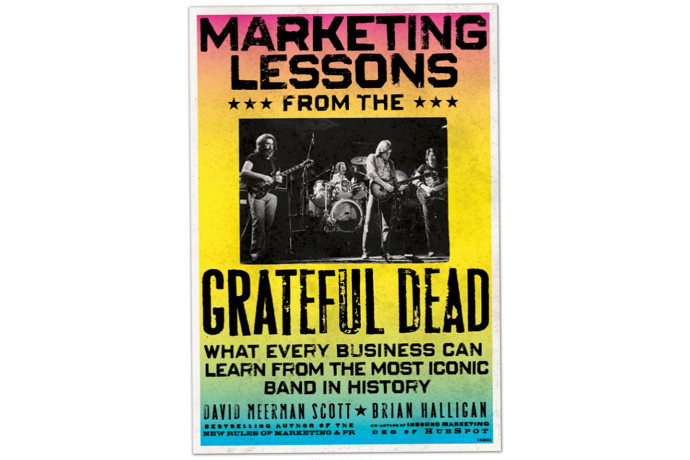
Long before the terms ‘inbound marketing’ and ‘social media’ were coined, the Grateful Dead were using these strategies to become one of the most successful bands of all time. They made a series of difficult and often unpopular decisions in order to differentiate themselves from their competition by providing the highest quality service to their fans, not just a product.
In Marketing Lessons from the Grateful Dead deadheads and marketing strategists David Meerman Scott and Brian Halligan explain how smart businesses can learn from one of the most successful rock bands of all time broke almost every rule in the music industry book and profited as a result. The lessons—and the effect the band had on the music industry and their fans—apply to businesses of all kinds.
The book includes a foreword by basketball legend—and the ‘world’s biggest Deadhead’—Bill Walton, who is 6’11” and has seen the band 750 times. Jay Blakesberg, who has been photographing the band for 30 years, has agreed to provide photos to illustrate each chapter.
Scott and Halligan collaborated to create a book that reflects the attitudes of the time. “The Grateful Dead can be considered one giant case study in doing social media marketing right,” says Halligan. “Not only did they pioneer the freemium business model by allowing concert attendees to tape the show, but also encouraged their fans to build a community, and kept them informed via their newsletters.”
Each chapter presents and analyzes a marketing concept practiced by the Dead and a real-world example of that concept in action today. Specific topics include:
• Rethink traditional industry assumptions – Rather than focus on record albums as a primary revenue source (with touring to support album sales), the Dead created a business model focused on touring. Halligan and Scott apply that idea to today’s Internet – where the cost of distribution of electronic information is zero. Now, entire new opportunities emerge for those willing to challenge established business models. The Grateful Dead teaches us that business model innovation is frequently more important than product innovation.
• Turn your customers into evangelists – Unlike nearly every other band, the Grateful Dead not only encouraged concertgoers to record their live shows, they actually established “taper sections” where fans’ equipment could be set up for the best sound quality. When nearly every other band said “no” the Grateful Dead created a huge network of people who traded tapes in pre-Internet days. The broad exposure led to millions of new fans and sold tickets to the live shows. Today, as many companies experiment with offering valuable content on the Web, the Grateful Dead teaches us that when we free our content, more people hear about our company and eventually do business with us.
• Bypass accepted channels and go direct – The Grateful Dead created a mailing list in the early 1970s where they announced tours to fans first. Later, they established their own ticketing office, providing the most loyal fans with the best seats in the house. The Grateful Dead teaches us that building a community and treating customers with care and respect drives passionate loyalty.
• Build a huge, loyal following – The Grateful Dead let their audience define the Grateful Dead experience. Concerts were a happening, a destination where all 20,000 or more audience members were actually part of the experience. Making fans an equal partner in a mutual journey, the Grateful Dead teaches us that our community defines who we are. In an era of instant communications on Twitter, blogs and the like, we learn that companies cannot force a mindset on their customers.