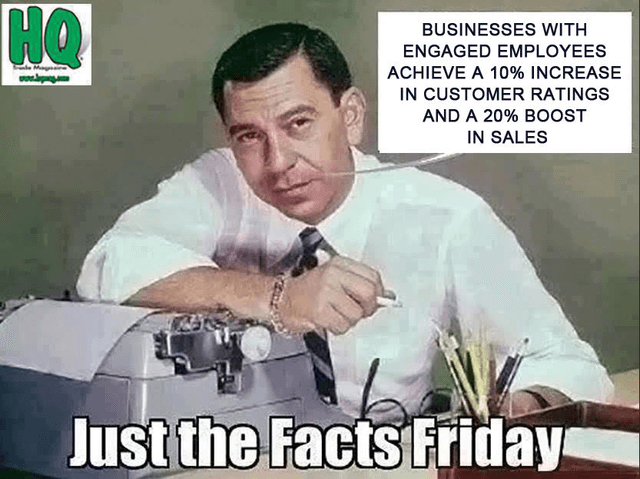
Businesses With Engaged Employees Achieve A 10% Increase In Customer Ratings And A 20% Boost In Sales


How many times have you gone into a smoke shop and the person behind the counter is so involved with playing a game on their phone that they barely look up to say hello. It’s a pretty safe bet that store isn’t making very many sales and very few people come back for a second visit.

This guy, like the majority of the U.S. workforce (51%) is not engaged with his job, according to Gallup’s State of the American Workplace report. These employees are indifferent and neither like nor dislike their job.

Showing up and staying: Engaged employees make it a point to show up to work and do more work — highly engaged business units realize a 41% reduction in absenteeism and a 17% increase in productivity. Engaged workers also are 86% more likely to stay with their employers.

Profit: Engaged employees are more present and productive; they are more attuned to the needs of customers; and they are more observant of processes, standards and systems. When taken together, the behaviors of highly engaged business units result in 21% greater profitability.

Customer outcomes: It’s easy to see why wmployees who are engaged help the business achieve a 10% increase in customer ratings and a 20% increase in sales.
So put the phone down and pay attention —- businesses with highly engaged staff share common philosophies and practices. Among other things:
– They know creating a culture of engagement starts at the top.
– Their leaders are aligned in prioritizing engagement as a competitive, strategic point of differentiation.
– They communicate openly and consistently.
– They place the utmost importance on using the right metrics and on hiring and developing great managers.
Highly engaged businesses also hold their managers accountable for the entire team’s overall performance. They ensure that managers are engaging employees from the first minute of their first day at work. Employee engagement is a fundamental consideration in their people strategy, not an annual “check-the-box” activity.


Recent Articles

I went home and told my girlfriend, who, after Googling the name of the business I bought it from, told me that, yes, it was technically weed. But it was CBD. She started laughing, telling me I had been ripped off.
State-sanctioned medical and recreational cannabis programs benefit the average user in many ways. Still, they remain a double-edged sword for dispensary owners, greenhouse growers, and others who earn their living from the cannabis industry. There are plenty of profits to be had, sure, but how exactly are you expected to secure your cash or process electronic transactions when banks refuse to work with you?
Aubrey Amatelli wants to help dispensaries and cannabis retailers navigate one of the toughest parts of the industry: money. When the company she worked for right out of grad school was acquired by JPMorgan, Aubrey entered the complex world of payments and has stayed there for her entire career.
There’s a paradox to business conferences. The best ones manage to swing from buttoned down to wildly unscripted—sometimes seconds apart. For attendees, it’s the combination of personal connections and professional development that makes regular trips to conferences worthwhile. And in an industry like this one, pulling that off is harder than it looks.
Your shop is not only a smoke shop; It's also a hangout spot and a community hub. It is a place where the regulars know your staff by name, and your staff knows what the regulars need. That's the secret sauce that the big-box chains can't replicate, and it starts with who you put behind the counter. A well-staffed smoke shop is an operational strategy, but it's also a community. In lean economic times, that community is what keeps the lights on. When people feel like your shop is their spot, they don't stop coming in when money's tight. They prioritize it. It all starts with Hiring.
Dr. Macias first fell in love with science while studying at Howard University, where she completed her undergraduate studies and later earned her PhD in cellular and molecular biology. While at Howard, she became especially interested in cancer research due to personal ties. Growing up in a Creole family and predominantly Black community in Louisiana, Dr. Macias watched many women around her battle breast cancer, so at Howard, she decided to focus her research on the BRCA1 gene.
It’s almost amazing that the same institutions that brought us the 2008 financial crisis have a problem with selling glass pipes. Almost. The truth is that an industry's past sins are only held against it when the money isn’t right. Big banks were willing to risk cratering the U.S. housing market because the profits were too good to ignore. But the cannabis industry rolls a different kind of paper, so instead of a slap on the wrist, it gets a surcharge.
Smokeshop and counterculture enthusiasts enjoy discovery as part of the experience. Customers enjoy browsing. When they walk into a shop, they don't simply grab a product and leave. They look for something new. This is the main reason flyers and posters still work. Smokeshops and dispensaries are highly visual environments. You want to see bold artwork, psychedelic graphics, and street-style posters that naturally capture attention.