




An old adage tells us not to judge a book by its cover, but A Woman’s Guide to Cannabis: Using Marijuana to Feel Better, Look Better, Sleep Better–and Get High Like a Lady makes a powerful statement about the role of beauty and femininity in the cannabis industry before you even read the first page. The cover features an elegant, red-lipsticked woman smoking a joint, whose plumes of smoke become her wavy, black hair. She’s surrounded by a kaleidoscopic array of marijuana leaves in teal, yellow, green, red, and purple—some are even embossed in gold. This classy and classic cover sets the stage for the book’s overall mission, which is to empower women to use cannabis to “feel better, look better, and sleep better.” By writing directly to women—and writing specifically for mothers and older women with chronic health conditions—Furrer debunks common cannabis myths and reimagines the negative image of a stoner.
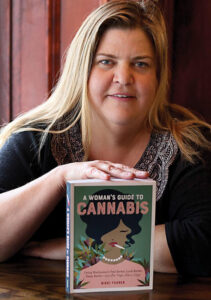 In A Woman’s Guide to Cannabis, author Nikki Furrer combines her passion for both books and cannabis. When she couldn’t find the perfect introductory book to recommend to women at the beginning of their cannabis journeys, Furrer decided to write it herself. As a former independent bookstore owner of Pudd’nhead Books, Furrer was struggling with burnout and depression and knew she needed to make a career change. This decision led her from Missouri to Colorado, where she worked in several grow operations and medical dispensaries. Though it was published eight years ago, Furrer’s accessible guide remains relevant and approachable for both the canna-curious and the more seasoned stoners alike.
A Woman’s Guide to Cannabis begins with the “why” of cannabis use, digging into the medicinal history of the plant and its various use cases, from pain relief to beautification to the more widely known mood boost. “Cannabis doesn’t just make us feel high and happy; it also has powerful analgesic, anti-inflammatory, antioxidant, antibacterial, antifungal, antianxiety, and antidepressant qualities,” Furrer writes. While she delves into the “how” of the science more in the next section, this first chapter serves as a helpful primer for anyone new to marijuana who might be fearful or intimidated by it. There’s even a step-by-step guide for how to start a conversation with your mom about trying medical cannabis herself.
Furrer is especially passionate about medical cannabis use after a car accident left her with a fractured spine and chronic back pain. As a budtender, she became an expert in Colorado’s medical strains and products, helping each patient find the medicine that worked best for them. She continues this patient-centered, accessible work in her book, diving into some light science, all while maintaining an approachable, conversational tone that conveys trustworthiness and knowledge without losing its friendliness.
 In Part Two, Furrer covers the endocannabinoid system, different strains, THC vs. CBD, and other minor cannabinoids, along with other helpful buzzwords like “terpenes” and “potency”. After recommending different sativa, indica, and hybrid strains for creativity, socializing, yoga, and deep relaxation, she even provides a “First-High Checklist” to further assuage any fears and help make someone’s first high as enjoyable as possible. Here, Furrer also covers the various modes of administration and the pros and cons of each, including inhalation, edibles, sublinguals, suppositories, transdermal patches, and topicals.
Even for regular cannabis users, the dispensary can be an intimidating place. For a first-time or novice user, a trip to the dispensary often feels incredibly daunting and even prohibitive. Luckily, Furrer guides readers every step of the way in her section called “Buying Cannabis” section, without ever coming off as patronizing or condescending. She talks about the differences between medical and recreational dispensaries, what to ask your budtender, and how to buy flower for the first time (including how much weed is in an eighth and a quarter). In the Budtender FAQ section, she talks about specific medical use cases like fibromyalgia, chronic pain, Crohn’s disease, seizures, and menstrual cramps, and what she’d recommend. While she urges readers to always consult their specific doctors, Furrer still provides some basic guidance and suggestions for how to get started with cannabis plant medicine, especially for people who might not know where to begin or how it could help them.
A Woman’s Guide to Cannabis is full of helpful tables, tips, and drawings, including some helpful criteria for how to determine the quality of a cannabis flower and illustrations of different cannabis concentrates. The section on edibles also includes over 20 recipes for various infusions and extractions, including cannabutter, caramels, and even bacon, and, of course, her recipe for some “classic pot brownies.” The topicals section also showcases recipes for THC- and CBD-infused serums, lotions, and lip balms. At the end of the book, the glossary includes helpful terminology and cannabis slang so even a one-time smoker can walk into a dispensary or circle of stoners and sound like a pro.
In addition to authoring A Woman’s Guide to Cannabis and working as a cultivator and budtender, Furrer is also a cannabis lawyer and the CEO of Fleur. This cannabis company develops products focused on women’s health. One such product is Infused Ink, a line of temporary tattoos infused with CBD for transdermal application, including the original “Cramp Stamp”, designed specifically for menstrual cramps.
You can buy A Woman’s Guide to Cannabis: Using Marijuana to Feel Better, Look Better, Sleep Better–and Get High Like a Lady at bookshop.org or wherever books are sold, or follow Nikki on Instagram.
Do you know a powerhouse woman making waves in the cannabis industry? Whether she’s leading, innovating, advocating, or inspiring, we want to hear her story! Our Women in Cannabis spotlight celebrates the trailblazers, changemakers, and unsung heroes shaping the future of the industry. Nominate someone who deserves the recognition—because their work deserves to be seen! Submit your nomination here.










