Cannabis Banking Reform is Near Predicts American Banking Association President

The head of the American Bankers Association (ABA) is predicting that the House of Representatives will pass legislation allowing banks to service state-legal marijuana businesses as early as this month and no later than October.

In an interview on the podcast Engage with Andy Busch that was released on Friday, ABA President and CEO Rob Nichols said that his group will be actively lobbying for the bipartisan cannabis banking bill in order to provide clarity to financial institutions that currently worry that taking on marijuana-related clients will put them at risk of federal penalization.

“We have banks and their customers and clients that are throwing up their hands say that we need this to be fixed,” Nichols said.

“The consequences extend beyond cannabis growers, shops, and dispensaries to any person or business that derives revenue from a cannabis firm,” Nichols added. A perfect example, he explained, is lending company that lends money to a mall owner or property management company that leases space to a cannabis-related business.

Nichols emphasized the importance of the Secure and Fair Enforcement (SAFE) Banking Act, which currently has 206 cosponsors in the House, including 26 Republicans. If approved it would remove regulatory restrictions on the financial institutions in legal states.

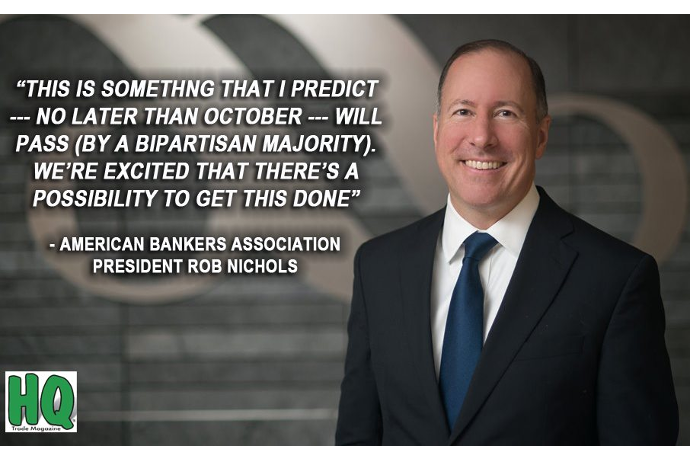
“This is legislation that already passed in the House Financial Services Committee early in this calendar year by a huge bipartisan margin, and this is something that I predict — as early as September—probably no later than October—will pass the full House of Representatives by a bipartisan majority, which is exciting,” Nichols said.

“We’re excited that there’s a possibility to get this done. We’ll be pushing very hard,” he said. “Again, we understand the cultural, societal and moral implications of this issue, but we need federal rule clarity so banks know who they can and cannot lend money to.

“What we’re working on is having banks that are supervised and regulated based on the business profile, activities and underlying risk profile.”


Recent Articles

North Carolina might save us all. A new state bill may be the industry’s best option to save itself from demise when new federal cannabinoid bans take effect in November. And it could use your support.
Hemp is often considered for the things that it is not. It is not intoxicating, it is not illegal, and it is not marijuana. However, now we are seeing a focus back to what it can be. The plant is moving into the level of wine and chocolate and becoming a movement and a culture.
It’s been several months since President Donald Trump signed an executive order to reschedule cannabis from Schedule I to Schedule III within the Controlled Substances Act (CSA). On paper, the recent executive order, entitled “Increasing Medical Marijuana and Cannabidiol Research,” is a huge step in the right direction for cannabis smokers across the country.
For years, we’ve been told that this industry is the Wild West: a place where the only law amounts to whatever the guy with the gun says. But over the last 12 months, state governments have passed a spate of new regulations that promise to swap the relative lawlessness of poor enforcement of vague rules with real law and order.
With a last name like hers, it’s only fitting that Liz Grow ended up in the cannabis industry. Born and raised in Texas, Liz returned to her home state almost a decade ago to start Grow Haus Media with her husband, producer Patrick Pope. However, her personal journey with cannabis started back in 2011.
Kunda Wellness isn’t your average CBD brand. It was founded by two Doctors of Physical Therapy who have spent their careers treating pelvic floor dysfunction and helping people reconnect with a part of their body that’s often overlooked, dismissed, or wrapped in shame.
“Winter rain Now tell me why Summers fade And roses die.” – Bob Weir, “Weather Report Suite”
For years, Jennifer Mansour felt them coming. “You can’t stop one,” she said. “As soon as I’d notice that the lights felt a little too bright, I knew I was done for. I’d tell my boss, and then I’d get in the car and pop on my sunglasses because I could feel another one coming on, and I couldn’t do a thing to stop it.”