



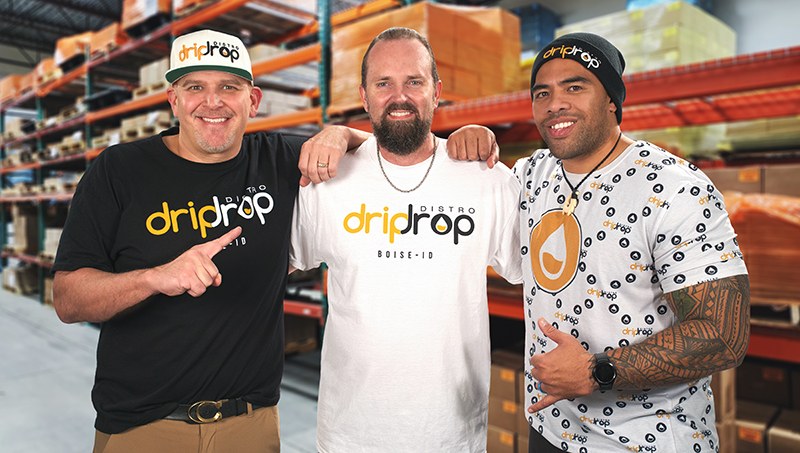
If you have “drip,” it means you’ve got swagger. You’re on point. You’ve got the sauce. It’s also an apt description of Douglas Campbell Jr., Troy Palmer, and Matthew “Motu” Nu’uvali, and their company Drip Drop Distro, which reps some of the hottest brands and most popular products in the smoke shop and cannabis spaces.
“We don’t think of ourselves as a distributor, even though we function as one,” notes Campbell. “We’re more of a brand builder. “Our goal is to create our own brands and partner up with other up and coming brands to help them achieve the best promotion and market penetration possible.”
The trio started out in 2014 pushing their own vaping products, but when a cascade of regulation came down around vaping, they pivoted into the kratom space launching a couple of their own brands, Hush being the best known and received by retailers and customers.
Not only does Drip Drop and their Kush brand have great quality products, they were the first in the kratom space to create a nano shot and the first to come out with flavored shots that actually tasted good. The “cherry on the top,” as Campbell says, and that the reason retailers want to do business with Drip Drop, is because of the relationships they foster and their ability to truly service their customers.
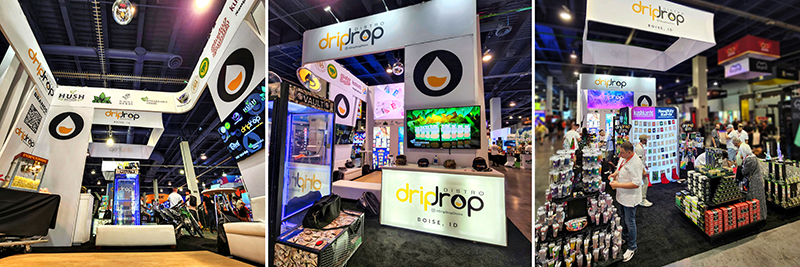
“We come with solutions and people respect that,” Campbell says. “The first couple years when we came on the scene, we got a lot of business because people liked the products, but there were a lot of other people that were sitting on the sidelines because they’d never done business with us. Now those people are our customers as well because they’ve heard other retailers say, ‘Those dudes are solid! That is a testament to who me, Troy, Motu, and our staff are, and that we try to always do the right thing.”
“I like to think that we raised the bar and, and I don’t think anybody would deny that,” Campbell adds. “The best part about having a healthy category with healthy competitors is that it raises everybody up, which is good for the consumer.”
In 2017, Drip Drop refocused their efforts again, this time upping the stakes as a distributor of other brands, and in 2022, the decision was made to expand their offerings in the smoking accessory category.
Drip Drop became the North American and Canadian sole master distributor for Beautiful Burns printed pre-rolled cones; you may recognize that company’s other brand, Elephant Brands, but according to Campbell, those two will be merged into Beautiful Burns going forward to make things simpler and more efficient for all involved.
KushKards is another recent partnership. Drip Drop picked up the line of tongue-in-cheek, cannabis-centric greeting cards, helping founder and graphic designer Lauren Miele scale her greeting card business, which despite having won a number of awards, had yet to break into more mainstream outlets.
“We’ve been really lucky to work with KushKards,” Campbell says. “It’s going to be a monster!”
Beautiful Burns, Kush Kards, and Blazing Buddies novelty socks are perfect examples of where Drip Drop Distro plays a strong hand. “They had created amazing brands that have been on the market for a couple of years, were getting some traction and plugging along, but needed help with scaling their brands and taking them to the next level,” Campbell says. That next level was getting them into Spencer’s Gifts where they could reach an even wider customer base.
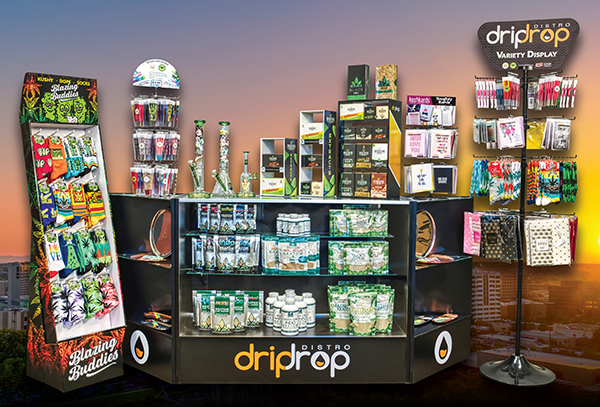
“We aggressively push products and fight for shelf space. The reality of it is, we don’t feel sorry about it because we push brands that move,” Campbell says.
Drip Drop’s in-house marketing team is one of their strongest assets. Knowing how to navigate social media is an especially important part of the plan because of how strict online platforms are about advertising and promoting most counterculture products.
“It’s very difficult to build brands and get traction to go mainstream when you’re not allowed to use the same advertising tools as somebody who’s selling shampoo, potato chips or even makeup,” Campbell says. “At the same time, though, those challenges actually work as motivators because you have to use old school tactics.”
“Luckily, where you really build brands is in retail,” Campbell continues. “Where Drip drop is different [than many other distributors] is that we’re out there taking risks, putting feet to the pavement and ears to the phone, and engaging with retailers. We spend a lot of time at the stores to get the placement and price in alignment and really educate teams about the products and their selling points.”
“I challenge anyone out there to run like we do,” he adds.
Drip Drop Distro has scaled right along with the brands they represent. Having started out from a 2,500 sf flex space with a single rollup door, they’re now operating with 50 employees from two Boise, Idaho warehouses covering over 50,000 square feet.
Campbell recalls with fondness Drip Drop’s first 10×10 trade show booth and the ambition to one day be among the go-to names in the industry.
“It’s so fun coming from something small like that,” he says. “I still love walking around the trade show floors and seeing unique new products. I love the energy and the amazing stories connected to the personalities and characters that you meet and how they have so much passion for their brands. We want Drip Drop to be the partner that helps build those brands and those dreams.”










