Gina “Boots” Gaffner

Gina “Boots” Gaffner

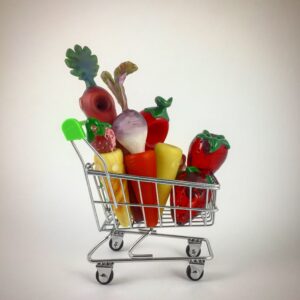
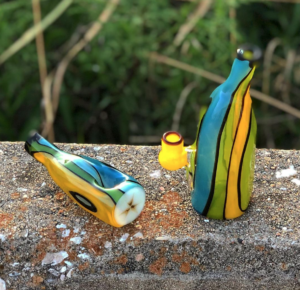
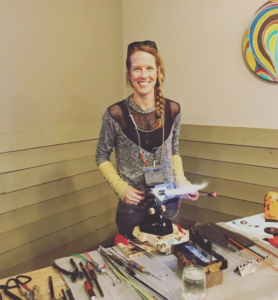
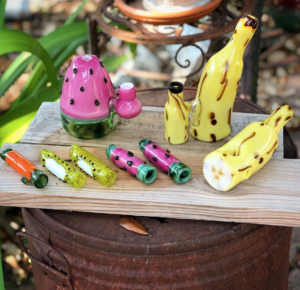
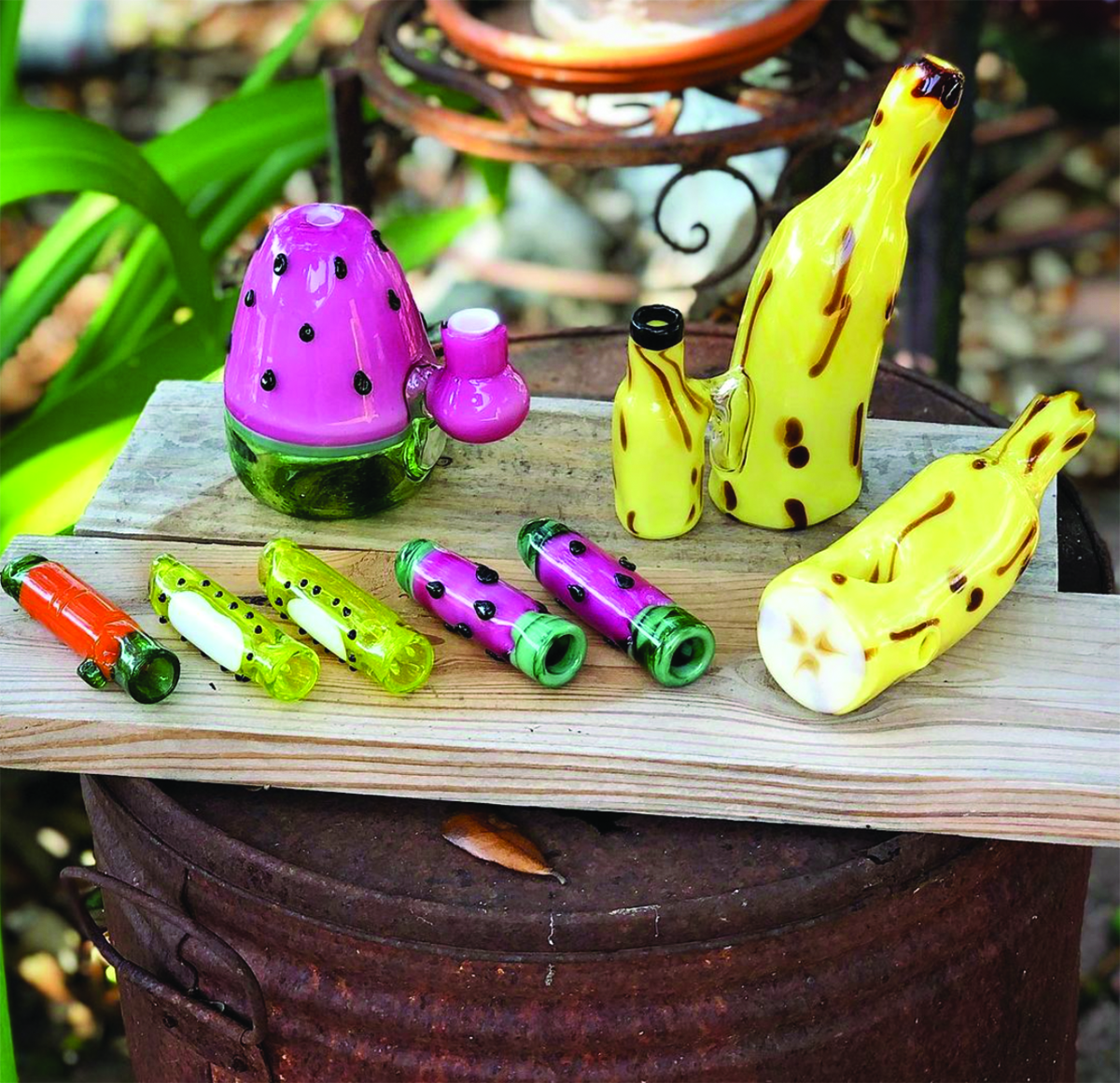
Lampworker Gina Gaffner loves to garden, and glass collectors are enjoying the fruits and vegetables of her labor.  


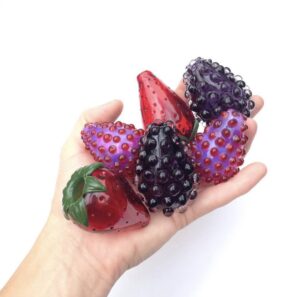
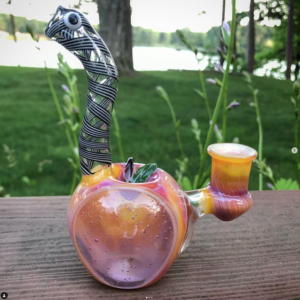
“I’m inspired by bright colors, and fruits and vegetables are vibrant and fresh, and they make you feel really good,” says Gaffner, better known as “Boots” to her 25,000 Instagram followers. “It’s amazing how little seeds turn into flowers and fruit, and I have a lot of fun figuring out how to translate that transformation with glass. They’re some of the most basic shapes, but also challenging to get exactly right because you don’t want people to mistake an apple for a tomato.” 


Based in Austin, Texas, Gaffner was looking for a career change, after waiting tables for many years, when she saw a Craigslist posting for a flameworking job. The job description didn’t implicitly state that it would be about making pipes, but Gaffner landed what turned out to be a paid apprenticeship at a local glass studio. Over the next eight months she learned how to how use the torch, spin glass, and the fundamentals of functional glass art. With her newfound experience, she built a studio with some glass artist friends, and they made and sold pipes to shops in the local area. 
 
The fruits and veggie idea sprouted organically. Gaffner was chilling in front of the television one day, watching the cooking channel, when a carrot came on the screen. If you can use an apple as a pipe, she thought, why not a carrot.  
 
“I made a huge glass carrot; bigger than anything you’d find in the produce section at the grocery store,” she says. “It was challenging to perfect the color because back then orange wasn’t a color you really worked with — I had to experiment with putting white frit inside of amber white and pulling it down to lighten it up.” 

Lorem ipsum dolor sit amet, consectetur adipiscing elit. Ut elit tellus, luctus nec ullamcorper mattis, pulvinar dapibus leo.

Luckily, Gaffner quickly realized that fruits and vegetables come in a cornucopia of colors. 

 
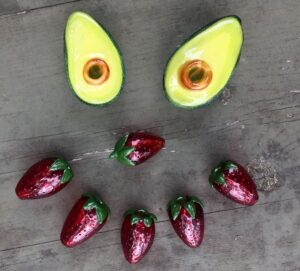
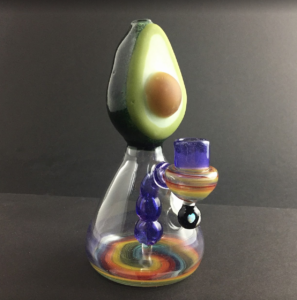
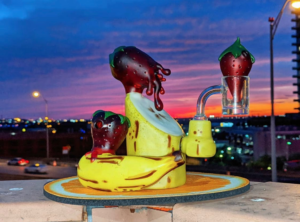
Smoke shops gobbled up the carrots (no pun intended) and before long requests were coming in for apples, peppers, turnips, beets, radishes, avocados, strawberries, zucchini, squash, kiwis, watermelon and even leafy greens.  


“I’ve had a farmer’s market of glass ever since,” she says. 


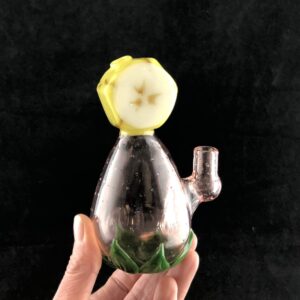
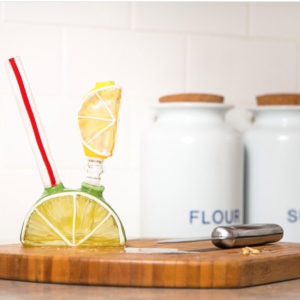
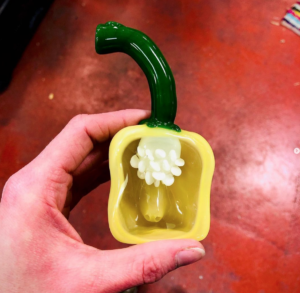
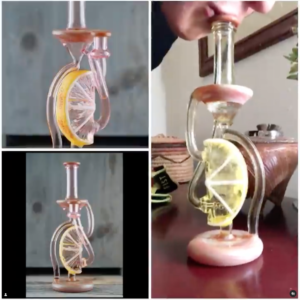
Some of Gaffner’s most unique pieces feature cross sections, such as a bell pepper where you can see the seeds inside or a lemon slice revealing the juicy wedges. 
 
“I’ve only scratched the surface with cutting up the fruits and vegetables,” Gaffner says. “I was so excited when I figured out how to do a banana slice! I left a banana sitting on my bench and would look at it every day to see how it was aging so that I could make a set of bananas all the way from green to brown.” 


When it comes to snacking, strawberries are Gaffner’s favorite fruit, and in the vegetable category, it’s a tie between Brussel sprouts and sweet potatoes. Every visit to the farmer’s market yields a harvest of flavors and ideas. 


“There are so many directions to go. . . I have a whole buffet from which to pick.” 


Instagram @glassbyboots 

Recent Articles

I went home and told my girlfriend, who, after Googling the name of the business I bought it from, told me that, yes, it was technically weed. But it was CBD. She started laughing, telling me I had been ripped off.
State-sanctioned medical and recreational cannabis programs benefit the average user in many ways. Still, they remain a double-edged sword for dispensary owners, greenhouse growers, and others who earn their living from the cannabis industry. There are plenty of profits to be had, sure, but how exactly are you expected to secure your cash or process electronic transactions when banks refuse to work with you?
Aubrey Amatelli wants to help dispensaries and cannabis retailers navigate one of the toughest parts of the industry: money. When the company she worked for right out of grad school was acquired by JPMorgan, Aubrey entered the complex world of payments and has stayed there for her entire career.
There’s a paradox to business conferences. The best ones manage to swing from buttoned down to wildly unscripted—sometimes seconds apart. For attendees, it’s the combination of personal connections and professional development that makes regular trips to conferences worthwhile. And in an industry like this one, pulling that off is harder than it looks.
Your shop is not only a smoke shop; It's also a hangout spot and a community hub. It is a place where the regulars know your staff by name, and your staff knows what the regulars need. That's the secret sauce that the big-box chains can't replicate, and it starts with who you put behind the counter. A well-staffed smoke shop is an operational strategy, but it's also a community. In lean economic times, that community is what keeps the lights on. When people feel like your shop is their spot, they don't stop coming in when money's tight. They prioritize it. It all starts with Hiring.
Dr. Macias first fell in love with science while studying at Howard University, where she completed her undergraduate studies and later earned her PhD in cellular and molecular biology. While at Howard, she became especially interested in cancer research due to personal ties. Growing up in a Creole family and predominantly Black community in Louisiana, Dr. Macias watched many women around her battle breast cancer, so at Howard, she decided to focus her research on the BRCA1 gene.
It’s almost amazing that the same institutions that brought us the 2008 financial crisis have a problem with selling glass pipes. Almost. The truth is that an industry's past sins are only held against it when the money isn’t right. Big banks were willing to risk cratering the U.S. housing market because the profits were too good to ignore. But the cannabis industry rolls a different kind of paper, so instead of a slap on the wrist, it gets a surcharge.
Smokeshop and counterculture enthusiasts enjoy discovery as part of the experience. Customers enjoy browsing. When they walk into a shop, they don't simply grab a product and leave. They look for something new. This is the main reason flyers and posters still work. Smokeshops and dispensaries are highly visual environments. You want to see bold artwork, psychedelic graphics, and street-style posters that naturally capture attention.