Ryan Rosburg

Ryan Rosburg

What makes a good burger?  
 

“I like the classic — American cheese, onions, tomatoes, lettuce, mustard, ketchup, and mayo,” says Ryan Rosburg. “It’s perfect and delicious.” 


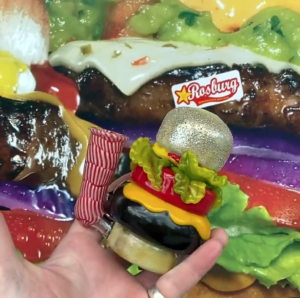
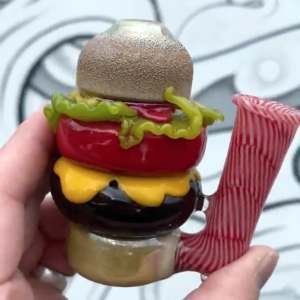
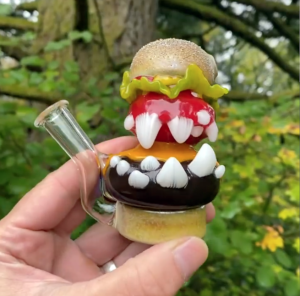
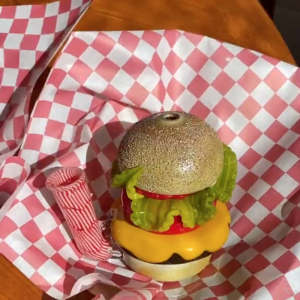
As a glass blower, Rosburg has turned his passion for food, particularly the all-American hamburger, into functional works of art. 


“I’ve always been a good cook. I’ve made some nasty things too, for sure,” says Rosburg, whose kitchen and studio are in Portland, Oregon. “Once you learn how different ingredients works together, you can play with your creativity and make something that’s totally your own.” 


It’s the same with glass, says Rosburg.  


“You’re really just a student of the medium and the material, and you’re always learning,” he says. “When I started blowing glass, I came up with these ideas that were things that you weren’t supposed to be able to do. You tell yourself that if you try it, the glass is gonna fail and it just won’t work out. The things I used to think were impossible are what I do now every day in my work.” 


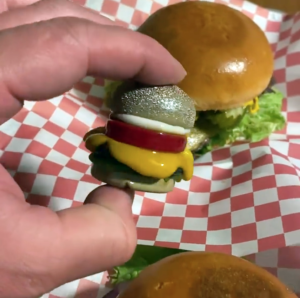
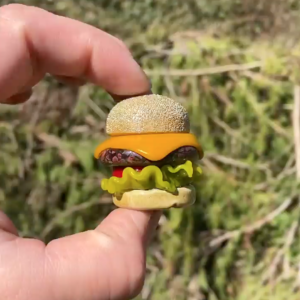
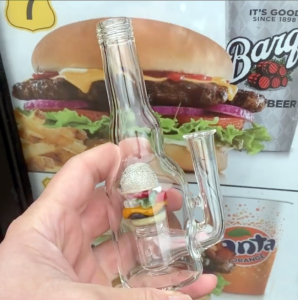
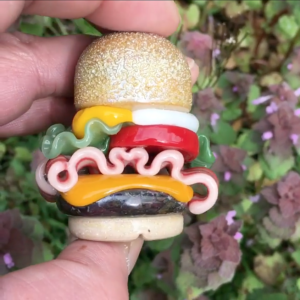
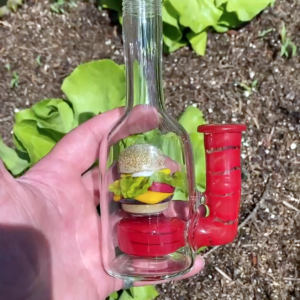
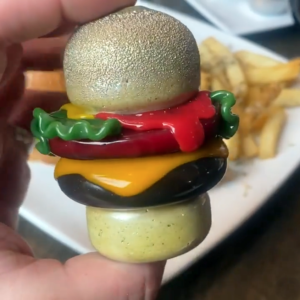
Rosburg’s hand-sized bubblers and rigs, and carb caps, terp spinners, and pendants, may look like miniature burgers, but the beauty of the sculpted sandwich is that it lends itself to so many unique variations. Some of the burgers are stacked with bacon and fried eggs, others are real monstrosities with teeth and tongues. There’s even a burger with “sausages” appropriately dubbed the “HIMburger.” 


“It never really gets old. If people are excited by the pieces, I’m excited, and it’s usually recipe for a good time,” Rosburg says. “I always jump on a funny concept because there’s enough humor in the world these days.” 
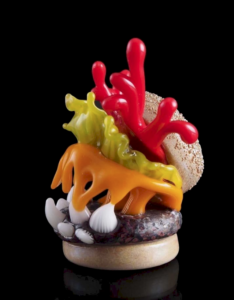
Rosburg’s process for building his burgers starts with tons of prep — stack of bacon strips, and onion and tomato murrini chips ready to go. Chefs refer to it as “mise en place,” a French culinary concept that translates (loosely) to “put in place.” If you’ve seen a cooking show when the chef has a set of tiny bowls with ingredients ready to go before they start cooking, you’ve got the idea.  


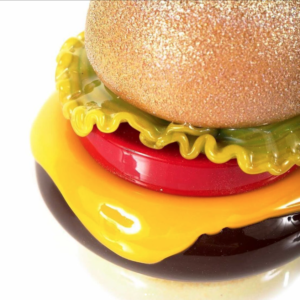
A burger wouldn’t be complete without a sesame seed bun. Rosburg accomplishes that two ways; drawing them on individually with dots and smashing them into shape and frosting the buns with frit to create the texture. 


“You start with a bun, you put the patty on and smash it, you melt the cheese, and then you stack everything on top of it,” he says.  
 
“You have to keep everything really hot the whole time and just ride the edge of failure,” he adds. “It’s a good day when I open the kiln and pieces are not exploded or cracked. 

 
“Glass is an incredible material; and glass blowing is an infinite media. The sense of accomplishment is amazing when you execute an idea and it’s something that you struggled to pull off. Being able to make a living by being creative and building something with my hands is really fulfilling.” 

 
Instagram: rosburgglass 
Recent Articles

Dr. Macias first fell in love with science while studying at Howard University, where she completed her undergraduate studies and later earned her PhD in cellular and molecular biology. While at Howard, she became especially interested in cancer research due to personal ties. Growing up in a Creole family and predominantly Black community in Louisiana, Dr. Macias watched many women around her battle breast cancer, so at Howard, she decided to focus her research on the BRCA1 gene.
It’s almost amazing that the same institutions that brought us the 2008 financial crisis have a problem with selling glass pipes. Almost. The truth is that an industry's past sins are only held against it when the money isn’t right. Big banks were willing to risk cratering the U.S. housing market because the profits were too good to ignore. But the cannabis industry rolls a different kind of paper, so instead of a slap on the wrist, it gets a surcharge.
Smokeshop and counterculture enthusiasts enjoy discovery as part of the experience. Customers enjoy browsing. When they walk into a shop, they don't simply grab a product and leave. They look for something new. This is the main reason flyers and posters still work. Smokeshops and dispensaries are highly visual environments. You want to see bold artwork, psychedelic graphics, and street-style posters that naturally capture attention.
The use of cannabis in professional sports has always been a controversial subject. While some are firm believers that all substances should be banned from professional sports altogether, most people aren’t thinking about cannabis when they’re discussing performance-enhancing drugs (PEDs). In fact, there have been countless cannabis users in the world of professional sports throughout the years; some of whom are more open about their love for the plant than others.
North Carolina might save us all. A new state bill may be the industry’s best option to save itself from demise when new federal cannabinoid bans take effect in November. And it could use your support.
Hemp is often considered for the things that it is not. It is not intoxicating, it is not illegal, and it is not marijuana. However, now we are seeing a focus back to what it can be. The plant is moving into the level of wine and chocolate and becoming a movement and a culture.
It’s been several months since President Donald Trump signed an executive order to reschedule cannabis from Schedule I to Schedule III within the Controlled Substances Act (CSA). On paper, the recent executive order, entitled “Increasing Medical Marijuana and Cannabidiol Research,” is a huge step in the right direction for cannabis smokers across the country.
For years, we’ve been told that this industry is the Wild West: a place where the only law amounts to whatever the guy with the gun says. But over the last 12 months, state governments have passed a spate of new regulations that promise to swap the relative lawlessness of poor enforcement of vague rules with real law and order.