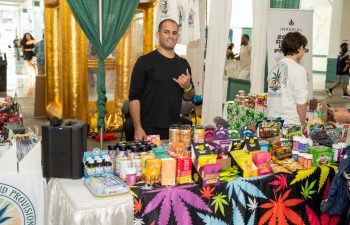
High on the Hill

How long have you been in business? 

Since May 22, 2006 

How did High on the Hill come to be in business? 

The original owner was Geri Twitty.  Her dream became a reality when she found the ideal property just outside of Indianapolis Motor Speedway after a failed attempt at a partnership in Broad Ripple. The new location was seated high upon a hill, so it chose its own name . . .  High on the Hill. I purchased the business from her in 2016 and we celebrated the ten-year anniversary that summer with Hillstock. 

I’m glad you mentioned the Indy Speedway. In what ways has proximity to the track benefited you? 

Race season is always a hectic time for Zach and I leading up to Memorial weekend, preparing for tens of thousands of people to descend upon your little corner of the world. We do not commonly have a significant increase in sales . . . but  we do offer parking, showers and camping opportunities. Every year, we collaborate with Mike’s Speedway Lounge (we share a parking lot) and on Friday and Saturday night we close off the parking lot to motorcycles only and have local bands provide live music.  We have made several friendships with people that come to camp and park on our property every year. Some of our favorites come annually and have spent weekends on The Hill for over 4 decades, this year being the only year they’ve missed because of the pandemic.  

According to the MPP, Indiana currently has some of harshest cannabis laws in the country. Does this make it difficult to do business as a counter-cultural tobacco shop? 

We try to stay involved with activist opportunities and help educate people to try to get our laws changed here. We have found that the state allowance of CBD with up to .3% of THC has brought in more clients looking for information. We do not have a specific demographic; we see people from all walks of life, so we try to encourage them to vote and seek ways to help bring change. 

Indianapolis is a big city with a lot of other smoke shops. What’s your secret sauce? Ultimately, what in your opinion, is the deciding factor that makes a customer say, “I’m going to High on the Hill instead of Store X”? 

We focus on helping local talent & entrepreneurs come up. We support local artists, vendors, outreaches and build up our community. We have a field on the property where we have held weddings, memorials, festivals and many a gathering. 

Wow. I would love to say I got married at a head shop.

Haha, right?? 

Imports, domestic or both? Is there a ratio you try to maintain? 

Heritage Farmacy is our go to CBD supplier locally. We also carry BadAsh Dugouts based out of Franklin, INOur incense is WildBerry made in Ohio.Our line of acrylic water pipes is strictly Headways, made in AmericaHowever, we do offer soft glass and novelty items to keep options for every budget. 

How have you been affected by the pandemic? Were you able to stay open, do curbside pickup, delivery, etc? 

We closed the first week, then phased into curbside & delivery. We are now reopened encouraging social distancing within the shop. 

If the Desiree of right now could take a time machine and go back to the Desiree that was just starting out in this business, what would she tell her? 

It’s going to be a long, strange trip, but it will be worth it. 

Where do you see High on the Hill in another five years? 

Evergrowing. 

Succinct and informative. Well said. Any parting words?  

We are thankful to the love and support from our community, customers, friends and family.  


Recent Articles

You’ve chosen to work in a gray area. You sell products that contain cannabis or cannabis-adjacent substances as well as accessories that can be used to consume it. And while that area has become less gray—you can see rays of sunlight peeking through—the skies are still cloudy. THC remains a Schedule 1 substance, even as medical marijuana has migrated to Schedule 3.
Running a cannabis business is notoriously complicated. For dispensaries, complex compliance burdens permeate every facet of the business, from zoning and licensing to marketing and payments. Whether you’ve been in the cannabis space for mere months or multiple decades, you’ve likely run into drawn-out approval processes, supply chain headaches, or constantly changing regulation that makes compliance challenging, not to mention the other micro and macroeconomic factors that plague all small business owners.
Blending traditional values with modernized, energetic branding, Not Ya Son’s Weed falls somewhere between the cannabis days of yore and today’s recreational cannabis boom. Not Ya Son’s Weed offers a variety of products—including pre-rolls, exotic flower, and gummies—that provide much-needed relief without being too overbearing.
The officials came for Lance Alyas once before. In 2023, they caught him in a sting, seized his merchandise, and tossed him in jail. But just seven days later, after he invoked Hawaii's version of a Freedom of Information Act request, the whole case fell apart. Alyas was released without bail, allowed to simply walk out the door. Now, he’s advocating for freedom from Hawaii’s state officials once again. Only this time, it’s not just his own freedom. As the owner of Oahu’s top-rated smoke shops, he’s fighting for everyone’s right to sell hemp products in the Aloha State.
Born Sara Benetowa in Warsaw, Poland, in 1903, Sula Benet may not be an immediately recognizable name in cannabis spaces today, but she should be. While she primarily studied Polish folk customs, Benet became known for her graduate thesis at the University of Warsaw, titled Hashish in Folk Customs and Beliefs. In the paper, she claims that the plant kaneh bosm—which is referenced throughout the Old Testament and Torah and often translated as “calamus”—actually refers to hemp. Benet’s theory remains both significant and highly controversial today, especially as various religious and evangelical groups continue to demonize the plant.
If the United States were ever a country based on strict adherence to the law, those days are long past. The modern game lies in devising methods to circumvent laws. It’s how the rich avoid taxes, the powerful avoid jail, and industries of all kinds bypass regulations. The paradox is that, despite its ubiquity, it’s not easy to stay beyond the reach of the long arm of the law. Well-moneyed, influential organizations still sometimes misjudge the political and legal playing field and have to pay up. The Sacklers (the family behind Purdue Pharma) eventually were bankrupted by the courts for their role in the opioid epidemic, and officials hit Meta with a $5 billion fine over privacy concerns.
When you walk into a smoke shop today, you might notice the glass cases that once held rolling papers and blunt wraps now display CBD tinctures, functional mushroom capsules, kava elixirs, and hemp-infused sparkling water. The staff might talk to you about terpene profiles, cortisol levels, and a new vape line.
I went home and told my girlfriend, who, after Googling the name of the business I bought it from, told me that, yes, it was technically weed. But it was CBD. She started laughing, telling me I had been ripped off.