If you knew exactly how to satisfy a women, you’d be the most important person on the planet. Fortunately, for those in the cannabis industry, findings from Headset’s Cannabis Data Intelligence, give valuable insight what women want, and how their shopping habits compare to those of the guys.
At the top of the female “gotta-have-it” list are flower and vapor pens. Interestingly, those are the top two for men, as well, albeit men buy more of these than women. In flower, men hold 56% of the category share. Women hold 44%. Men edge women out by a little more than a percent with vapor pens. Men hold 52% of the category share; women are at 48%.
Where women’s tastes start to differ is with edibles, topicals, and tinctures, and sublinguals. They’ll fill their carts with these before concentrates (which men love, by the way). Women account for 58 percent of the edible category share while men make up 42 percent. For tinctures and sublinguals, women make up 64 percent of the category. Moreover, topical numbers —while a small percentage of overall sales— skew the most female, making up 68 percent of sales.
Experts think women are increasingly gravitating to the edibles, topicals, and tinctures, and sublinguals because they are becoming more concerned about their health and wellness. It’s not about getting high. Women — especially those in their 40s and 50s—are using lower-dose cannabis to address concerns such as sleep, anxiety and sexual pleasure.
Women may not consume as much as men, but they still make up an important one-third of the cannabis market. Flower and vapor pens are the most popular categories with both genders.
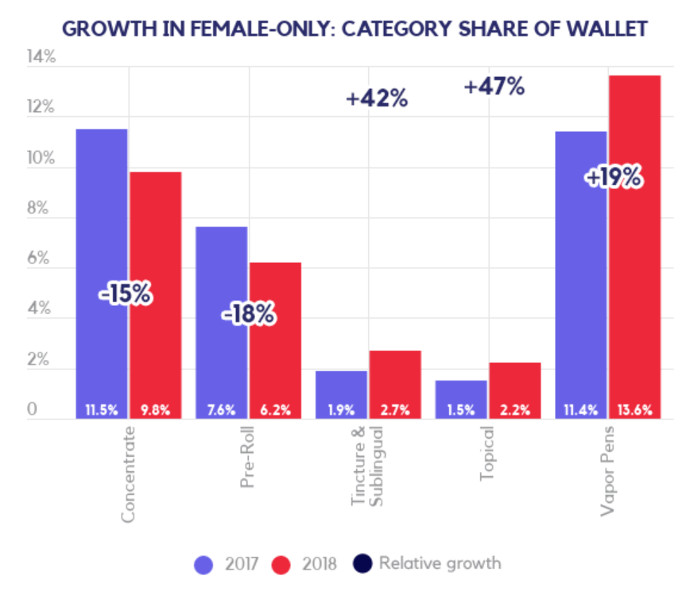
Yet female shoppers buy less of each, and prefer edibles, topicals and tinctures, and sublinguals. Men on the other hand buy significantly more concentrates.
Similarly, the theory of women trending towards wellness makes sense when looking at the specific products they bought in 2018. Women over-indexed for the popular Humboldt Apothecary 3:1 Calm CBD Tincture, which contains 3 mg of CBD for every 1 mg of THC.
Women also purchased Papa and Barkley’s 3:1 Releaf Balm, meant to target areas of muscle pain and inflammation. It’s notable that these two products are marketed for their healing and calming effects.
But women also over-indexed for Milk Chocolate Blueberry Terra Bites by Kiva, which contain 5 mg of THC per bite. Despite the stereotype, there’s no real science proving women crave chocolate more than men. They just admit to it more.
In the end, while no single product or category is exclusive to one sex, it seems more women are engaging in some of the more nuanced methods of cannabis consumption. Simply put: Women want to buy and use cannabis on their own terms. Retailers who want to satisfy the ladies in the market need to reach them on a personal level with a focus on product education and benefit awareness.