





A Tour of Canopy Growth’s Tweed in Smith Falls, Ontario
“Tweed is the best thing to happen to Smith Falls since the railroad showed up in 1880!”
He has to yell for me to hear him across the horseshoe shaped bar—or at least take his best stab at yelling. His voice sounds tired, like it’s a struggle to push the air out of lungs whose better days have long since come and gone. His withered frame is slouched in the barstool, as if gravity has become a force to be battled. Scant, white tufts of hair show through the screened portion of his baseball cap as he turns his head and reaches for the pale, yellow-gold beverage to his right. I find myself wondering if he’s pulling the railroad reference from living memory. He’s competing to get his words in with seven other patrons, who are all sitting around the bar, all speaking up at once to answer my query. I’m not sure if I expected so much excitement when I asked. Then again, I’m not sure what I expected.
As the opening line implies, we’re in Smith Falls, Ontario, a small town about an hour’s drive southwest of Ottawa with a population of just under 9,000. Up until the last decade, what the town lacked in size, it made up for in vibrance, thanks almost solely to the Hershey Chocolate factory located there, which served as the headquarters for the company’s Canadian operation. It was the anchor of Smith Falls’ economy, benefitting the town’s inhabitants directly with jobs, as well as indirectly with a steady stream of chocolate-loving tourists making their pilgrimage to see the operation in person. But everything came to a grinding halt in 2008 when the factory shut its doors. “Recession” is a mild term for the aftermath. The town shriveled into little more than a memory, with nothing left to offer but low-priced housing for middle class retirees. If we accept “sleepy” as a term for rural towns with little-to-nothing going on, Smith Falls was in a coma.
It’s difficult to imagine now. As we made our way through the town, there were signs of life everywhere. Newly opened shops and various local businesses dotted the formerly shuttered landscape, all bustling with the hum of commerce and well-trodden by the feet of eager consumers. There’s a brand-new economy here, and it all revolves around cannabis.

It started in 2014, when two serial entrepreneurs from the tech industry set their sites on the emerging legal cannabis market. They bought the sprawling 470,000 square foot defunct chocolate factory and opened Tweed, then a fledgling foray into cannabis cultivation, today a multinational corporation that operates under the moniker, Canopy Growth. It has since become the largest cannabis operation in the world, as well as the first of its kind to be publicly traded, with offerings on both the Toronto and New York Stock Exchange and a sizable portion of shares held by Constellation brands, better known in households and pubs as the makers of Corona and Ballast Point. The original name, Tweed, is now just the most popular brand of several owned by the parent company, but it’s still the name affixed to the operation in Smith Falls.
The ‘wow’ factor set in the minute we entered the foyer. I had known better than to expect a Humboldt County outlaw-tinged motif, but a hazy notion is a far cry from the visceral experience of being there. Everything was so clean—in upkeep, of course, but even more so in design. The overall look was decidedly millennial, somewhere between Urban Outfitters and REI, with an extra dash of earthiness to remind the subconscious that their specialty was in growing. A gentle collision of modern and vintage tied the space together seamlessly.
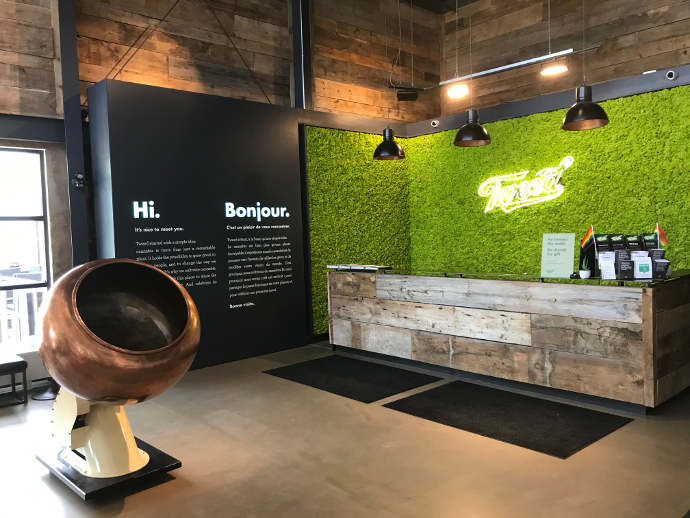
The subject matter of the tour was far more about the plant than the brand. It makes sense; the brand itself really needs no introduction, especially when standing within the belly of the operation as we were. Really, the entire experience was one giant application of branding, everything from the tasteful, modern décor to the exhaustive crash course on the history and benefits of cannabis.
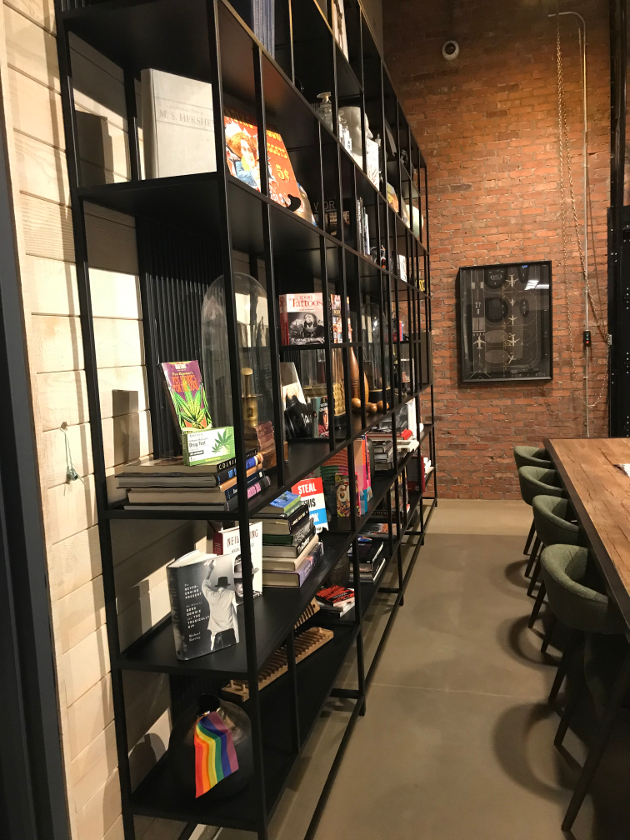
The first two adjoining rooms were focused on history. We began in a space full of mini-displays that alternated between bios of noteworthy activists and scientists and artifacts from the prohibition era and before. A tattered pharmacy catalogue from the turn of the last century that listed medicinal hemp prices sat in a glass case as evidence of the plant’s wide acceptance before the propaganda war began. Speaking of propaganda, there were plenty of relics from that era as well, the most memorable being a collection of Reefer Madness posters from the 30s and 40s.
The next room served as a mini-theater where we were treated to an eight-minute movie that detailed this history of the plant from a Canadian perspective. It was fascinating to take in such an exhaustive and detailed history of cannabis and its ill-fated prohibition without mention of names like Hearst and Anslinger. In the U.S., we often forget that we aren’t the only country with a story to tell.
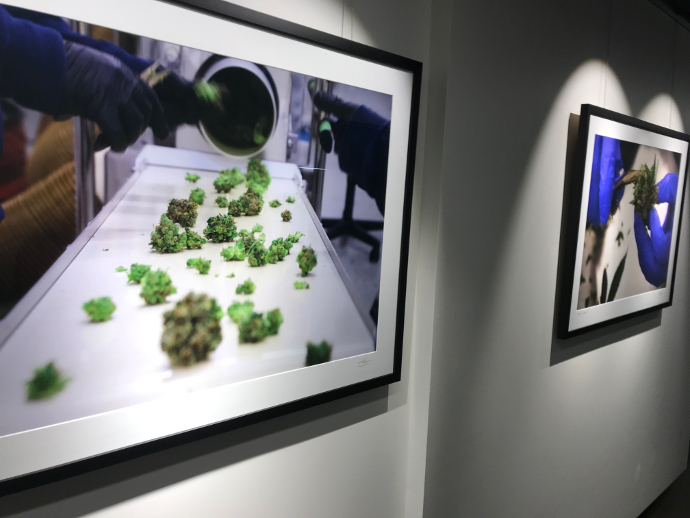
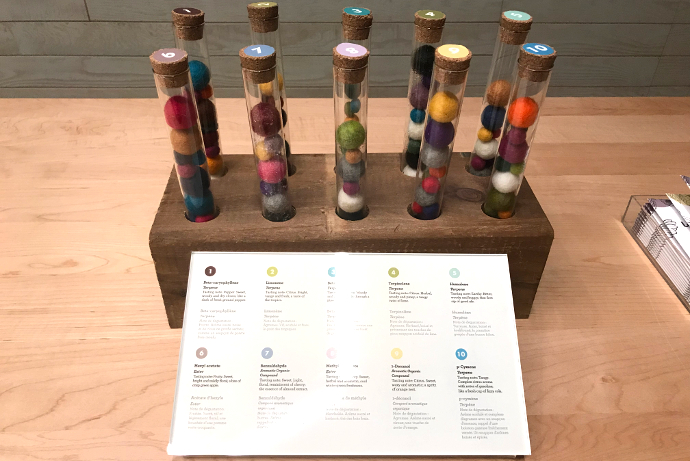
From there, the education shifted to the science of the plant, covering everything from grow cycles, to terpene profiles, to a detailed explanation of the endocannabinoid system. Barely a snippet of the current cannabis knowledge was left out, and every aspect was explained in glorious detail through charts, graphs, creative displays and copious amounts of text.
A long, narrow corridor flanked by windows providing views of the grow rooms led to a staircase, the descent of which put us at the entrance of a small coffee lounge, which opened to the final leg of the tour: the gift shop. For all intents and purposes, it was a head shop, stocked to the hilt with the finest apparel and accessories, but once again, it was laid out and curated in such a way that it felt more like a high end lifestyle boutique than anything associated with the counter culture as we have come to know it. But that was the point of the whole experience. Cannabis is mainstream now, a multibillion-dollar industry that caters to every walk of life, from the stay at home mom to the top tier executive.
I can’t deny the fact that Canopy Growth is the literal archetype of “Big Cannabis,” the dreaded corporate takeover of this egalitarian plant that was long championed by the downtrodden. I won’t even say that I love the idea of white-collar execs of a multi-national conglomerate being the ones to benefit from legalization while minorities still rot in jail over a dimebag. But I will say that it might be necessary to move our agenda forward, and for the people of this small town, it’s necessary for survival.
As I sit on my bar stool, quelling my munchies with an order of fish’n’chips and slugging back a post-tour IPA, I’m mesmerized by the responses I’m hearing after asking this room full of aging, silver-headed locals how they felt about a pot factory showing up in their quiet town. They gush with appreciation for Tweed, practically climbing over one another with their words to get their thoughts on record. It’s overwhelming but inspiring. Inspiring to witness firsthand the economic opportunities this once maligned plant can provide. Amidst the voices, though, there is a naysayer. She’s not angry about the devil’s lettuce, though. She’s just disheartened. She had been an employee at Tweed for the past three years, but was laid off just a week ago.
“They’re changing,” she tells me. “They’re losing their heart and becoming too corporate.” In my heart, I hope that she’s just a disgruntled employee who needs to vent, but from my vantage point, I couldn’t say one way or the other. Retaining a soul while reaping profits is hard for any corporation, and Canopy Growth is no exception. I reached out to the corporate offices for an interview, and while they did respond and promised to get back to me, they weren’t able to make it happen within the necessary time frame. With any luck, I’ll be able to report back next month with a second installation and hopefully get a little closer to the core of who they are and where they’re going. Stay tuned—and cross your fingers.
READ MORE:










