Jordan Lucas “Sheepdawg” Glass

Jordan Lucas “Sheepdawg”
Corvallis, Oregon
@sheepdawgglasscraft

You don’t spot too many parrots in Oregon’s Willamette Valley. You’re most likely to see a robin, goose or a duck. That is unless you visiting the studio of glass artist Jordan Lucas.

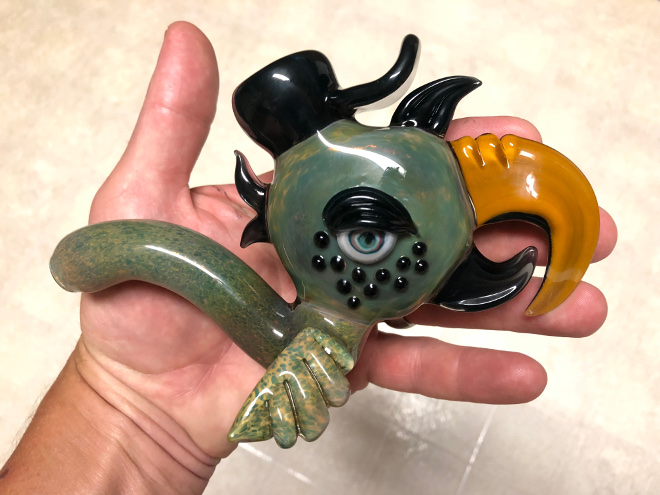
At SheepDawg GlassCraft you’ll find exotic parrots in every color combination and every functional shape from rigs and dry pipes to dabbers, carb caps and pendants.

Jordan has been blowing glass since 1999, and rather than being a “Parrothead” as you might assume, he has always been hardcore into the hippie culture. He started out making belts, jewelry and guitar straps from hemp as well as homemade soap and incense. His customers often asked if he could hook them up with a custom glass piece, and so he would turn them on to one of his local glass blower friends. It wasn’t long before he got into glass blowing himself, learning from artists like Levi Baird and Clinton Roman.
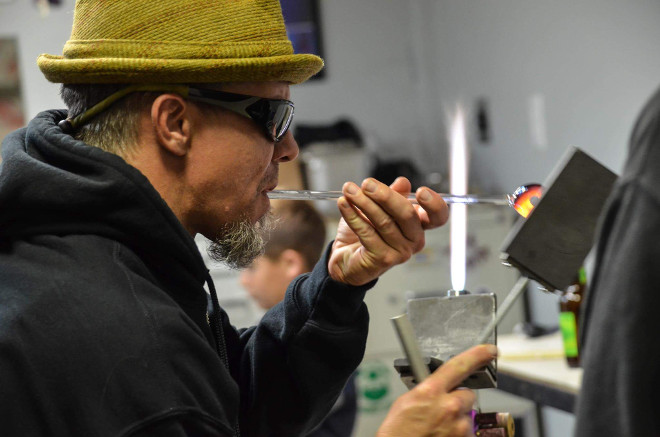
“I just kinda took it and ran with it,” Jordan says, “I buried my ego and I’d ask everybody for their advice.”

One thing Jordon noticed is that many artists are known for making pipes in animal shapes, whether dragons or dinosaurs. The Parrots became Jordan’s calling card.

“They just spoke to me and I felt a real connection. The first one I made just came to life right before my eyes — it was amazing,” Jordan says.

“There’s a bunch of different ways you can go about making a parrot,” Jordan explains. “Rather than trying to recreate the look of an actual parrot, like you might see in the wild, mine are characters — it might be a pirate parrot or a parrot riding a dirt bike. I want to have an army of high vibrational parrots that really speak to people.”
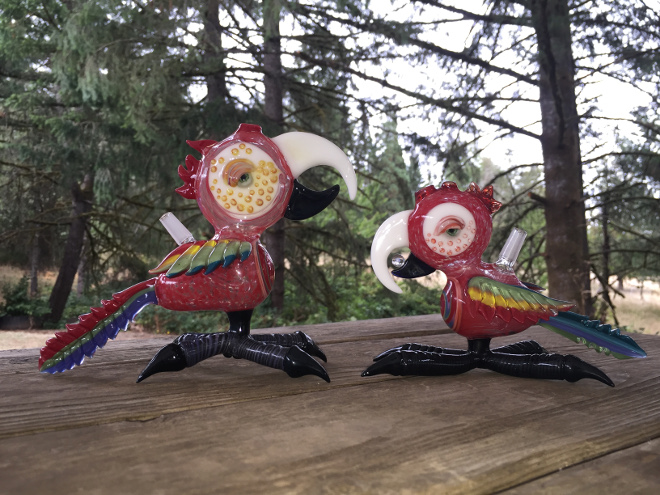
“The biggest challenge is the time it takes to make a parrot,” Jordan adds, “every little piece from the claws and wings to the eyeballs are all constructed separately and then put together.”

When Jordan isn’t in his studio, he likes to hunt, ride dirt bikes and snowboards, and spend time with his family. Glass blowing, he says, is a special part of himself that he enjoys sharing with the world.

“This glass that we make is a part of alchemy; it absorbs energy, vibration and metaphysical frequencies,” Jordan says. “Whenever I’m blowing glass, I’m in my happiest place, and the colors, shapes and characters really reflect the positive energy that I put into my pieces.”

Recent Articles

You’ve chosen to work in a gray area. You sell products that contain cannabis or cannabis-adjacent substances as well as accessories that can be used to consume it. And while that area has become less gray—you can see rays of sunlight peeking through—the skies are still cloudy. THC remains a Schedule 1 substance, even as medical marijuana has migrated to Schedule 3.
Running a cannabis business is notoriously complicated. For dispensaries, complex compliance burdens permeate every facet of the business, from zoning and licensing to marketing and payments. Whether you’ve been in the cannabis space for mere months or multiple decades, you’ve likely run into drawn-out approval processes, supply chain headaches, or constantly changing regulation that makes compliance challenging, not to mention the other micro and macroeconomic factors that plague all small business owners.
Blending traditional values with modernized, energetic branding, Not Ya Son’s Weed falls somewhere between the cannabis days of yore and today’s recreational cannabis boom. Not Ya Son’s Weed offers a variety of products—including pre-rolls, exotic flower, and gummies—that provide much-needed relief without being too overbearing.
The officials came for Lance Alyas once before. In 2023, they caught him in a sting, seized his merchandise, and tossed him in jail. But just seven days later, after he invoked Hawaii's version of a Freedom of Information Act request, the whole case fell apart. Alyas was released without bail, allowed to simply walk out the door. Now, he’s advocating for freedom from Hawaii’s state officials once again. Only this time, it’s not just his own freedom. As the owner of Oahu’s top-rated smoke shops, he’s fighting for everyone’s right to sell hemp products in the Aloha State.
Born Sara Benetowa in Warsaw, Poland, in 1903, Sula Benet may not be an immediately recognizable name in cannabis spaces today, but she should be. While she primarily studied Polish folk customs, Benet became known for her graduate thesis at the University of Warsaw, titled Hashish in Folk Customs and Beliefs. In the paper, she claims that the plant kaneh bosm—which is referenced throughout the Old Testament and Torah and often translated as “calamus”—actually refers to hemp. Benet’s theory remains both significant and highly controversial today, especially as various religious and evangelical groups continue to demonize the plant.
If the United States were ever a country based on strict adherence to the law, those days are long past. The modern game lies in devising methods to circumvent laws. It’s how the rich avoid taxes, the powerful avoid jail, and industries of all kinds bypass regulations. The paradox is that, despite its ubiquity, it’s not easy to stay beyond the reach of the long arm of the law. Well-moneyed, influential organizations still sometimes misjudge the political and legal playing field and have to pay up. The Sacklers (the family behind Purdue Pharma) eventually were bankrupted by the courts for their role in the opioid epidemic, and officials hit Meta with a $5 billion fine over privacy concerns.
When you walk into a smoke shop today, you might notice the glass cases that once held rolling papers and blunt wraps now display CBD tinctures, functional mushroom capsules, kava elixirs, and hemp-infused sparkling water. The staff might talk to you about terpene profiles, cortisol levels, and a new vape line.
I went home and told my girlfriend, who, after Googling the name of the business I bought it from, told me that, yes, it was technically weed. But it was CBD. She started laughing, telling me I had been ripped off.