




Lance Weber – Obiwook Glass
Instagram/obiwookglass
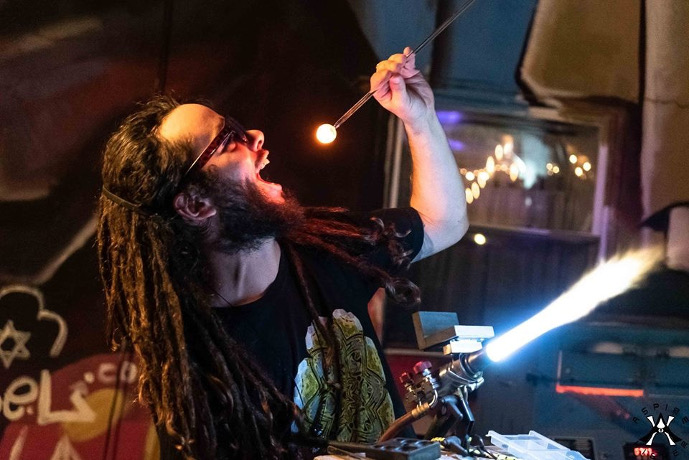
Lance Weber wants to blow glass in every state in the US. So far, the Baltimore-based artist has made it to 17. But his mission is about more than just putting another dot on the map. It’s also about showcasing the painstaking craft of constructing intricate “dotted” patterns by melting thin stringers of colored glass onto a clear base to create truly one of a kind pieces of wearable art.
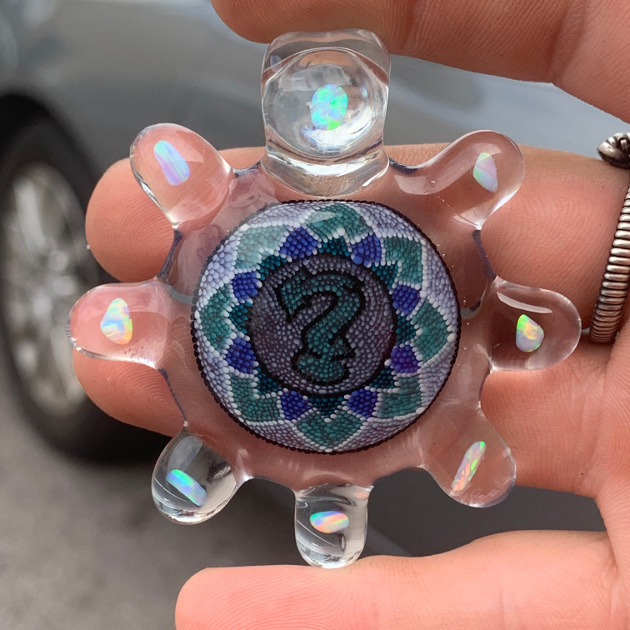
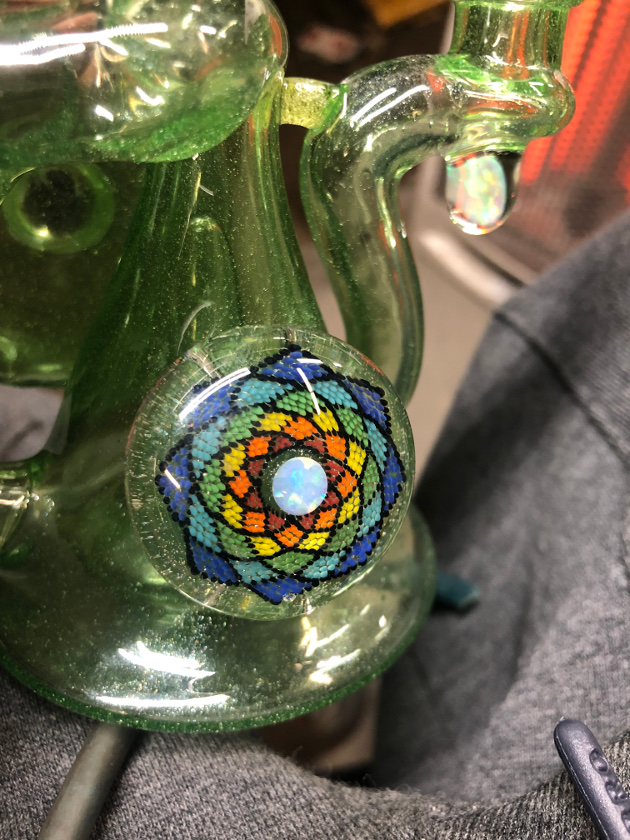
Dot work, explains Lance, is a form of implosion. Just instead of laying in 10 or 20 dots that form an abstract design, a finished piece can have anywhere from 1,500 to 5,000 dots carefully placed to make distinctive patterns, shapes and even recognizable logos and characters.
Lance starts with standard clear tubing that he blows out into a bubble as round as possible. Not an easy task without a lathe. Lance is happy to get one usable bubble out of every five that is up to his standards. The next step is etching the pattern onto the glass so that he has a map from which to work. On some piece, he will place dots from the center outward, an others from the outside in.
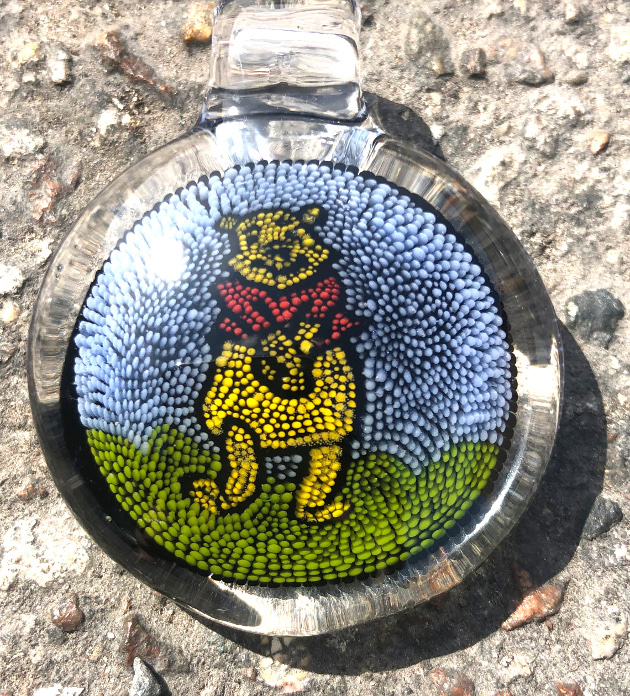
A lot of the designs aren’t planned out, Lance admits. For others, that are recognizable, such as the Grateful Dead’s dancing bears, he will pixilate the image with a specialized software program that show him exactly where each dot and each color should be placed — picture the graphics from an old school video game.
Precision is key. “You want to be as accurate as possible — if you’re not, then things can go south very quickly,” Lance says. “When I lay that dot on the bubble, I am able to remove it if I’m not happy with the placement, but the more times you do it, the more chance there is for it to break away the clear. I’ve had times where I was 90 percent done with a pendant, and went to remove one dot and broke a hole in the bubble — that was eight to 10 hours wasted.”
Some dot artists work from a full size glass rod; Lance prefers to dot from a stringer, putting each color in at a time. “Maintaining a rhythm in and out of the flame keeps the size of the dots consistent,” he says. “Only the stringer is in the flame; you never want the heat to touch the bubble, but that’s when cracks start happening. If I piece cracks, very rarely is it fixable — I made a promise to myself and my followers that all second quality work will be throw into the bucket.”
“There’s very few pieces where I’ve sat there and dotted from start to finish,” Lance adds. “Sometimes I’ll do 500 dots and then through it kiln for a little bit, and rejuvenate myself with a couple of dabs, before I go back to it.”
Lance learned the fundamentals of glass blowing from Darryl Lewis (Drlglass), but his dot work skills are all learned trial by fire. Many of his followers come from the festival scene — that’s where he picked up the nickname Obiwook Glass. His pieces can also be found in smoke shops including Galaxy Glass (Colorado), Lifestyles Smoke Shop (Florida) and Level 42 Gallery & Studio (North Carolina).
“I respect the shit out of pipe makers, but I think of myself more as a jeweler than a pipe maker. There’s a lot of people who smoke weed, but there 20 times more people that wear jewelry,” Lance says.
“Dotting is very zen,” he adds. “It’s kind of the same as when I was riding motorcycles where it’s just me, the bike and the road — when I’m dotting, it’s just me, my torch and a LOT of dots.”










