If you want to send congratulations to Lauren Miele you might do it with one of her own clever cannabis-centric greeting cards. As the owner/founder of KushKards, Miele has given her own creative touch to a common, everyday product that people give for birthdays, anniversaries, holidays, and other special occasions, and transformed it into an entirely new category for the smoke shop and counterculture communities.
It makes perfect sense that Miele, being a woman, and a graduate of the Fashion Institute of New York, and somebody who likes to partake on a daily basis, would have the idea to merge the cannabis and gift giving communities in a truly unique and creative way.

“My friends in college would describe my style as ‘Wham, bam, beautiful.’ I was always the one to go for adding color and seeing the beauty in a simple rainbow palette,” Miele says. “When I first enrolled at FIT, I didn’t know how to draw or even how to use a computer, but I had all of these super creative ideas. I didn’t think that I’d ever work for myself; it just happened because I came up with the idea for KushKards.”
“As a natural card giver and a consumer of cannabis, along with my past career in fashion, I have a flair for making cannabis fun and giftable,” she adds. “I don’t know if a man would have thought of that exactly.”
Not only do women hold 80% of purchasing power, they also dominate the gift buying space. While men might head straight to the electronics section, women shop for gifts that are more personal.
“I think women teach people about the personal aspect of gifting. . . if anything, show up with a card,” Miele says. “What’s fun for me is that sometimes my buyers are men and I’ve started to see an evolution in the demographics of my buyers. I’m starting to see more guys buying cards for cannabis-friendly women in their lives.”
Typical greeting cards don’t offer “High Wishes” on birthdays, or an everyday sentiment to “Just Say High,” or a sympathy card so together you can “Smoke About It.” KushKards was a sensation at Miele’s first industry trade show. But she says it still took some convincing to get those who only saw dollar signs to understand the real value of her cards.
“When I started in 2015, it was challenging in the fact that buyers were hesitant to take on my products. Dispensaries were like, ‘Oh, we don’t need this’ because they were making so much money on weed and assumed that’s all their customers wanted.”
Now, you should see the dispensary outreach!
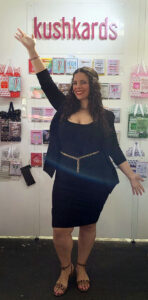
“There’s a much larger demographic going into dispensaries than just your typical stoner. You’ve got moms, dads, and people with money buying gifts,” Miele says.
Until recently, when Miele partnered with Drip Drop Distro to rep her brand, she was a one-woman show. She had the help of some friends, but was responsible for everything from designing cards to sales and shipping. If you came across KushKards at a trade show it was Miele herself who made the first introduction.
“Doug [Campbell, one of the owners of Drip Drop Distro) told me, ‘People know your cards are great, but they’re buying them because of YOU. You’re out there and people are connecting with your story and your passion for your products,” Miele says.
Going forward, Miele is enthusiastic about bridging the gap between counterculture and mainstream markets. With Drip Drop’s help, her cards are now in the rack at Spencer’s Gifts, and someday she hopes to make good on KushKards being called the “The Hallmark of Marijuana.”
“I could have moved on in my career and kept building my portfolio in product development of home goods. But I decided to pursue this idea that surely somebody had thought of, but no one had gone for,” Miele says. “I had a lot of women as mentors who helped me launch KuskKards, taught me about pricing and trademarking, and really just gave me that green light to go and do it.”
“Not everybody may get my cards,” she concedes, “but they see the vision and understand it. It’s been a fun journey for me.”