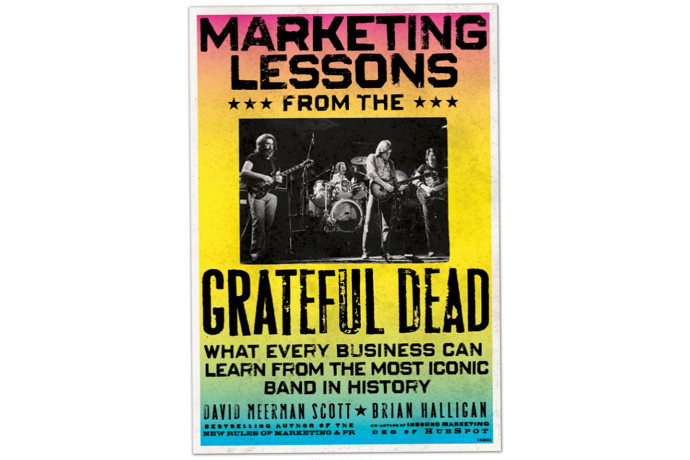
Marketing Lessons from the Grateful Dead: What Every Business Can Learn from the Most Iconic Band in History

Long before the terms ‘inbound marketing’ and ‘social media’ were coined, the Grateful Dead were using these strategies to become one of the most successful bands of all time. They made a series of difficult and often unpopular decisions in order to differentiate themselves from their competition by providing the highest quality service to their fans, not just a product.

In Marketing Lessons from the Grateful Dead deadheads and marketing strategists David Meerman Scott and Brian Halligan explain how smart businesses can learn from one of the most successful rock bands of all time broke almost every rule in the music industry book and profited as a result. The lessons—and the effect the band had on the music industry and their fans—apply to businesses of all kinds.

The book includes a foreword by basketball legend—and the ‘world’s biggest Deadhead’—Bill Walton, who is 6’11” and has seen the band 750 times. Jay Blakesberg, who has been photographing the band for 30 years, has agreed to provide photos to illustrate each chapter.

Scott and Halligan collaborated to create a book that reflects the attitudes of the time. “The Grateful Dead can be considered one giant case study in doing social media marketing right,” says Halligan. “Not only did they pioneer the freemium business model by allowing concert attendees to tape the show, but also encouraged their fans to build a community, and kept them informed via their newsletters.”

Each chapter presents and analyzes a marketing concept practiced by the Dead and a real-world example of that concept in action today. Specific topics include:

• Rethink traditional industry assumptions – Rather than focus on record albums as a primary revenue source (with touring to support album sales), the Dead created a business model focused on touring. Halligan and Scott apply that idea to today’s Internet – where the cost of distribution of electronic information is zero. Now, entire new opportunities emerge for those willing to challenge established business models. The Grateful Dead teaches us that business model innovation is frequently more important than product innovation.

• Turn your customers into evangelists – Unlike nearly every other band, the Grateful Dead not only encouraged concertgoers to record their live shows, they actually established “taper sections” where fans’ equipment could be set up for the best sound quality. When nearly every other band said “no” the Grateful Dead created a huge network of people who traded tapes in pre-Internet days. The broad exposure led to millions of new fans and sold tickets to the live shows. Today, as many companies experiment with offering valuable content on the Web, the Grateful Dead teaches us that when we free our content, more people hear about our company and eventually do business with us.

• Bypass accepted channels and go direct – The Grateful Dead created a mailing list in the early 1970s where they announced tours to fans first. Later, they established their own ticketing office, providing the most loyal fans with the best seats in the house. The Grateful Dead teaches us that building a community and treating customers with care and respect drives passionate loyalty.

• Build a huge, loyal following – The Grateful Dead let their audience define the Grateful Dead experience. Concerts were a happening, a destination where all 20,000 or more audience members were actually part of the experience. Making fans an equal partner in a mutual journey, the Grateful Dead teaches us that our community defines who we are. In an era of instant communications on Twitter, blogs and the like, we learn that companies cannot force a mindset on their customers.


Recent Articles

You’ve chosen to work in a gray area. You sell products that contain cannabis or cannabis-adjacent substances as well as accessories that can be used to consume it. And while that area has become less gray—you can see rays of sunlight peeking through—the skies are still cloudy. THC remains a Schedule 1 substance, even as medical marijuana has migrated to Schedule 3.
Running a cannabis business is notoriously complicated. For dispensaries, complex compliance burdens permeate every facet of the business, from zoning and licensing to marketing and payments. Whether you’ve been in the cannabis space for mere months or multiple decades, you’ve likely run into drawn-out approval processes, supply chain headaches, or constantly changing regulation that makes compliance challenging, not to mention the other micro and macroeconomic factors that plague all small business owners.
Blending traditional values with modernized, energetic branding, Not Ya Son’s Weed falls somewhere between the cannabis days of yore and today’s recreational cannabis boom. Not Ya Son’s Weed offers a variety of products—including pre-rolls, exotic flower, and gummies—that provide much-needed relief without being too overbearing.
The officials came for Lance Alyas once before. In 2023, they caught him in a sting, seized his merchandise, and tossed him in jail. But just seven days later, after he invoked Hawaii's version of a Freedom of Information Act request, the whole case fell apart. Alyas was released without bail, allowed to simply walk out the door. Now, he’s advocating for freedom from Hawaii’s state officials once again. Only this time, it’s not just his own freedom. As the owner of Oahu’s top-rated smoke shops, he’s fighting for everyone’s right to sell hemp products in the Aloha State.
Born Sara Benetowa in Warsaw, Poland, in 1903, Sula Benet may not be an immediately recognizable name in cannabis spaces today, but she should be. While she primarily studied Polish folk customs, Benet became known for her graduate thesis at the University of Warsaw, titled Hashish in Folk Customs and Beliefs. In the paper, she claims that the plant kaneh bosm—which is referenced throughout the Old Testament and Torah and often translated as “calamus”—actually refers to hemp. Benet’s theory remains both significant and highly controversial today, especially as various religious and evangelical groups continue to demonize the plant.
If the United States were ever a country based on strict adherence to the law, those days are long past. The modern game lies in devising methods to circumvent laws. It’s how the rich avoid taxes, the powerful avoid jail, and industries of all kinds bypass regulations. The paradox is that, despite its ubiquity, it’s not easy to stay beyond the reach of the long arm of the law. Well-moneyed, influential organizations still sometimes misjudge the political and legal playing field and have to pay up. The Sacklers (the family behind Purdue Pharma) eventually were bankrupted by the courts for their role in the opioid epidemic, and officials hit Meta with a $5 billion fine over privacy concerns.
When you walk into a smoke shop today, you might notice the glass cases that once held rolling papers and blunt wraps now display CBD tinctures, functional mushroom capsules, kava elixirs, and hemp-infused sparkling water. The staff might talk to you about terpene profiles, cortisol levels, and a new vape line.
I went home and told my girlfriend, who, after Googling the name of the business I bought it from, told me that, yes, it was technically weed. But it was CBD. She started laughing, telling me I had been ripped off.