Sculpting is Lisa’s passion and art is a deeply rooted part of her family heritage. Her father followed in his father’s footsteps to become a renowned sculptor of western art, and opened the Heikka Foundry in Hollywood during the early seventies. Her grandfather Earl Heikka was a western sculptor from Great Falls, Montana, whose work can be seen in the National Cowboy Hall of Fame, The Smithsonian, The Rockwell Museum and The C.M. Russel Museum in addition to many private collections and galleries.
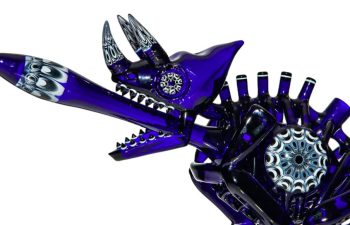
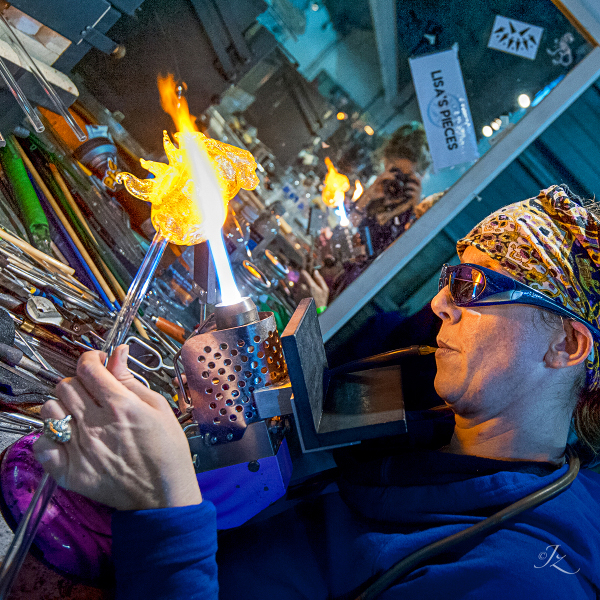
Those sculptures were made from clay, whereas Lisa’s Pieces, which also happens to be the name of her northern California studio, are blown from glass. She began working glass in the hot shop of Shasta College in 1998, and before long she got a full time job lamp working borosilicate glass for an area production studio turning out steamrollers. In 2000 Lisa moved out on her own, and it was right then that she found out she was pregnant, and her motivation switched from being a freewheeling artist to a professional glass blower. To make a living, she created her own signature line of steamrollers inspired by the techniques she’d learned, while at the same time adding her own creative twist and making them bigger and more colorful.
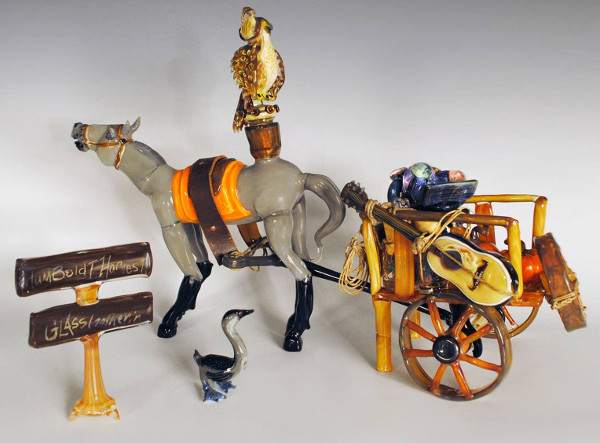
In 2006, Lisa took a week-long private class with Banjo, further developing her glass sculpting abilities. This enabled Lisa to win the very first Female Flame Off. She took first place in both functional sculpture and wearable art. This sparked Lisa’s desire to focus more on hollow sculpting. Life and realism in motion within her glass are constantly driving her work.
Lisa has the honor of bring part of the very first functional glass exhibit in a mainstream setting at the National Liberty Museum in Philadelphia. Among her recent projects are a series of glass interpretations of her grandfather’s clay sculptures for the C.M. Russell Museum in Great Falls, Montana.
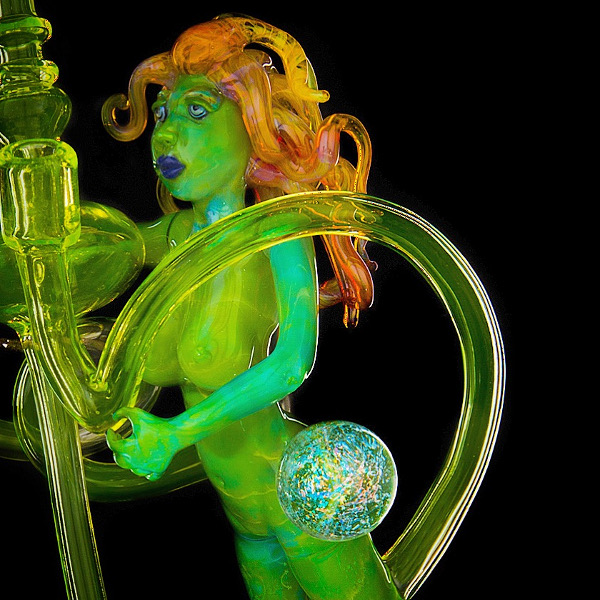
After 20 years at the torch, Lisa’s pieces are bridging the chasm between the art community and the smoke shop world. Her headiest pieces are on display at some of the most prestigious smoke shops/glass galleries including Illuzion, in Denver, Frolic on the Pike, in New Jersey, and Peace Pipe, In Santa Rosa, California.
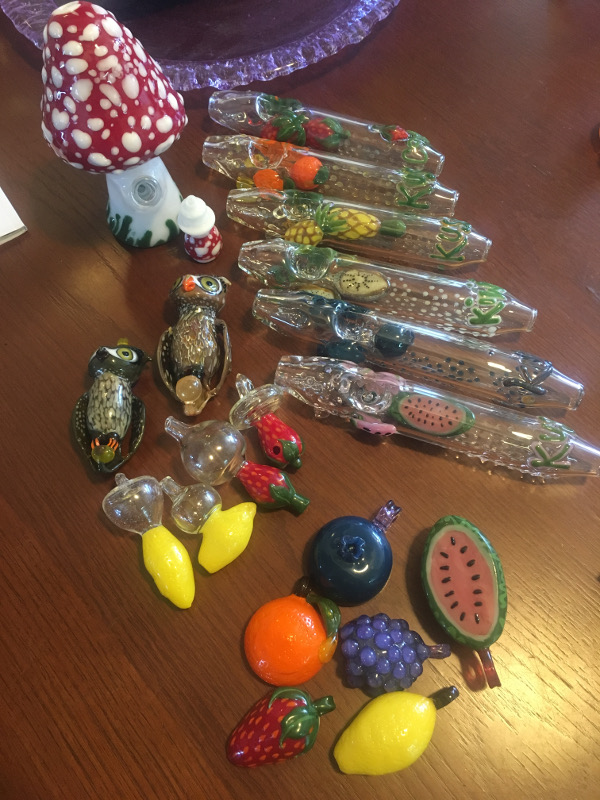
Look in the showcase at your local smoke shop and you’re likely to find one of Lisa’s pipes with interior sculpted figures of Rick & Morty and Pickle Rick. She also makes pendants and carb caps in the shape of mushrooms, fruits and veggies and owl. Over the years, Lisa has developed a catalog of more than 170 different glass smoking accessories, many have come from collaborations with her fans on custom orders. Each piece, no matter how small, is signed and dated so that even everyday smokers know for sure the piece on which they spend their hard earned cash on is 100 percent authentic and special.
Lisa is not just about promoting her own work, but growing the glass blowing community as a whole. Along with Joshua Weitz, she helped to stage the trade show’s first flame-off events which featured some of the biggest names in the industry including Banjo, Tristan, Chaz, and Mr. Gray.
“Our goal was to demonstrate how difficult it is to make artistic pieces, show off our skills, and legitimize the reason for charging thousands of dollars. Once the head shop people who came to CHAMPS saw exactly what we were doing, it really shifted the industry in an awesome way,” Lisa says.
“The high end demand will always be there, and it’s really put (functional glass artists) in a different category,” she adds. “It’s hard to say where it’s all going, but I think it’s all for the best.”
“I feel fortunate to be able to work where I want to work, when I want to work and on what I want to work. When I’m making orders, I’ll be in the studio 10-12 hours a day, but I don’t mind because I’m a glass junkie,” Lisa says. “Glass is a medium that teaches me new things every time I turn on the torch. The supplies and the tools are so amazing now that we’re able to create things that before we never thought were possible.”