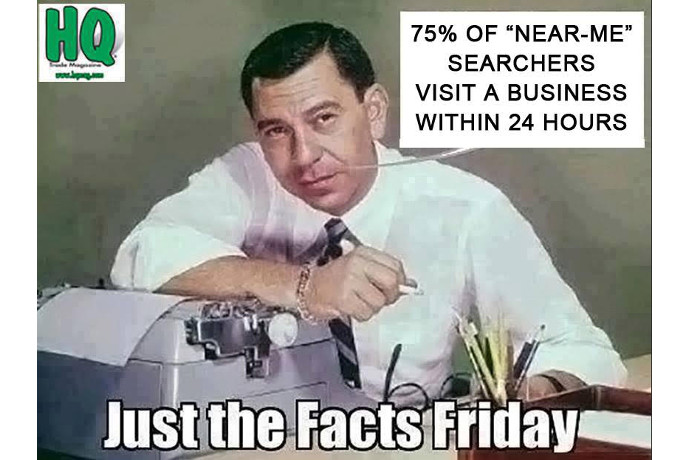
There are a lot of hook up apps, and while Near Me isn’t about scoring a booty call, it is about bringing together people looking for each other —- in this case, businesses and customers.
NEAR ME searches are those conducted in various apps that show users all the businesses that fit their search criteria. In other words, anytime someone uses their computer or smartphone to search for a place close by to purchase something, they’re conducting a NEAR ME search.
According to comScore more than 75% of local-intent mobile searches result in offline store visits within a day, and nearly 30% result in a purchase. Google’s current official position is that 46% of mobile searches are seeking local business information.
There’s another oft-cited statistic that says, 80% of U.S. disposable income is spent within 10 to 20 miles of home.
Are these your customers? A recent survey from Uberall found that among consumers who use their smartphones to shop (69%), 82% of that group had done “near me” searches (92% for Millennials).
In order to list your business in the local search results, you need to open a business account on Google and then optimize your business listing in the Google local search results:
• You may already have a Google listing — even if you didn’t create one — so your first step is to head over Google My Business (www.google.com/business) to claim and manage your listing.
• Add the complete direction to reach your business address using Google Maps.
• Add your business hours and contact details like phone number and website.
• Include your business in the correct category and be as specific as possible.
• Add photos of your favorite products. Optimizing images starts with the file name. You want Google to know what the image is about without even looking at it: if your image shows a mural on your storefront in Smallville, USA, the file name shouldn’t be DSC4536.jpg, but Smallville-USA-Smokeshop-mural.jpg.
• Ask customers to leave reviews on your business page. More than 145 million people visit Yelp each month just to read the reviews left by other users. Reviews are a great way to filter the best businesses from the average ones, and Google always prefers to list the best businesses on top.
• Make sure the Name, Address and Phone Number remains consistent on each of your business profiles scattered around the web, including social media sites like Facebook.
• If you have multiple locations, spread the love and create webpages for each business you have. Making individual landing pages for each location will allow you to provide additional information that your customers are looking for, such as your address, phone number, and hours of business. You can place all locations in the footer of your website, but it is imperative that you give all locations a separate landing page.
Between smartphones and voice searches, local intent searches are the virtual version of the Yellow Pages. Ranking for these searches can introduce your smoke shop to a new and broader base of potential customers and ensure they can find you out in the real world.