





Lora DiCarlo: the G-Spot and the C-Suite
Lora Haddock isn’t terribly interested in dredging up the past. Even when it’s a topic as fresh as her company’s recent, highly publicized feud with the Consumer Technology Association, she’d much rather be talking about the future. It’s a fact befitting her role as the founder and CEO of a tech company, yes, but still unexpected, considering the fiasco was the catalyst that sparked our conversation. However, since context is everything, it’s the elephant in the room that must be addressed, and she obliges.
The events that unfolded are so flatly archetypal of a male-dominated society, the story almost reads like a poorly-written Lifetime special. It’s all true though, sadly indicative of the giant strides we’ve yet to make collectively as a culture. But to fully appreciate the events and their implications, backstory is needed.
From the beginning, it was equal parts entrepreneurship and activism. Lora had spent a decade in the healthcare system as a nurse, and through that time, became increasingly aware of the gap in information about female reproductive health, specifically the pleasure-related aspects. There was plenty of material on male anatomy and how babies were made, but very little on how that process could be made enjoyable for a woman.
“So, you remember looking at human physiology books . . . when you looked at a cross section of the male organs, you’d see that they had everything down,” she says. “Then, when you looked at female physiology, pretty much all you’d see were the sexual reproductive organs.” All work, no play, as it were.
She goes on to explain the root of the problem—the indifference of the authors of these books (men) toward the needs of women, an attitude that pervades not only the healthcare space, but sadly, the world of sex toys, as well as tech. (2) The observation served as the breeding ground that spawned the formation of Lora DiCarlo, a company that, in the words of Marketing Director, Sarah Brown, makes “products created by people with vaginas, for people with vaginas.”
The first of the company’s many planned offerings is the Osé Robotic Massager, a verified breakthrough achievement in innovation, both robotic and erotic. For further elaboration, it’s best we look to the website, lest I commit the blunder of ‘mansplaining’:(1)
Osé is the only product designed for hands-free blended orgasms. Using advanced micro-robotics, it mimics all of the sensations of a human mouth, tongue, and fingers, for an experience that feels just like a real partner. No need for buzzing, desensitizing vibrations. It even flexes and adapts to your body for a personal fit that hits all the right spots – because there are better uses for your hands.
Seriously. There’s nothing that I could have done to make that any better.
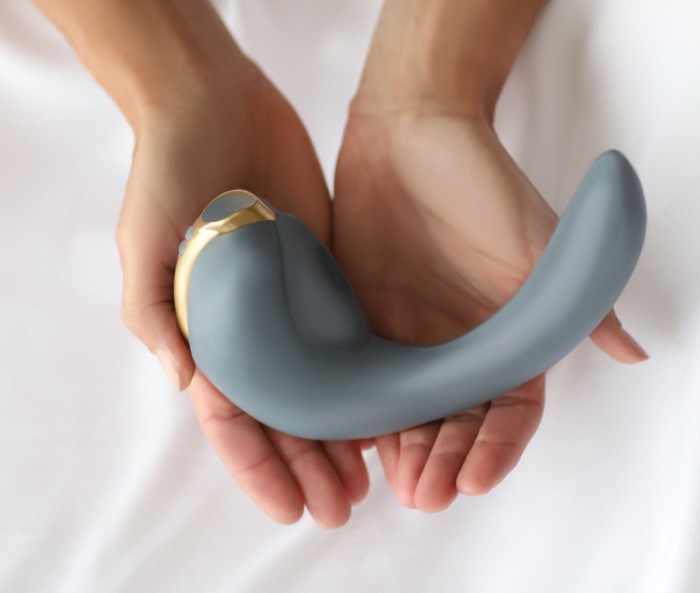
“So we’re stimulating the external part that most people are familiar with, all the way to the inside of the vaginal canal where the g-spot is located,” Lora elaborates. “What most people don’t understand is the two are actually connected. The clitoris itself is actually about the size of a halved avocado. It runs from the point that you see, along the inner-labia and external labia, all the way to the inside of the vaginal canal where there’s a bundle of nerves.” (3)
“It’s called a ‘blended orgasm’ for a reason,” she later adds. “You’re stimulating the whole thing. You get a really explosive orgasm when you stimulate both spots.”
Knowing they had developed something special, they submitted the Osé for consideration in the CES Innovation Awards Program, basically, the Oscars for the tech world. Not surprisingly, they won in the robotics category.
But then, they didn’t.
That’s confusing, yes. Here are the broad strokes:
Consideration for the award first required a rigorous approval process, which they completed successfully. Lora explained it best on LoraDiCarlo.com.
“It was vetted by the Consumer Technology Association (CTA, which owns and produces CES) and then a panel of independent expert judges in robotics scored it highly across all judging criteria; they saw the same marvel of cutting-edge technology that we did. A product that pushes the limits of engineering and design and opens the door to even bigger leaps in innovation, beyond even the sex tech uses.” But then the CTA changed their mind.

With the sweet taste of victory still lingering, Lora and her team received notice that not only was their award rescinded, but they would be barred from displaying the Osé on the show floor. The reason? The product was deemed to be “immoral and obscene.” The simple explanation is the big-shots at the CTA are just a little too uptight about sex. Yet, lo and behold, there was a sex doll for men on display, as well as a booth where men were allowed to watch VR porn in the middle of the show as attendees walked past. The message was clear: Sex tech is OK, so long as it’s for men.
The entire ordeal is clearly another manifestation of our puritanical strangle-hold on female sexuality, the long-held dichotomy that teaches us that men are players, but women are whores. It’s an attitude that can be traced back to colonial times, when residencies for single women were often legally defined as brothels.
But while Lora, Sarah and their team don’t dismiss this, they don’t linger on it either. Besides, in hindsight, the CTA did them a favor.
“This is the best thing they could have done for us,” Sarah acknowledges. “I’ve never seen any coverage like this from an adult product. This is out of the stratosphere.”
Now, they’re moving forward—and with admirable grace. Forgive them, for they know not what they do, etc.
“I don’t know if it’s always been necessarily a conscious bias,” Sarah suggests, contemplatively. “I think a lot of it comes from the idea of, ‘Well this is the way I’ve always done it, and this is the way my boss has always done it, and his boss and his boss and his boss.’”

“That’s probably the key phrase: ‘his boss,” Lora interjects. “We’re social creatures. You tend to hang out with the folks that are most like you . . . Unfortunately, that’s how a lot of business works.”
This is the crux of their message, that on the grand scale, these injustices occur by default rather than malicious intent; that a simple course correction through wider inclusion can be farm more effective than razing the institutions to the ground. They’re activists just as much as they are entrepreneurs; that much is clear. But they’re also realists who understand that building alliances works better than drawing battle lines.
“We have a lot of males in our camp who are supportive of what we’re doing and understand it,” Lora explains. “I think that’s very important to note. So, bashing an entire demographic . . . that doesn’t make sense to me. I think if you speak gently and speak logically to even the ones that don’t understand yet, they start to get it.”
“The most effective way to go about changing something is to speak the language of the people that you’re trying to change,” Sarah adds. “And I think that what we’re finding now and what we know from all of the research is that when you have a diverse workforce, when you have . . . more diversity within the C-suite, you have a more successful company.”
(1) Full Disclosure: I shouldn’t be writing this. When the story was first pitched to me, I didn’t hesitate for a moment, genuinely understanding the significance of the events that took place as well as the importance of Lora’s voice being heard on the matter. It wasn’t until I began putting pen to paper that I came to fully appreciate the precarious nature of my situation. Here I am, a man trying to articulate the frustration that only a woman, or more apropos, a person with a vagina, could truly understand. The very idea of filtering the narrative through the lens of someone possessing both X and Y chromosomes seems counterintuitive in light of the message. However, being that I envelope the male stereotype of thick-headedness to a level that’s almost laughable, I still just spent an hour attempting to explain the Osé in my own words. Hence, the citation of the website.
(2) Let’s be real; this attitude is ubiquitous, whatever your world.
(3) Heterosexual men, are you taking notes? You should be. The G-spot is not a pot of gold, nor a unicorn, and the vagina, as magically mysterious as it may seem to the reptilian brain, is in fact flesh, a part of human anatomy that can be studied and understood. Any ignorance on the subject is purely willful.










