Patrick Beck

Patrick Beck – Denver, Colorado
@boss_glass

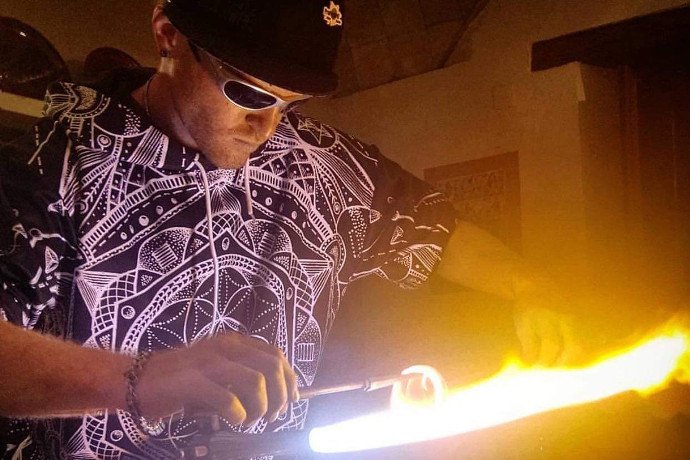
Patrick Beck gained worldwide attention for his glass sculpture of Venom, a human fused with a symbiotic alien entity to become the shape-shifting anti-hero of the Marvel Universe. In reality, the two are a lot alike — minus the long-tongue and sharp-teeth. Patrick’s skills as a glass artist are a melding of his background in welding, chemical engineering, entrepreneurial management and extensive treks around the country and throughout Europe, soaking up the sights and cultural experiences.

Patrick has always been interested glass and his family would even bring him glass souvenirs from their travels. Later on, he got into oxy acetylene welding, which uses acetylene gas as fuel for the flame that heats the metals causes them to melt together — it wasn’t a big leap from there into glass blowing. He found even more artistic inspiration as part of a local collective that was also home to ceramics and metal sculptors and stained glass workers.

While visiting Los Angeles, Patrick was invited to a crew screening of Black Panther, where he met some of the digital animators who had worked on the film, and from whom he gleaned insight into their artistic process that he was able to apply to the glass world.
“One person would start with rough animation, another adds detail and so on until you’ve got the finishing touches. It’s easy to say ‘good enough’ and be done, but what clicked for me, that if I took what I was doing that was basic, then taking more steps and adding details that I could go even further,” Patrick says.

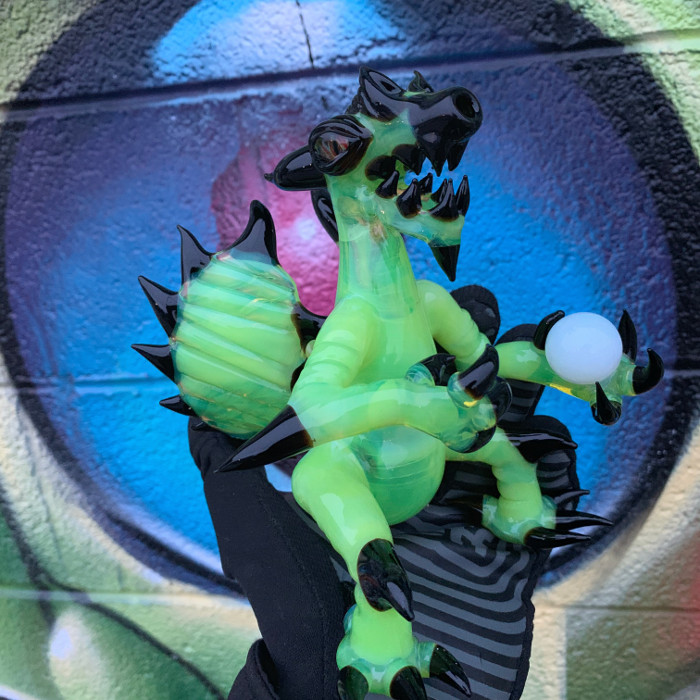
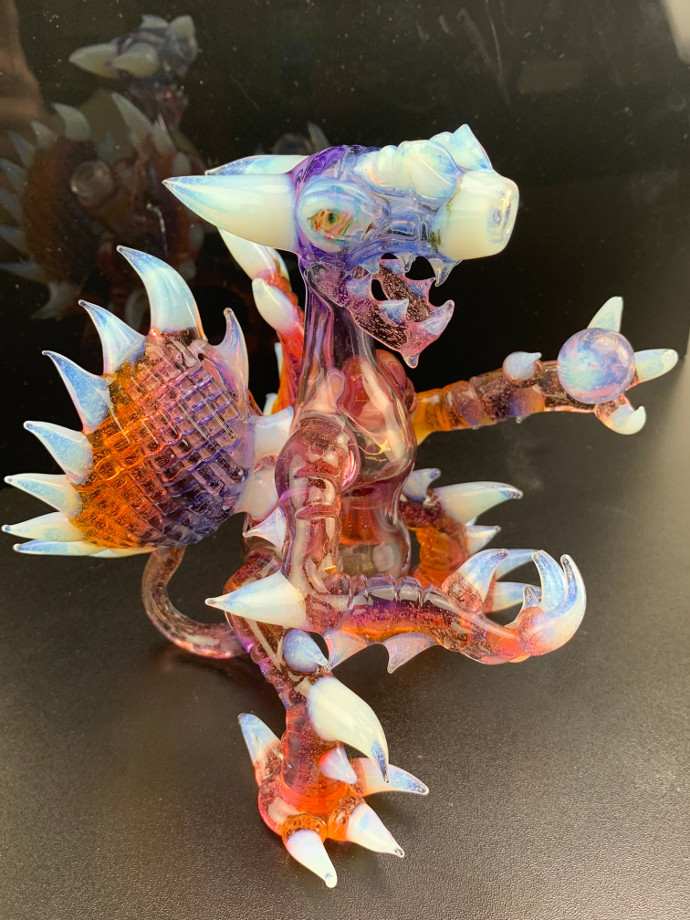
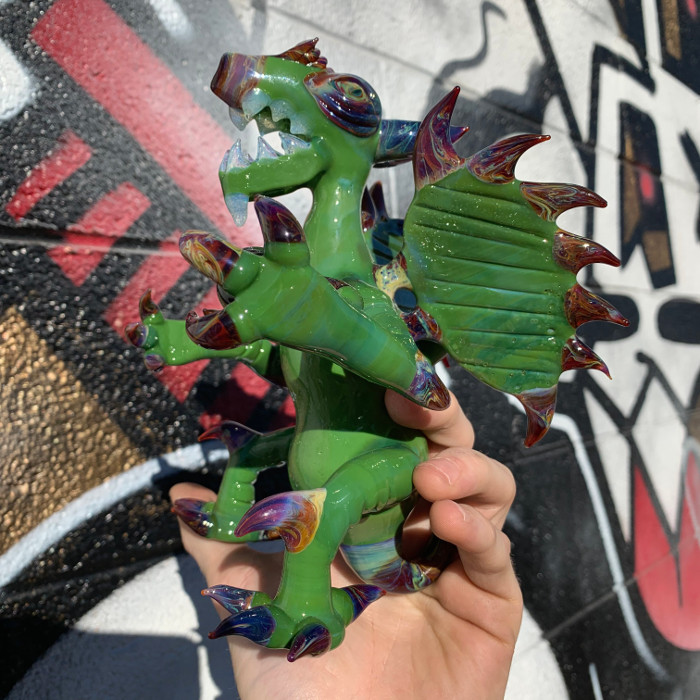
Patrick was attracted to the artistic freedom and challenge that go hand-in-hand with glass blowing. Oil rigs in the form of dragons have become Patrick’s signature, as are the nightmarish pieces based on Venom and Carnage, his supervillian symbiote foe.

“As a kid I was into comic books and Venom was one of my favorite characters. There’s something really fascinating about the story of Venom being a symbiotic alien creature,” Patrick says.

“I really pushed myself in creating the Venom piece,” he adds. “It turned into an eight week process where I kept telling myself that I could do more.”
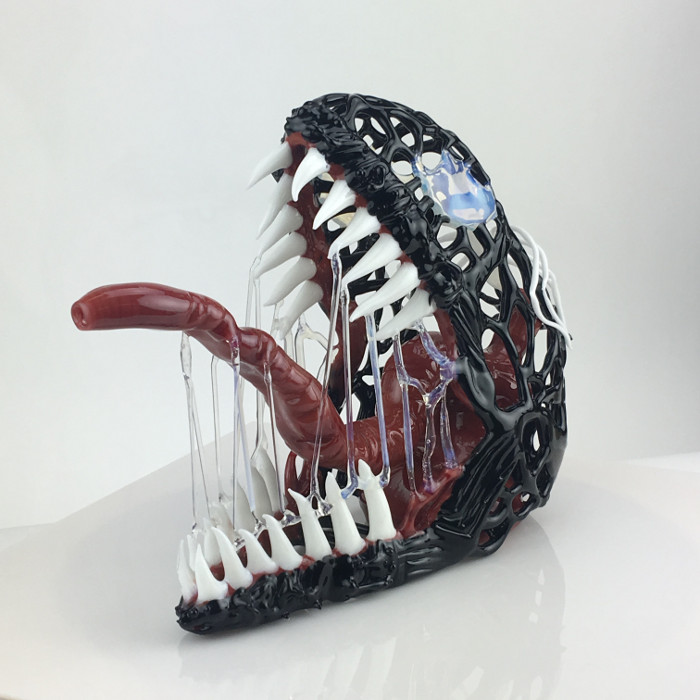
It was time well spent. When Patrick posted the finished piece to social media, the terrifyingly realistic snarling Venom complete with fangs, glorious, disgusting tongue and plenty of slime (clear glass stringers), drew a million views in an hour.

Patrick’s ideas, like his inspirations, are always evolving. One of his latest projects involves fusing live bonsai trees with glass art, training the plants to grow in and around the pipe.

“I’ve always been into the functional glass, but I’ve always been able to see the artistic value in it,” Patrick says. “Right now, I’m all about the cannabis community — there’s a lot of benefits to it. I’ve met some people who are really cool, are very open and inspire me to push myself and do better and better work.”

Patrick Beck – Denver, Colorado
@boss_glass
Recent Articles

Dr. Macias first fell in love with science while studying at Howard University, where she completed her undergraduate studies and later earned her PhD in cellular and molecular biology. While at Howard, she became especially interested in cancer research due to personal ties. Growing up in a Creole family and predominantly Black community in Louisiana, Dr. Macias watched many women around her battle breast cancer, so at Howard, she decided to focus her research on the BRCA1 gene.
It’s almost amazing that the same institutions that brought us the 2008 financial crisis have a problem with selling glass pipes. Almost. The truth is that an industry's past sins are only held against it when the money isn’t right. Big banks were willing to risk cratering the U.S. housing market because the profits were too good to ignore. But the cannabis industry rolls a different kind of paper, so instead of a slap on the wrist, it gets a surcharge.
Smokeshop and counterculture enthusiasts enjoy discovery as part of the experience. Customers enjoy browsing. When they walk into a shop, they don't simply grab a product and leave. They look for something new. This is the main reason flyers and posters still work. Smokeshops and dispensaries are highly visual environments. You want to see bold artwork, psychedelic graphics, and street-style posters that naturally capture attention.
The use of cannabis in professional sports has always been a controversial subject. While some are firm believers that all substances should be banned from professional sports altogether, most people aren’t thinking about cannabis when they’re discussing performance-enhancing drugs (PEDs). In fact, there have been countless cannabis users in the world of professional sports throughout the years; some of whom are more open about their love for the plant than others.
North Carolina might save us all. A new state bill may be the industry’s best option to save itself from demise when new federal cannabinoid bans take effect in November. And it could use your support.
Hemp is often considered for the things that it is not. It is not intoxicating, it is not illegal, and it is not marijuana. However, now we are seeing a focus back to what it can be. The plant is moving into the level of wine and chocolate and becoming a movement and a culture.
It’s been several months since President Donald Trump signed an executive order to reschedule cannabis from Schedule I to Schedule III within the Controlled Substances Act (CSA). On paper, the recent executive order, entitled “Increasing Medical Marijuana and Cannabidiol Research,” is a huge step in the right direction for cannabis smokers across the country.
For years, we’ve been told that this industry is the Wild West: a place where the only law amounts to whatever the guy with the gun says. But over the last 12 months, state governments have passed a spate of new regulations that promise to swap the relative lawlessness of poor enforcement of vague rules with real law and order.