Knowing the difference between margins and markups could make or break your business. While the two terms are easily confused, they mean completely different things.
They can help you set product prices that customers will be willing to pay. They also make it easy to gauge your business’ profitability. However, just like most accounting terms, it’s easy to struggle to understand the meaning of both terms beyond accounting jargon.
If you’re looking for a breakdown of what the two mean in digestible terms, you’ve come to the right place. We’ve also included examples on how to calculate a smoke shop’s retail markups and margins to drive the point home:
Noteworthy Terms
Before we dive deep into the difference between markups and margins, here are some essential terms to take note of:
- Revenue: This is the income you get after selling your products or services.
- Cost of Goods Sold (COGS): This is the cost of producing your goods or services. It represents the cost of the product itself if you’re a retailer that’s buying from a wholesaler. If you’re a manufacturer or producer, it will include the costs of raw materials and electricity used during production. The cost of anything you use to directly produce your product or service is included here.
- Gross profit: This is the amount of cash your business keeps after subtracting your direct cost of goods sold from your total revenue.
We’ll use these terms while calculating markups and margins, though at different points.
What Are Retail Margins?
Margins are a percentage representation of your gross profits. They represent whatever your business makes after subtracting the COGS from your revenue.
The formula for calculating retail margins is as follows:
Retail margin = (Revenue – COGS)/revenue * 100%
OR
Retail margin = Gross profit/revenue * 100%
Example of a Retail Margin for a Vape Shop
Let’s say that your vape shop buys a vape pen at a wholesale price of $10 (COGS). You then sell the same vape pen to customers at $15 (revenue). Your retail margin will be:
Retail margin = (15 – 10)/15*100%=33.33%
You’ll have a retail margin of 33.33%, which is a healthy profit margin.
What Are Retail Markups?
Markups are a percentage representation of the amount you charge your client on top of your cost of goods sold. The more your markup is, the higher the revenue you keep after selling your vape pen.
Calculate your retail markups using either of these formulas:
Retail markup = (revenue – COGS)/COGS * 100%
OR
Retail markup = Gross profit/COGS * 100%
Example of Retail Markup for a Vape Shop
Let’s refer to the example of our vape pens above. The wholesale cost of the pen (COGS) is $10, while our revenue is $15. Here’s how we’ll calculate our retail markup:
Retail markup = (15 – 10)/10*100%= 50%
Our retail markup is 50%, meaning that we increased the price of the goods by 50% in comparison to the wholesale price.
The Difference Between Markups and Margins
Both our retail markups and margins refer to the same dollar amount, which is our gross profit. In the case of our vape shop, they refer to the $5 gross profit we’re making from each vape pen.
The difference comes when the figures are converted into percentages. Margins refer to the percentage profit we’re making in relation to our revenue ($15). Markups refer to the percentage profit we’re making in relation to our COGS ($10).
Using the two terms interchangeably is wrong. It could also affect your bottom line as you could choose a product price that’s not representative of your ideal price or the market prices.
For instance, in the case of our vape shop, if you told your sales team that you’re looking for a markup of 33.33% instead of the 50% in our example, you’ll be selling your product cheaper.
If you tell them that you’re looking for a margin of 50% instead of the 33.33% in our example, your vape pens might be so expensive that you’ll push away most customers.
Why Retail Markups and Margins Matter
Retail markups are very useful for setting product pricing policies. You can choose your ideal markup percentage and sell all vape pens using it.
However, while you might have your ideal retail markup in mind, you need to focus on your product’s demand and the prices of the competition. This consideration ensures that you’re not setting the prices too high or too low.
Creating suitable product pricing policies also ensures that your business can pay costs like salaries and energy bills without incurring a loss.
Retail margins and profit margins help determine how financially healthy your business is. It also helps you decide whether to keep selling a product that’s not bringing in the expected profits.
By assessing your profit margins, you can determine whether you need to reduce production costs, source your goods from a different supplier, or even adjust your product prices. The trick is to set profit margins that will help keep your business running and customers happy.
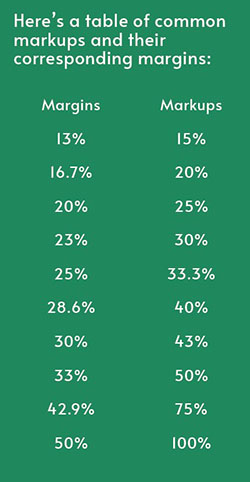
Margin to Markup Conversion Formulas and Vice Versa
If you’d like to know the markup that corresponds to a specific margin and vice versa, there are formulas for that. This will come in handy when you know the markup you want but would love to know what it means in terms of profits.
The good thing is that markups and margins correspond to each other in a predictable manner. Markups are always higher than margins.
Since you could have a unique markup, here’s the formula for converting markups to margins:
Margin = [Markup / (1 + Markup)] * 100
If you have a 60% markup, you’ll calculate its corresponding margin as follows:
Margin = [0.60 / (1 + 0.60)] X 100
Margin = 37.5%
If you want to convert margins to markups, use this formula:
Markup = [Margin / (1 – Margin)] * 100
In case you’re targeting a 35% margin, you can calculate your markup as follows:
Markup = [0.35 / (1 – 0.35)] X 100
Markup = 54%
Ensure Your Workforce Knows the Difference Between Markups and Margins
The close similarities between markups and margins make it easy to confuse them both. Unfortunately, communicating the wrong figure could result in you losing money or pricing your products too high. Take time educating your workforce on the difference between the two to ensure you’re on the same page.
If you need insights on running your retail store profitably, subscribe to HQ Magazine. We arm retailers with information that’ll take their business to the next level financially, from helping you choose the best tech stack for business automation to guiding them on optimal price points for your products.