Good morning, class. Please take your seats and get your papers out. Everyone situated? Good. Now, use those papers to roll yourself something nice. We’ll be talking to Dawn from Higher Education today. Pay attention and you’ll learn a thing or two. After all, she’s from Higher Education.
That’s not just a clever name. Well, it’s certainly clever, yes, especially since her primary location is in downtown Charlottesville, right next to the University of Virginia campus. But there’s another layer to it. You see, long before she was dressing up as a giant bo—err—water pipe and recording hip hop parodies to sling various accoutrements of 420 culture, she was a college philosophy professor.
So how did she end up running a smoke shop? Good question. Thank you for asking. Basically, It took an act of God. But when we say that, we’re not alluding to a burning bush experience. We’re using the phrase the way an insurance agent would use it.
“There was a huge flood in Colorado,” she explains. “It just so happens that my department was in the basement of the building . . . so, here I was, trying to finish my research with no library . . . none of my own notes, nothing. Everything was destroyed.” Suffice it to say, the situation dampened her drive to finish (pun intended).
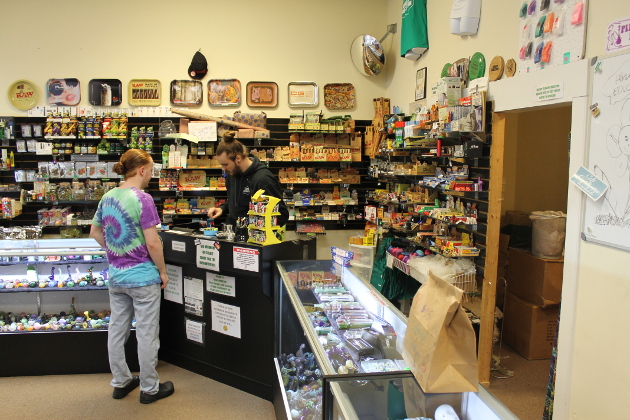
Meanwhile, to pass the time, she took a job at a local hippie shop called Campus Gifts. Very quickly, two things became very apparent. The first thing was that she had a knack for the business. The second was that her boss did not, and by the end of that summer, she was already negotiating a deal to buy him out. Yes, I see you raising your hand. You’re confused because we said her shop’s in Virginia, but we’re talking about Colorado.
It’s complicated, but here’s the simplified version: After 12 years running a shop in Fort Collins, Colorado, Dawn decided she needed a change of scenery, as well as some time to focus on her children. Her business had been successful enough to allow her some time off, so she took it, and with her two kids in tow, took off to rural Virginia.
“For six years, I did nothing but be a mommy and play scout leader,” she recounts fondly. “It was six years of raising chickens, pigs and goats—and hanging out with children.” But kids have an uncanny ability to grow up, and eventually, they did exactly that, leaving her the time to pursue her own interests again. Getting back into the head shop business was a no-brainer.
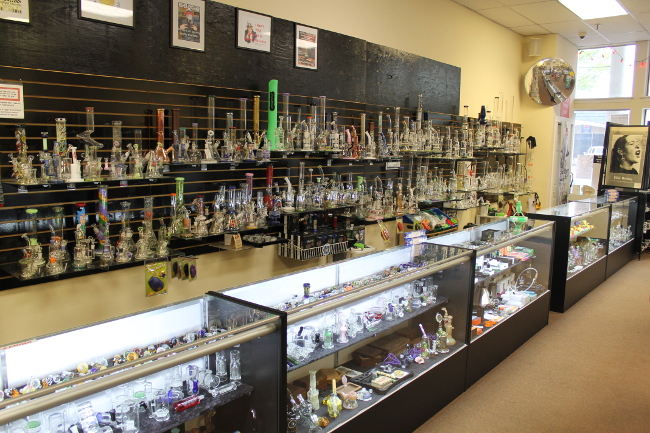
“Why did I come back?” she asks rhetorically, echoing the question that was no doubt, in your head. “I love the glass . . . I really, really love the artistry . . . I get to see the most beautiful pieces of art and talk to some of the most amazing artists that are never going to be seen or found in this world because of the type of the art they’ve chosen.” She really does love the glass. So much so, in fact, that she maintains a policy that requires her store to be stocked with a minimum of 420 glass water pipes at any given time.
“And when I say there are 420 tubes on the wall,” she adds, “they’re not allowed to look the same . . . They’re all different. We don’t soldier.” That mindset goes far beyond the glass. Whatever the category of accessory, it’s all about the variety.
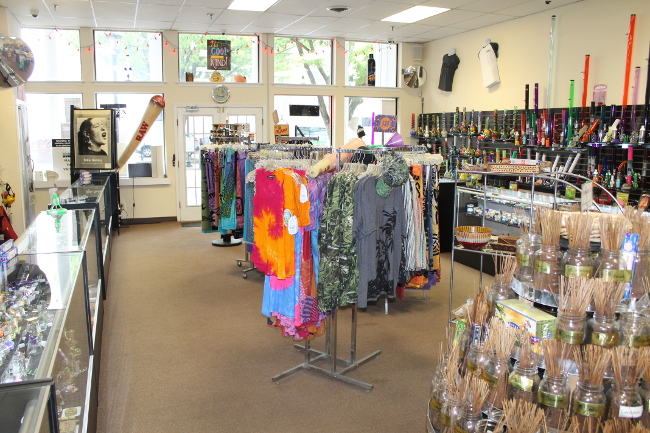
“You go to a lot of smoke shops and they’ll have a certain specialty. Maybe it’s glass. Maybe it’s specifically headies. Maybe they specialize in inexpensive stuff. Maybe they’re all about their papers. We don’t do that. We attempt to have the best selection of everything. Even our rolling papers take up two sections of a wall.”
When it comes to customer experience, though, selection is only half of the equation. Her employees, whom she describes as “phenomenal,” are the far more important variable. “I love them,” she gushes. “I really do. I wouldn’t be where I am without every single one of them.”
But while the ‘wow’ factor of the selection, combined with her highly educated staff keeps people coming back, it’s her advertising that gets them in the door in the first place. She leaves no medium untouched, saturating the town in flyers, billboards, radio ads, promotional products and of course, social media posts—though in her opinion, the latter are somewhat of an afterthought, comparatively.
“Though I do understand that everyone’s into digital marketing . . . Nobody has ever come into my store and said ‘I love your Pinterest page,’ or ‘I love your Instagram,’ but people come in all the time and tell me they love my radio ads.”
Of course, they do. Who wouldn’t love a 420-themed parody of “Ice, Ice Baby” or “Rapper’s Delight”? The best part: She performs a lot of them herself. She’s that dedicated.
That concludes today’s session. Be sure and pick up the updated syllabus on your way out, and remember, all of this will be on the final exam.