It’s the post-industrial age. We have supercomputers that fit in our pockets. Sex robots are imminent. So why are we still grinding our herb by hand?
It’s a good question, but if you’ve ever tried using your coffee grinder to bust up your herbage, you already know the answer. All that resin gums up the blades like something fierce. Besides, coffee grinders are for beans, not buds. They lack the proper finesse. We would need to reimagine the concept entirely.
 Done and done, thanks to the new release from G&E Innovations. It’s called the Wakit and it’s a rechargeable electric herb grinder that uses a ball and chain system instead of blades or teeth, allowing you to parse your bud to the perfect fluff. More than just grinding, the chain miraculously shaves the herb while leaving the stems intact for easy separation. No more smoking sticks.
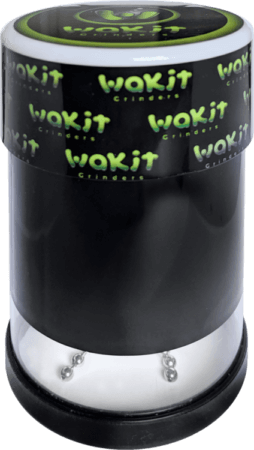 To use, simply place a nickel-sized bud on a tray, remove the Wakit’s bottom lid, and press it down over the herb. One to two short taps will give you a good course grind. For a finer texture, tap it once more. The herb will be ready to load, stem-free.
So, in review: Buzz, buzz. Toke . . . buzz.
To use, simply place a nickel-sized bud on a tray, remove the Wakit’s bottom lid, and press it down over the herb. One to two short taps will give you a good course grind. For a finer texture, tap it once more. The herb will be ready to load, stem-free.
So, in review: Buzz, buzz. Toke . . . buzz.
Done and done, thanks to the new release from G&E Innovations. It’s called the Wakit and it’s a rechargeable electric herb grinder that uses a ball and chain system instead of blades or teeth, allowing you to parse your bud to the perfect fluff. More than just grinding, the chain miraculously shaves the herb while leaving the stems intact for easy separation. No more smoking sticks.
To use, simply place a nickel-sized bud on a tray, remove the Wakit’s bottom lid, and press it down over the herb. One to two short taps will give you a good course grind. For a finer texture, tap it once more. The herb will be ready to load, stem-free.
So, in review: Buzz, buzz. Toke . . . buzz.