Tony “Kazy” Kazimakis @tonykazyglass
Tony Kazimakis likes playing with fire.
“When I was in high school, I went to the Corning Museum and got to watch a soft glass demonstration. I was just so intrigued by how the glass moved and worked,” says Kazy. “When I saw the molten taffy-like glass and the heat, I thought, ‘This is so cool — I get to burn something and nobody’s going to yell at me.'”
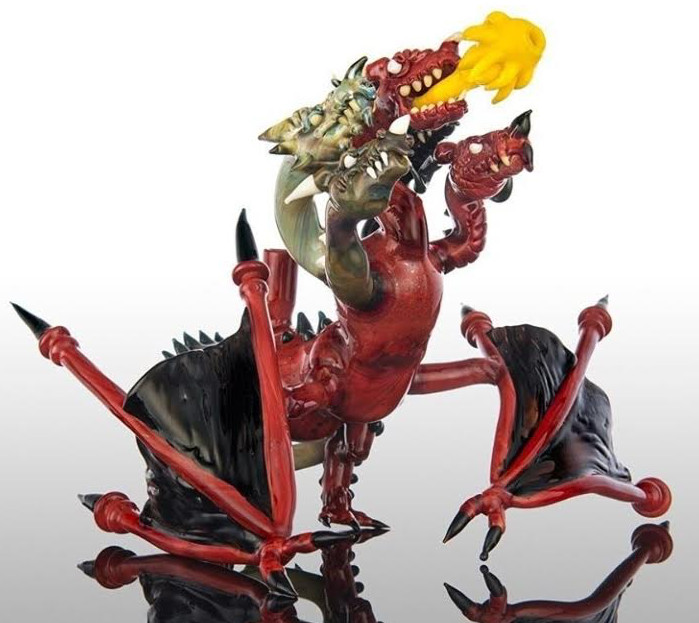
Growing up in the eighties, Kazy was big into collecting and playing with MAGIC and Pokemon cards, and dragons, lizards and dinosaurs were his favorite characters. Jurassic Park was one of the first movies he ever saw on the big screen. His inspirations found their way onto his sketch pads and eventually into his glass.
“Dragons are one of those cross-platform, multi-cultural beasts that everyone really likes,” Kazy says. “There are so many so many different avenues that you can go for functionality.”
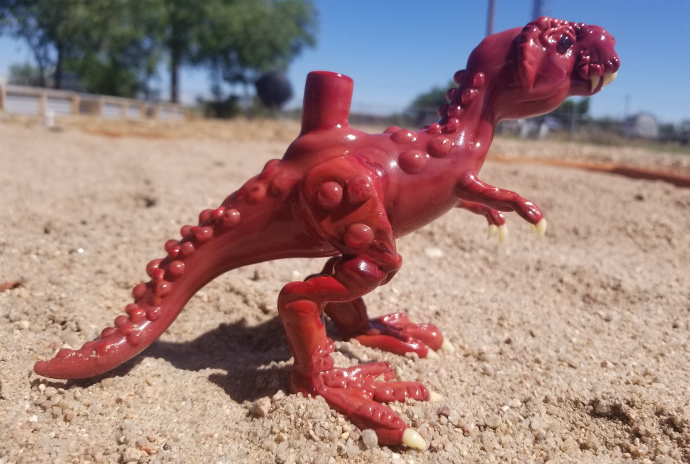
In many tales, dragons are fabled for guarding treasure. For Kazy, who’s been at the torch since th start of this decade and has his bench in Peublo, Colorado, that loot includes medals from Glass Games competitions at CHAMPS Trade Show — first and second place awards in the carb cap category at the Atlantic City show, and most recently, at the summer Vegas event, first in Mystery Collab with Eric Runes, and third in Action Figures where he brought from the flame, Jabberjaws the shark from Saturday morning cartoons.
“I’ve been very fortunate that people want me to step out of my comfort zone and create more unique pieces,” Kazy says.
One of his most atypical creations has more to do with materials than form. Inside a clear bubble atop a bomb-shaped pendant is a tiny piece of trinitite. Geologically, trinitite is fairly straightforward. When scientists detonated the first atomic test bomb—nicknamed Trinity—in New Mexico’s Jornada del Muerto desert in July of 1945, the massive explosion threw sand into the air, where it was liquified instantly by the heat of the blast. When it cooled down, it wasn’t sand anymore: it had reformed into glassy chunks.
An interesting bit of trivia is that Kazy sources the trinitite from a laboratory in Michigan operated by none other than Bob Lazar, the alien conspiracist who once worked at Area 51, the mysterious base where scientists are said to be reverse engineering tech from crashed UFOs.
Trinitite remains radioactive, but no more than your cell phone. There’s only so much trinitite available, as it’s now illegal to collect it from the blast sight, so the pieces made with it are very limited edition.
“It’s a little piece of history,” Kazy says.
As an Italian Catholic, growing up it was drilled into Kazy that the harder he worked, the more he could could achieve. That goes to dispelling the misconception of those outside the cannabis industry, that glass blowers are real artists and not all about partying and smoking pot.
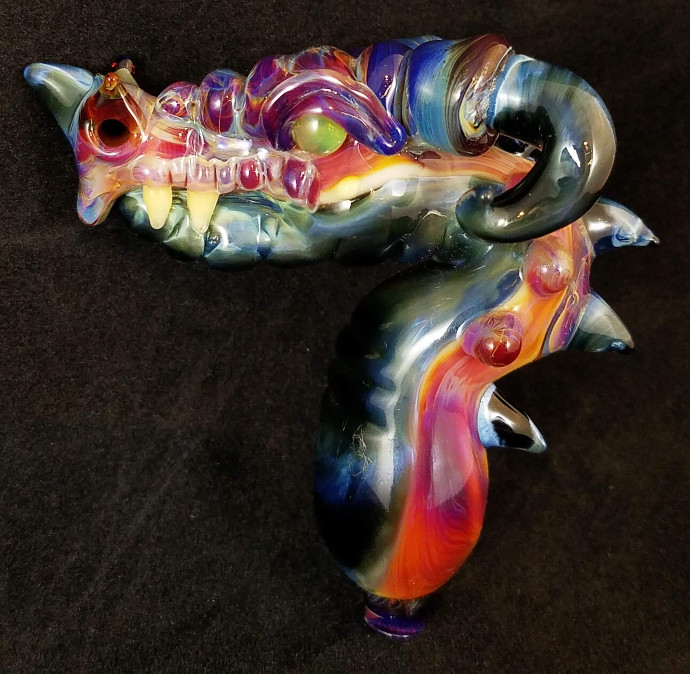
“When I started, and told people that I made pipes and functional glass pieces, they looked at me like I was an alien. I remember one time I called my mom to tell her one of my pieces had been featured in a magazine, but when I told her it was a bong, she hung up on me. Over the last five years, there’s been an explosion in the acceptance of what we as glass artist can do,” Kazy says.
As the market has grown, Kazy has seen the heady statement pieces becoming more popular with retailers and glass fans alike. “Glass is becoming the fancy sports car for the new generation, and people want to show it off,” he says.
“Glass needs to be on display, but people need to connect with it,” he adds. “Smoke shops need to have a higher standard in the glass they carry so that we can keep growing as a community. The more we push that we are artists verses just production pipe makers, the more we’ll be able to express ourselves and do bigger things.”