

Quality Counts and Here’s Why

Can the profit margin on “cheap” products be higher than when you sell something of quality at a higher price point? Sure — at least when you first do the math. But when you look at the entire equation, quality always equals more sales and better customer relations.

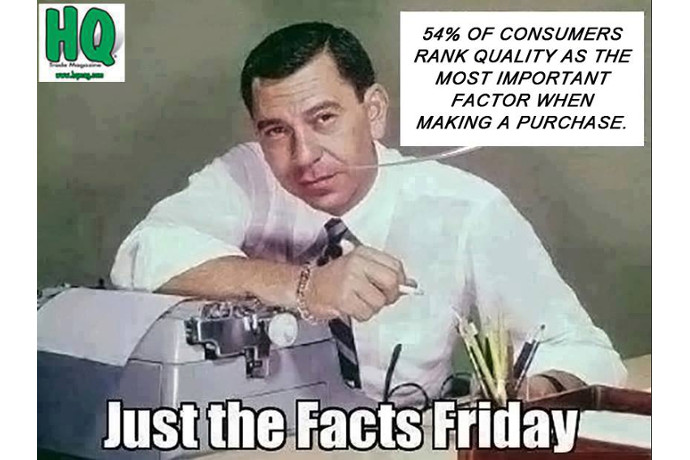
According to a recent customer expectations report by First Insight, 54 percent of consumers rate quality as the most important factor when making purchases.

More than half of Baby Boomers, Millennials and Generation Xers choose quality over price. Similarly, while 62 percent of affluent respondents (who make more than $100,000 per year) ranked quality as the most important, compared to 49 percent of those that made less, it was still significantly more important than price with both groups. 

Another retailer survey showed that 47 percent products were returned for not matching customer expectations. If you’re selling poor quality products or knock-off at a higher price point, you might manage to ‘fool’ your customers into buying, but it won’t take long before quality (or lack thereof) catch up with you. First, your return rate is going to increase, and before long, people begin to connect your business with poor quality products, nobody will be willing to buy from you.

One dimension of quality is how a product looks, feels, tastes or smells. In a market crowded with similar products, features, and even colors, make all the difference. Customers notice these kind of details, and they can make or break a sale. There are so many options out there these days that unique attributes and designs have a big impact on purchasing decisions.

Ultimately, quality is what a product can do for a customer, how well the product does what it’s supposed to do, and how well it holds up over time. Good products result in good reviews. Friends and family want to know if someone they trust had a good experience with a product or business. The higher quality product you have to offer, the better chance you’ll have at generating positive reviews and recommendations, and repeat customers.


Recent Articles

Even without the representation and recognition they deserve, women have always been at the center of the cannabis movement.
There are objects Americans buy because they need them, and objects Americans buy because they let them be a certain kind of person. A perfectly functional version exists, usually for a fraction of the price. But the other version comes with a name, a story, and a reason to pay extra.
Walk into any warehouse rave, desert gathering, or rooftop after-hours in 2026, and you’ll feel it: the psychedelic underground is back, louder, weirder, and far more self-aware than its ‘60s predecessor ever imagined.
In 62 BC, Julius Caesar announced his plan to divorce his second wife, Pompeia. She had been involved in an ancient Roman sex scandal, accused of flirting with another man during a women-only religious event.
ile Mike Wittenberg sat in a Dominican Republic prison, a thought occurred to him. “I could appreciate flushing the toilet,” he said. “When you’re in a third-world jail without running water 23.5 hours a day, you learn to appreciate the little things.”
When it comes to marketing, cannabis is different from every other consumer good available today. If sales start to dip in traditional retail, you can simply increase ad spending. However, with companies like Google, Meta, and even traditional broadcasters placing strict bans or severe limitations on cannabis advertising, the standard “pay-to-play” system just doesn’t work.
It feels impossible sometimes to escape the more ridiculousness aspects of pop culture—like pickleball, whatever a Labubu is, and the inevitable media frenzy surrounding Taylor Swift and Travis Kelce's upcoming wedding. Thankfully, there’s at least one trend that’s still on the rise that I can get behind, which is kratom.
When Adelia Carrillo (Fakhri) and Parisa Rad first sat down for brunch in Phoenix, AZ, with a few other women in the cannabis industry, they had no idea how that moment would change the trajectory of their lives. “The energy in that room was transformative,” Adelia says.








