

RANDY’S
Each smoke shop is different with a unique customer demographic, but there are still essentials that every store needs to carry. Rolling papers are one, glass cleaner is another. Since 1975, Randy’s has been supplying those products and more to retailers serving the cannabis and alternative culture communities.
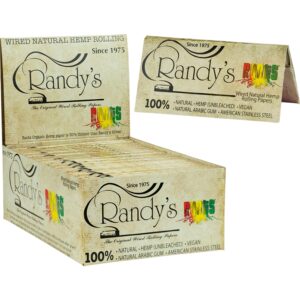
Back in the day, if you rolled a joint, it’s likely you did so with the help of Randy’s Wired Rolling Papers. It was a pioneering invention for smokers, not so much the paper itself, but the thin, stainless steel wire built into the premium papers that not only helps with an even roll, but more importantly, after about three or four hits, the wire becomes a handy little handle for the last few draws.
Randy’s Classic, made with a blend of flax and tree pulp, are still a cornerstone of the company’s success. They’ve since added a natural unbleached hemp version of the wired papers known as Randy’s Roots.
If you’re curious, the name Randy’s pays homage to the partner of the founder of the company and inventor of the wired rolling papers. Brian, who previously worked with Glow Industries, has owned Randy’s since 2008. He knew a good thing when he saw it and set out to expand the catalog with innovative smoking accessories.
“I’m a little ADHD, so I like a lot of different things going on,” Brian says. “Especially coming from a wholesale distributor background, having lots more options than just one product seemed the way to go.”
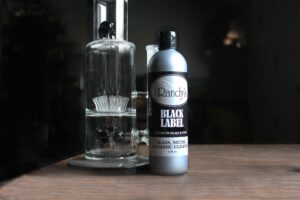
The first idea was to make handheld rolling machines, which made perfect sense to go with rolling papers. Then bristle and soft pipe cleaners, a smoke shop staple for cleaning smoking utensils. But even the best swab doesn’t remove every bit of resin, so Brian and his team came up with an aggressive cleaning solution — Black Label, which became one of the most popular liquid cleaners on the market. It has proven so effective that it is officially endorsed by Illadelph who will often times send out samples with their bongs and scientific glass pieces.
“We came up with a great formula that was unmatched by anything else that we’d ever tried. People develop a very personal connection with the glass they own, and the great thing about Black Label is that it makes those pieces like new again,” Brian says. “Other cleaners out there leave a floral or orange scent, but Black Label is odorless; in fact, after you rinse it off, your glass smells brand new.”
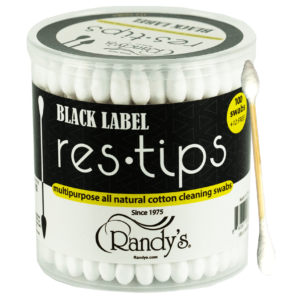
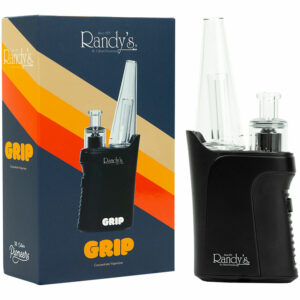
Black Label worked so well on glass, metal, and ceramic surfaces that Randy’s soon turned their attention to helping vape users maintain their devices such as Randy’s Grip, a compact e-rig, the Path, and the Path, a rechargeable electronic nectar collector. Made specifically for safely cleaning delicate electronics, Black Label Swipes are individually wrapped cotton swabs pre-soaked in alcohol and the perfect size for swabbing hard to reach chambers.
“How we look at where we’re going to go next into the market, really goes back to our roots,” Brian says. “We listen closely to our distributors and customers about what improvements or other products they would like to see, and we develop solutions that take care of those needs.”
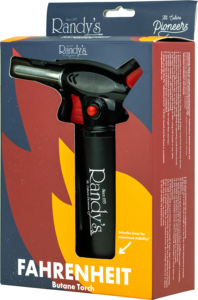
A perfect example is Randy’s recently released line of Fahrenheit torches which were a response to concentrate enthusiasts looking for a practical way to do hands-free blazing.
“There’s a ton of torches on the market and there’s a lot of them that are great, and there’s some that aren’t so great. We wanted to come out with a quality torch at an affordable price,” Brian says. “We like to say that we’re one degree better than the competition.”
In actuality, Randy’s new butane-fueled torch has a powerful flame that reaches 2,372 degrees Fahrenheit. It’s also designed be super ergonomic with an adjustable knob for precise control, a switch to lock the flame on for constant use, and a base for extra stability. Randy’s is so confident in the quality, durability, and functionality of the Fahrenheit torch that they back it with a one-year warranty.
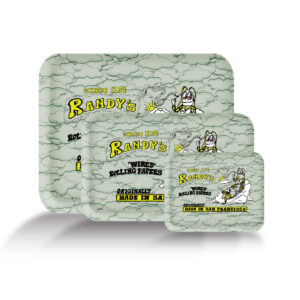
Building on their long-established and trusted band name, Randy’s also sells grinders, pre-packaged brass and steel screens, hemp storage pouches, stash containers, wooden dugouts, smoke filters, and rolling trays with vintage artwork.
“The name of the game,” Brian says, “is having products that create repeat business because they’re in demand.”
Randy’s proclivity for innovation extends to customer service, streamling their sales process and creating dynamic ways to connect with buyers. Randy’s new business cards have a QR code that give buyers a quick and easy way to contact sales reps and set up meetings. And they’re about to step into the metaverse with a virtual trade show booth equipped with multiple cameras so that reps can demonstrate products and educate customers on their selling features.
“There’s nothing like a real trade show, but these days many people are either too busy to attend or are concerned about health and safety issues, so being able to meet virtually in a seamless and safe environment is a necessary turn for the future,” Brian says.
“We’re all in this together. As long as Randy’s is a part of the community, our plan it to keep that personal level of involvement and grassroots vibe,” Brian continues. “We’ve got a lot of long term customers and we get approached every day by people reaching out to us because of our reputation. We make a point to take care of distributors and retailers, treat them with respect, and ensure that we have relevant products that will drive sales and increase their competitive edge.”