Tasty Puff’s Erin Kay Overcomes the Unthinkable
Erin Kay, co-founder of Tasty Puff, knows all too well that the road to business success is a wild ride of highs and lows that relentlessly test one’s mettle—and truthfully, she wouldn’t have it any other way. Challenge triggers growth, and growth undergirds continued success. And at the end of the day, it’s just business. But real life is another thing entirely, with stakes that are ineffably higher. And when the rug is pulled out from under both at once, all bets are off.
This brutal truth hit home for Erin when life dealt her the harshest blow—losing her husband, Roger, her life and business partner. In 2021, Roger was unexpectedly taken by complications from Covid-19. Erin was left alone, steering her business through the murky waters of a post-pandemic economy while wrestling with her profound loss.
Erin met Roger at a keg party. It was young love; she was 17—he was 19. Within a few years, they were tying the knot. At that point in her life, Erin was a student at the University of New Mexico, studying psychology and criminology. “My goal was to become a therapist,” she reveals. “The ‘deviant’ side of things always interested me.”

Though still carving out its path towards broader social acceptance, the cannabis industry enthralled Erin. She viewed it as a remarkably “awesome” sphere that promised more health benefits than harm. Roger, a successful operator of a smoke shop chain in Albuquerque, New Mexico, and co-publisher of HQ magazine, echoed her interest. He observed a lack of excitement in the traditional smoking experience with plain rolling papers and pondered aloud, “What if we could invigorate a rolled joint with flavored drops?” Seizing the initiative, Erin made their vision a reality, culminating in the inception of Tasty Puff.
As their journey continued, Roger’s involvement with the brand intensified, and together they amplified Tasty Puff’s product range. Erin looks back on those early days with warm nostalgia. “Whenever we tried something new, it was like, ‘Wow, that’s amazing!’” she recalls. “It was so satisfying to receive such positive reactions.” From the outset, the fusion of Erin’s tenacity and Roger’s industry insight crafted the foundation of Tasty Puff’s success.
But tragedy struck on January 11, 2021, when Erin received an urgent call from the hospital. Roger, who had waged a nearly month-long fight for survival against Covid-19, took his last breath. Engulfed by sorrow, Erin was left with the looming task of single-handedly raising their two children, on top of managing a business. But amidst the uncertainty of heartbreak and loss, two convictions stood firm. The first was obvious—and that was her devotion to family. The second: Tasty Puff would endure. Roger had crafted an enduring legacy within the smoke shop industry while helping multiple others along the way, including his sister-in-law, Annie of Organabus. The pride their family and staff took in the brand he and Erin had built was immeasurable. Erin knew the mission must endure.
“It took me a long time to get back the creative spark and the motivation,” Erin admits. “It was like trying to figure out how to keep going forward with this hole in your chest. But, honestly, everyone at Tasty Puff feels Roger’s presence; he was, and still is, a larger-than-life inspiration.”
Stepping up to sustain the Tasty Puff heritage, Erin has taken the reins, focusing on business growth and the development of innovative offerings. Among them are the new king-size flavored Tasty Palm cones, as well as a range of additions to their line of silicone pipes. These developments not only excite retailers and their customers but also ignite a sense of enthusiasm among the Tasty Puff employees. Erin shares, “Tasty Puff is a really cool company that’s taken on a life of its own. I swear you could put the name Tasty Puff on anything, and it would be a hit. We’ve been around a long time, and people recognize the name and love it. It’s a brand that represents the fun side of how people smoke.”
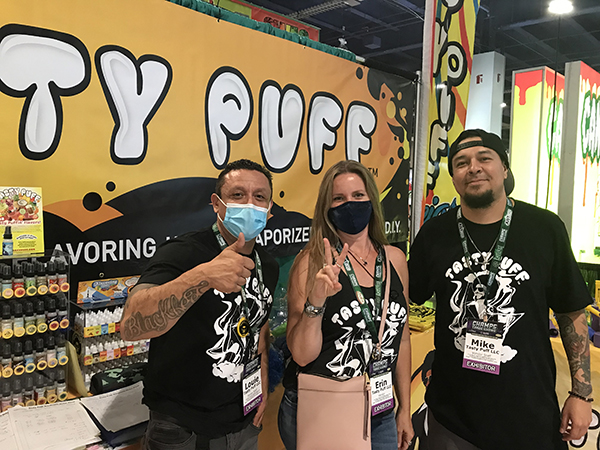
Despite the vibrant and exhilarating atmosphere of the cannabis and smoke shop industries, Erin is keenly aware of the hurdles that accompany her involvement, particularly as a woman and a mother in these fields.
“Sometimes I feel super judged,” she admits. “When I visit my kids’ school, parents and teachers will ask what I do for a living, and when I tell them I make smoking accessories, some of them are super cool and ask questions about it, and others turn and walk away.
“There’s always going to be somebody who doesn’t like you or what you represent. To each their own, I guess; you have to shrug it off, hold your head up, go to work, and keep pushing forward. I know that I’m a good person, a good mom, and a good businessperson.”
The social stigmas yet linger, but the internal tensions can take their toll as well, especially for someone who has been in the space longer than some of the players have been alive.
“I don’t want to sound like an old lady,” remarks Erin, who is now nearing the half-century mark at 49, “but I feel like [cannabis and smoke shop industries] are a young person’s business. Still, though, every day, I’m still dealing with the lasting effects of Operation Pipe Dream, 20 years ago when the feds came in and arrested so many of my friends and colleagues and put them in prison just for selling pipes. Even though the industry has opened up and become so mainstream, there’s so much regulation everywhere that it still feels like we’re dancing on the edge.”
Erin Kay’s story serves as an inspiration to persevere even in the face of immense loss. Her dedication to the success of Tasty Puff is a testament to the resilience and passion essential to navigating the unpredictable nature of the entrepreneurial journey.