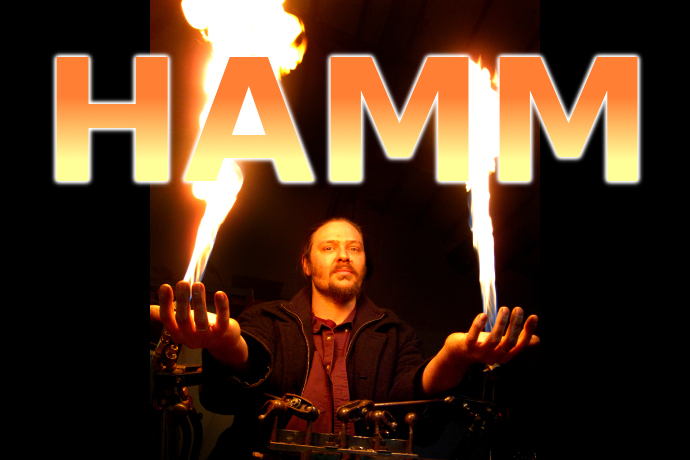
Hamm

PHOTO ATTRIBUTION: Encalmo Windowpane Set, photo credit to Wind Home – Gun and Retticello, photo credit to AReySocal – All other photos by Ariel Schulze – All pieces by Hamm Vitrifex. The 3 photos with mushroom, fern and tree sandblasted imagery are a collaboration Hamm x Ariel
 

Hamm – Eugene, Oregon
waterworksglass.com

The common recycler wasn’t always so common. Like every type of pipe, it had to be invented, and the glass artist that earns credit for that goes by simply the name of Hamm.

“I was trying to make this sculptural piece of kind that had a story theme and needed a couple of characters that needed to be distracted by something ‘bong powered’ that I could build into the piece,” says Hamm, who’s early childhood fascination with glass marbles and bottles, led him to start blowing glass and creating functional pieces more than 20 years ago. “My thought was ‘old school coffee pot percolator’, so I figured out how to make water splash into a bowl. Then I had to figure out a way to get all of that water out of the air stream — it turned out I made the best drip catch ever that even when it caught too much water it was able to cycle back into the system.”

It worked flawlessly. Instead of the water staying in the base, or just bubbling through a percolator, in a recycler, it travels from the base into a second chamber near the mouthpiece. As the vapor releases from the water, the water falls back down into the base to be “recycled” for the next hit.
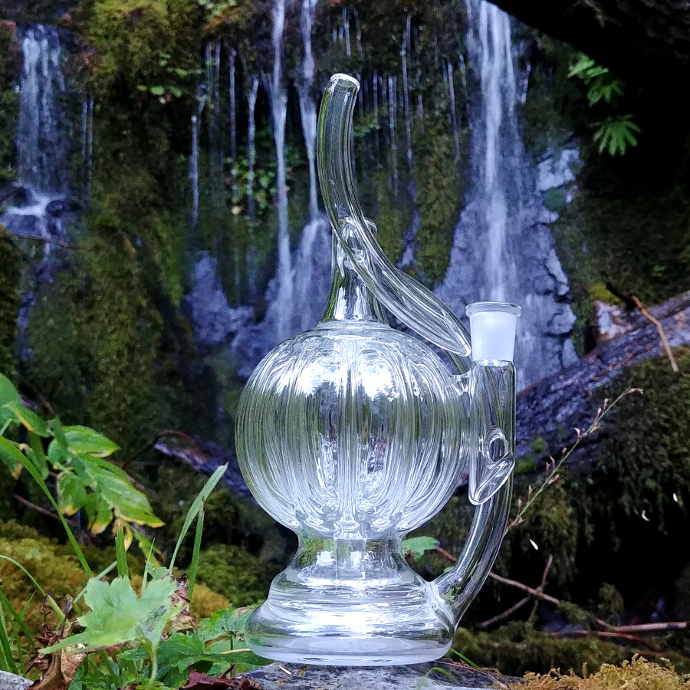
Hamm originally dubbed his creation the “Hurricane Perc.” Some smoke shops sold them as “Hamm Scientific,” and from somewhere in the recesses of the internet, glass fans started referring to them as “Recyclers.”

As they say, if only he had a nickel for every one that’s ever been made (or knocked off). Same goes for another of his inventions, the G-Bubb — a bubbling gravity bong. So innovative was this diffuser that it won the silver medal at the Cannabis Cup in Amsterdam completely on the merit of write-in votes.

In the last few years, Hamm has turned his creative brain to reimagining basic forms and shapes, like cubes, spheres, cones and triangles, as clear glass water pipes. He’s also reinvented the standard spoon and bong by turning them outside-in.

It’s no wonder, Hamm, who learned to make pipes by melting test tubes with a welding torch, is often tagged as a mad scientist. He’s also legendary for making an eleven-foot tall glass rocking chair — claimed to be the largest piece of lamp-worked glass in history, and then shattering it into a million shards by driving his suburban through it at 69 miles per hour. He recently completed a massive clear glass dining table, the creation of which required construction of a giant homemade kiln and a five-foot long torch with 31 jets that drinks a gallon of propane per minute and throws out a ten-foot flame.

“Life as a glass blower has given me reason to stick my feet in a lot of other trades like welding and carpentry,” Hamm says. “I came into this industry as a novice kid with no real skills, but I love to make and invent shit.”

Since the very early days, when Hamm was focused on small sculptural hand pipes and bubblers, he’s covered a lot of territory in pipeland, pioneering a number of the techniques have become fundamental to the craft; styles like ribbon builds, chip stacks and back stacks. A lot of the skills and methods Hamm has learned or developed, he gladly shares with others eager to learn the how and whys of blowing glass.

“I want this world to be full of beautiful glass,” he says. “It feels good to be able to facilitate that by passing down some tricks and some knowledge to people and helping to bring the community closer together.”

Hamm – Eugene, Oregon
waterworksglass.com

Recent Articles

I went home and told my girlfriend, who, after Googling the name of the business I bought it from, told me that, yes, it was technically weed. But it was CBD. She started laughing, telling me I had been ripped off.
State-sanctioned medical and recreational cannabis programs benefit the average user in many ways. Still, they remain a double-edged sword for dispensary owners, greenhouse growers, and others who earn their living from the cannabis industry. There are plenty of profits to be had, sure, but how exactly are you expected to secure your cash or process electronic transactions when banks refuse to work with you?
Aubrey Amatelli wants to help dispensaries and cannabis retailers navigate one of the toughest parts of the industry: money. When the company she worked for right out of grad school was acquired by JPMorgan, Aubrey entered the complex world of payments and has stayed there for her entire career.
There’s a paradox to business conferences. The best ones manage to swing from buttoned down to wildly unscripted—sometimes seconds apart. For attendees, it’s the combination of personal connections and professional development that makes regular trips to conferences worthwhile. And in an industry like this one, pulling that off is harder than it looks.
Your shop is not only a smoke shop; It's also a hangout spot and a community hub. It is a place where the regulars know your staff by name, and your staff knows what the regulars need. That's the secret sauce that the big-box chains can't replicate, and it starts with who you put behind the counter. A well-staffed smoke shop is an operational strategy, but it's also a community. In lean economic times, that community is what keeps the lights on. When people feel like your shop is their spot, they don't stop coming in when money's tight. They prioritize it. It all starts with Hiring.
Dr. Macias first fell in love with science while studying at Howard University, where she completed her undergraduate studies and later earned her PhD in cellular and molecular biology. While at Howard, she became especially interested in cancer research due to personal ties. Growing up in a Creole family and predominantly Black community in Louisiana, Dr. Macias watched many women around her battle breast cancer, so at Howard, she decided to focus her research on the BRCA1 gene.
It’s almost amazing that the same institutions that brought us the 2008 financial crisis have a problem with selling glass pipes. Almost. The truth is that an industry's past sins are only held against it when the money isn’t right. Big banks were willing to risk cratering the U.S. housing market because the profits were too good to ignore. But the cannabis industry rolls a different kind of paper, so instead of a slap on the wrist, it gets a surcharge.
Smokeshop and counterculture enthusiasts enjoy discovery as part of the experience. Customers enjoy browsing. When they walk into a shop, they don't simply grab a product and leave. They look for something new. This is the main reason flyers and posters still work. Smokeshops and dispensaries are highly visual environments. You want to see bold artwork, psychedelic graphics, and street-style posters that naturally capture attention.