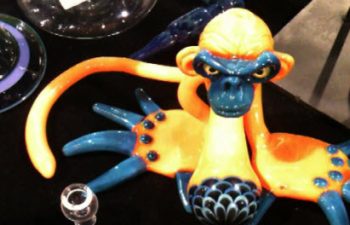
With all the fantastic glass pieces being created these days, there’s ostensibly no going backwards with the craft. But where Hugh Salkind in concerned, everything old school is new again. His signature pieces are almost exclusively in the shape of a classic chillum, sidecar steamroller or hammer, fumed with gold or silver, oftentimes integrated with his “skulltech” technique that features little skulls all throughout the fume using air traps for eyeballs and detail.
“I find that people sometimes make their life overly complicated,” Salkind says. “I grew up in the age of smoking out of a bong rather than a rig. I stick with what I like and what I hope other people will enjoy too.”
Salkind’s pieces may seem basic, at least in their form, but that, he says, is what makes them incredibly accessible. “You can wake up, put your bud in your pipe, take a lighter to it, and you’re happy. People tend to use my pieces as their daily drivers, and they become part of their life.”
Based in Eugene, Oregon, Salkind has been blowing glass since 1990 after hooking up with fellow Deadhead and now legendary glass artist Bob Snodgrass. As Snodgrass’ first apprentice, Salkind learned not only innovative pipe construction, but also played a part in furthering groundbreaking fuming techniques that gave glass magical color changing qualities.
“Bob had a set of rules for making pieces that worked incredibly well — one was a pushed in bowl so there would be air insulation around the piece; another was, putting the carburetor on the side of the piece, so that ash did not go to the bottom of the bowl,” Salkind says. “Bob was all about functionality, and basically against anything that would involve the piece heating up to the point where it got so hot that you wanted to drop it.”
Fuming, which involves vaporizing silver or gold until the resulting fumes bind to the surface of the glass. As the fumed pipe fills with resin, light gets reflected and passes through the fumed layer, creating distinct shades and hues when viewed from different angles.
Adding precious metals to a piece seems that it would logically up the price. According to Hugh, just the opposite is true. “Gold and silver are very expensive, but we use infinitesimally small amounts — in all my years as a glassblower, I’ve probably used less than an ounce,” he says. “Basically, you’re using clear glass with a slight staining of silver and gold over it, which creates the optical illusion of there being colored throughout the whole piece.”
“I’ve been accused of selling my stuff a little cheaper than I probably should, but I also know what goes into them,” Salkind adds. “I tend to make things a little more economical. Money is not important. It’s the experience that’s important.”
Besides running his own studio, Salkind teaches glass blowing at The Corning Museum of Glass, Glass Craft Expo, and Eugene Glass School. He is also a member of the Glass Art Society, and recently featured in a documentary about flameworking.
“One thing I’ve realized over the years is the more people who do what you do, the bigger your movement is and the whole industry is better off,” Salkind says. “Bob, by making me his first apprentice outside of the family, was opening the doors to people being able to do this and not have it be a secret.”
“I never thought the world would come to me. I always thought I’d have to rearrange my life and live an illegal lifestyle, but fortunately my lifestyle is now completed legal and vindicated by laws,” he adds. “I still smoke out of my pieces every day, and being a glassblower, when a piece gets dirty, I can just make a new one. I like being able to wake up in the morning, smoke and couple of bowls, go in to the studio and make whatever the hell I want.”
instagram.com/hugh.glass