



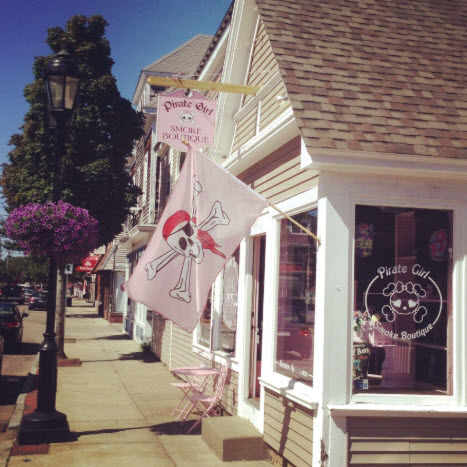
It’s been a few years since we last visited Pirate Girl Smoke Boutique. Nestled amongst a cozy strip of classic New England storefronts in Plymouth, Massachusetts, the shop itself is a testament to one woman’s love of smoking accessories. However, with many head shops catering more to male smokers, Pirate Girl Smoke Boutique chose a different route.
We recently caught up with the store’s owner, Nicole, to find out how she built her business model on female-focused smoking accessories, what it’s like transitioning from an online storefront to a brick-and-mortar location, and what might be on the horizon for Pirate Girl Smoke Boutique.
The Origin Story
 “It naturally progressed as time went on. I always just call it my snowball. And everyone was always like, well, how did you do this? Where did you start? And I was just saying, rolling my snowball; it just kind of grows and gets bigger as I go,” Nicole said when asked about the ongoing success of her shop.
Nicole started her online business as an Etsy shop in 2011. She expanded into an independent digital storefront shortly thereafter, eventually opening her brick-and-mortar location in 2015.
“It just made sense for me to open a (brick-and-mortar) store. At least everything would be up on shelves, so it was accessible, and I could easily ship it.”
But her journey on the high seas didn’t stop there. Noticing a trend, Nicole soon started offering curated subscription boxes—including the Monthly Pirate Girl Box, the Monthly Rolling Club, and the Monthly Princess Box. Each one is personally curated by Nicole herself, and they all feature a variety of feminine-inspired smoking accessories.
Finding the Right Items
All of the treasures found in Pirate Girl Smoke Boutique—whether they’re purchased online, in person, or included in a monthly subscription box—are hand-picked by Nicole herself. While this is a great way to ensure consistent brand messaging, it also guarantees that all of her products are appropriate for female smokers.
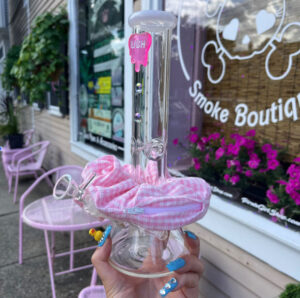 “We sell really cute bongs, and we never really have the same ones. We always have styles and inventory going in and out. But, for example, if we had a really cute Hello Kitty bong or a pink, girly bong, we can’t keep that in stock. They go really quickly, especially if it’s a good price on things. A lot of times, we’ll find close-out deals and discounted things, so we always pass those savings on to our customers,” Nicole said.
But Pirate Girl Smoke Boutique isn’t limited to pipes and bongs. They carry other products, too, including a small selection of CBD products.
“We actually sell a lot of CBD cigarettes. Those are popular because they’re an alternative to smoking cannabis, and they’re also an alternative to smoking tobacco. So we’ll use those to help people quit smoking and things like that.”
Playing an Active Role in the Community
Nicole also plays an active role in her community, where she does her best to inform the general public on local cannabis laws while promoting the Pirate Girl brand.
“I’m in a tourist location, so I definitely get tourists coming in wondering what the laws are, what you can do, where they can smoke, where they can’t smoke, because it definitely is confusing.”
She also does pop-up events whenever she can. While these events certainly help drive more business to her brand, they’re also about connecting with the community and having fun.
“We were popping up at different dispensaries this year. We were at South Shore Buds in Marshfield and Capeway Cannabis in Carver. They had a 420 party, so we popped up there to tell people about our monthly subscription box, give away free stuff, and just have fun, because those types of events are super fun,” Nicole said.
Nicole hopes to do more pop-ups in the future, including events that aren’t confined to the cannabis industry.
“I’d like to take my shop and do pop-ups at events that aren’t in the cannabis industry. I just don’t want to stay in our own little bubble. I want to go out into the mainstream and bring it mainstream. I think that’s more fun to me.”
Pulling Back the Curtain on the One-Woman Show
Pirate Girl Smoke Boutique truly is a one-woman show. The original Etsy shop was Nicole’s idea; she was the one who opened the physical store in Plymouth, and, as mentioned, she is responsible for sourcing inventory and curating the monthly subscription boxes.
 “Literally everything in the shop is me. I’m answering the chat box on our website. I’m answering emails, DMs, and I’m shipping everything. I’m putting together bundle deals, which is probably the second-most popular thing in the shop. Those are super popular, especially the ones that have the Blazy Susan papers and cones. And we also have a monthly subscription box that I curate every month, and it has a pipe usually worth at least $30, and then there’s a curated little theme around every pipe with accessories. So that’s something that I design and ship out every month to my customers.”
Nicole has already made quite a bit of progress in her journey, but she’s not done yet. With cannabis becoming more widely accepted, she already has her sights set on the future.
“I would like to see us in a big warehouse, shipping hundreds of orders a day off of our website, with our subscription box doing really great. Maybe I’d have a whole bunch of different subscription boxes to offer people and just keep growing and rolling my snowball,” Nicole said.
Heading Back to Port
Pirate Girl Smoke Boutique’s story is one of success. Not only did Nicole manage to turn her small Etsy shop into a fully-fledged online storefront, but she then expanded that into a brick-and-mortar location just outside of Boston. Moreover, she continues to capitalize on the latest trends with a reward program, monthly subscription boxes, and more.
To learn more about Nicole and the Pirate Girl Smoke Boutique legacy, check out her “Women in Cannabis” feature from 2023 HERE! And be sure to follow along on Instagram to stay up to date on their latest arrivals, events, and standout finds.











