Savina Monet is not your ordinary graphic designer. She’s an artist in the truest sense of the word, as well as an activist—and possibly a revolutionary. She stumbled into the world of collage art and made it her domain, incorporating clippings and images from vintage issues of High Times into her surreal pieces that reveal a unique aesthetic eye and a deep love for the cannabis plant. But her art is about more than just the plant. It’s about empowerment, specifically of women and minorities in the cannabis industry, and underscores her mission to promote transparency and best business practices in the emergent space.
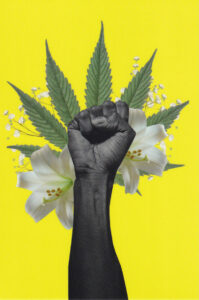
As a cannabis user herself, Monet understands the medicinal side of cannabis and how it can enhance creativity. “I find it as a way that I can actually settle down my thoughts and get a little bit more in tune with the creative vibe,” she says. Her go-to strain is Bernie Mac, from a Pacific Northwest farm called Loud. She describes it as “very strong stuff” and remarks that she only needs a couple of hits to feel the effects.
Monet’s relationship with cannabis is not only about personal enjoyment, but also challenging the stigmas rooted in decades of disinformation. Living in Portland, Oregon, one of the first parts of the country to legalize medical and recreational marijuana, opened the doors for Monet’s art to flourish. She saw it as an opportunity to incorporate the herb into her work and show people that cannabis is just another plant with no inherent danger when used responsibly. “It’s my way of challenging negative perceptions. I call it ‘exposure therapy,’” she explains.
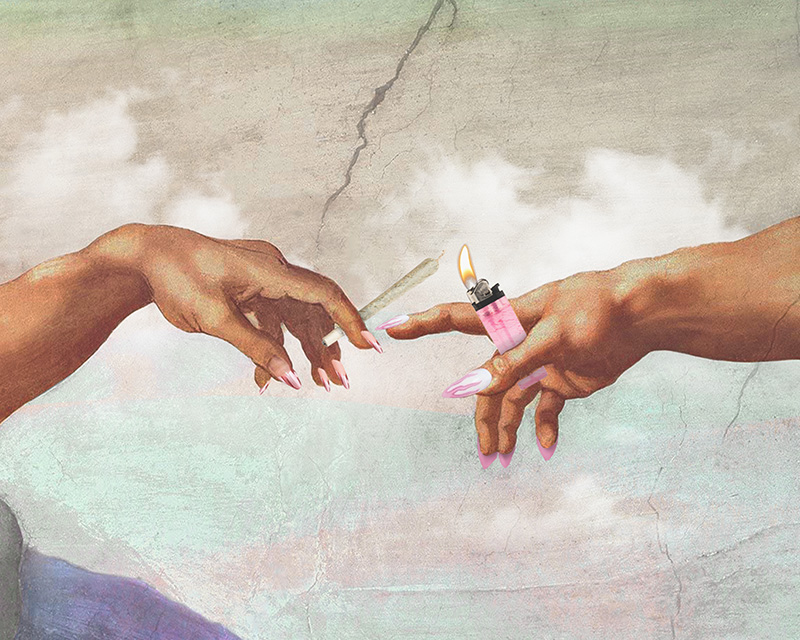
The growing popularity of Monet’s work has given her a unique platform, one which she has used to advocate for fair labor practices in the cannabis and hemp industries. She co-founded both the Cannabis Workers Coalition and We are MOTA (Minorities for Opportunities, Transparency, and Accountability in cannabis) to facilitate equal inclusion and representation of minorities in the cannabis industry.

“Around the beginning of the pandemic, there was a lot of uncertainty and confusion,” she says. “Workers were afraid of getting sick or losing their jobs, so it seemed like the right time to unify the voice of the labor movement in cannabis.”
The Cannabis Workers Coalition gives Black, Indigenous, Latinx, and low-income cannabis and hemp workers an opportunity to report incidences of exploitation and discrimination without fear of retaliation.
Monet acknowledges that women and minorities may feel intimidated to voice their concerns within the male-dominated cannabis industry, a space often led by “mountain men” who operate on their own terms. She believes that redefining professionalism is crucial in the cannabis industry, which provides an opportunity to challenge old attitudes and create a more inclusive environment.
MOTA focuses on promoting transparency and best business practices among cannabis brands that claim to represent a specific cultural lens. Monet shares her experience with a cannabis brand called La Chingona (the badass woman). According to the company bio, the brand was the creation of three sisters from Guadalajara, Mexico who perfected cultivation techniques while tending their family’s sugarcane fields. As a woman of Mexican and Italian descent, Monet was intrigued by the backstory. However, upon further investigation she discovered that a “white” dude had fabricated the entire story as a marketing strategy to attract Latino cannabis consumers. (Cue Law & Order “Dun dun” sound effect.)
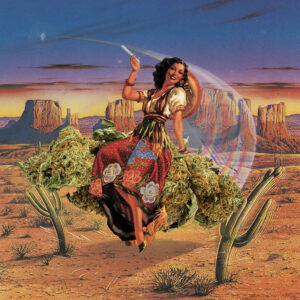
“We called him out on it,” Monet says, before highlighting the importance of holding brands accountable for misrepresentation. “No business, whether it’s within or outside the cannabis industry, should deceive or manipulate a marginalized community for financial gain. Once the truth came to light, we took action to have the misleading brand removed from store shelves.”
“There’s still a learning curve for consumers,” she adds. “We all want quality products, but don’t always consider where they come from, who touches them, and whether the labor practices are safe and healthy for everyone involved.”
As the cannabis industry has continued to grow and evolve, so too has Monet’s place within it. Her passion, creativity and advocacy have made her an influential personality in the space as she continues to be a driving force for positive change.
“I hope my work inspires others to speak up, challenge the status quo, and create a more inclusive and equitable cannabis industry,” Monet says. “We have the power to shape the future of this industry, and I’m committed to using my voice and my art to make a difference.”