Seth W.P. Nicols has a story to tell. The year is 2847 A.D. and a swarm of nanobots designed to bond with humans has taken over, and inside an area of the country near Denver, referred to as The Zone, turned people into horrific, mutated creatures. It is a dystopian future in which a group of female warriors, part human, part machine, with enhanced skills and knowledge, do battle against ruthless enemies and learn to survive and protect what remains of humanity.
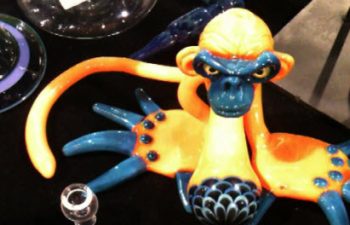
The Guardians of The Zone were birthed in Nicols’ fertile imagination. He is a hardcore fan of the magical fantasy genre, and the story is a way to give the characters he creates as a multi-media artist another dimension. The bodies are sculpted in glass and then covered in leather cloaks and armor, wrapped in copper wire, and detailed with found objects like gears, old watch faces, bits of metal and even vape cartridge components.
“People who are into weird things and oddities really zone in on the intricacies that I put into the pieces,” Nicols says.
Inspired to take up glass blowing by pipes he saw while following the Grateful Dead in the mid-nineties, Nicols (aka Justa Nuff) learned the craft from some well-known artists of the time and simply by watching his friends at the torches in their studios. He found sculpture, particularly of the human form, especially intriguing. The bodies of the glass warriors are in the form of spoons or sherlocks.
“As far as the glass goes, there’s nothing really impressive about it –- still there’s a challenge –- I’ve worked in painting, sculpture and clay, but I’ve never had anything other than glass explode on me if it’s not done perfectly,” Nicols says.
Nicols’ pieces are functional, but not necessarily daily drivers. “For the most part, people display them and then smoke out of them on special occasions –- an artistic piece will definitely enhance the smoking experience,” he says.
Unlike some glassblowers who produce signature pieces and do everything possible to keep other artists from copying their work, Nicols goes out of his way to show how his pieces are made and encourages others to create their own versions.
“I believe in the free sharing of ideas. If my style gets popularized, I’d like to see other people’s interpretations. They’ll improve on it and then I get to learn something new too,” Nicols says.
Nicols is likely the only glassblower whose studio is a portable shed that he packs into the converted school bus in which he travels the country. You could say he and his creations are in worlds of their own. “It’s great to be able to make a living with my art,” he says, “it also satisfies my creative urges and my need to be weird and different.”
Instagram: wp_nicols_glassworks
facebook.com/guardiansofthezone