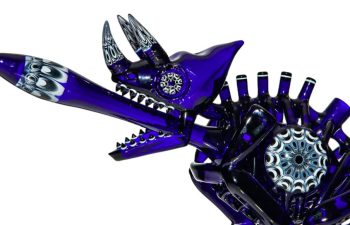
Seth W.P. Nicols


Seth W.P. Nicols has a story to tell. The year is 2847 A.D. and a swarm of nanobots designed to bond with humans has taken over, and inside an area of the country near Denver, referred to as The Zone, turned people into horrific, mutated creatures. It is a dystopian future in which a group of female warriors, part human, part machine, with enhanced skills and knowledge, do battle against ruthless enemies and learn to survive and protect what remains of humanity. 

The Guardians of The Zone were birthed in Nicols’ fertile imagination. He is a hardcore fan of the magical fantasy genre, and the story is a way to give the characters he creates as a multi-media artist another dimension. The bodies are sculpted in glass and then covered in leather cloaks and armor, wrapped in copper wire, and detailed with found objects like gears, old watch faces, bits of metal and even vape cartridge components.

“People who are into weird things and oddities really zone in on the intricacies that I put into the pieces,” Nicols says. 

Inspired to take up glass blowing by pipes he saw while following the Grateful Dead in the mid-nineties, Nicols (aka Justa Nuff) learned the craft from some well-known artists of the time and simply by watching his friends at the torches in their studios. He found sculpture, particularly of the human form, especially intriguing. The bodies of the glass warriors are in the form of spoons or sherlocks.

“As far as the glass goes, there’s nothing really impressive about it –- still there’s a challenge –- I’ve worked in painting, sculpture and clay, but I’ve never had anything other than glass explode on me if it’s not done perfectly,” Nicols says. 

Nicols’ pieces are functional, but not necessarily daily drivers. “For the most part, people display them and then smoke out of them on special occasions –- an artistic piece will definitely enhance the smoking experience,” he says. 

Unlike some glassblowers who produce signature pieces and do everything possible to keep other artists from copying their work, Nicols goes out of his way to show how his pieces are made and encourages others to create their own versions. 

“I believe in the free sharing of ideas. If my style gets popularized, I’d like to see other people’s interpretations. They’ll improve on it and then I get to learn something new too,” Nicols says.

Nicols is likely the only glassblower whose studio is a portable shed that he packs into the converted school bus in which he travels the country. You could say he and his creations are in worlds of their own. “It’s great to be able to make a living with my art,” he says, “it also satisfies my creative urges and my need to be weird and different.”

Instagram: wp_nicols_glassworks

facebook.com/guardiansofthezone

Recent Articles

I went home and told my girlfriend, who, after Googling the name of the business I bought it from, told me that, yes, it was technically weed. But it was CBD. She started laughing, telling me I had been ripped off.
State-sanctioned medical and recreational cannabis programs benefit the average user in many ways. Still, they remain a double-edged sword for dispensary owners, greenhouse growers, and others who earn their living from the cannabis industry. There are plenty of profits to be had, sure, but how exactly are you expected to secure your cash or process electronic transactions when banks refuse to work with you?
Aubrey Amatelli wants to help dispensaries and cannabis retailers navigate one of the toughest parts of the industry: money. When the company she worked for right out of grad school was acquired by JPMorgan, Aubrey entered the complex world of payments and has stayed there for her entire career.
There’s a paradox to business conferences. The best ones manage to swing from buttoned down to wildly unscripted—sometimes seconds apart. For attendees, it’s the combination of personal connections and professional development that makes regular trips to conferences worthwhile. And in an industry like this one, pulling that off is harder than it looks.
Your shop is not only a smoke shop; It's also a hangout spot and a community hub. It is a place where the regulars know your staff by name, and your staff knows what the regulars need. That's the secret sauce that the big-box chains can't replicate, and it starts with who you put behind the counter. A well-staffed smoke shop is an operational strategy, but it's also a community. In lean economic times, that community is what keeps the lights on. When people feel like your shop is their spot, they don't stop coming in when money's tight. They prioritize it. It all starts with Hiring.
Dr. Macias first fell in love with science while studying at Howard University, where she completed her undergraduate studies and later earned her PhD in cellular and molecular biology. While at Howard, she became especially interested in cancer research due to personal ties. Growing up in a Creole family and predominantly Black community in Louisiana, Dr. Macias watched many women around her battle breast cancer, so at Howard, she decided to focus her research on the BRCA1 gene.
It’s almost amazing that the same institutions that brought us the 2008 financial crisis have a problem with selling glass pipes. Almost. The truth is that an industry's past sins are only held against it when the money isn’t right. Big banks were willing to risk cratering the U.S. housing market because the profits were too good to ignore. But the cannabis industry rolls a different kind of paper, so instead of a slap on the wrist, it gets a surcharge.
Smokeshop and counterculture enthusiasts enjoy discovery as part of the experience. Customers enjoy browsing. When they walk into a shop, they don't simply grab a product and leave. They look for something new. This is the main reason flyers and posters still work. Smokeshops and dispensaries are highly visual environments. You want to see bold artwork, psychedelic graphics, and street-style posters that naturally capture attention.