



Cryptocurrency is taking the world by storm. It’s been over 15 years since the launch of Bitcoin, and although it’s more popular than ever before, it’s not the only form of crypto available today. In fact, some reports estimate that there have been more than 15 million different cryptocurrencies created to date.
Of course, not all of these have been successful. Some were shuttered after a few weeks, months, or years, and others didn’t even last that long. But with so many different options available, including altcoins, memecoins, and even shitcoins, it can be difficult for some investors to take the crypto market seriously, let alone turn a profit.
What is Cryptocurrency?
“Bitcoin, and the ideas behind it, will be a disruptor to the traditional notions of currency. In the end, currency will be better for it.”
– Edmund C. Moy, former director of the United States Mint
The roots of modern cryptocurrency can be traced back to the 1980s and 90s with alternative currencies like eCash, E-Gold, Bit Gold, B-Money, and Hashcash (no, not THAT kind of hash). Although most of these ideas never really made it off the ground, they did introduce several concepts that would help build the foundation of crypto as we know it today: anonymization and decentralization.
Anonymity isn’t a new concept by any means, but it never really served the notion of traditional currency. Personal and business checks are easily traced back to the account holder, as are credit card payments, for example. While crypto can be monitored and tracked through blockchain technology, which functions as a digital ledger for peer-to-peer transactions, it’s a much more difficult and highly technical process.
The fact that cryptocurrency is also decentralized means that it is not tied to a specific government, bank, or entity. Benefits of decentralization include:
The lack of a single point of failure protects crypto from being taken offline due to the actions (or inactions) of any one institution.
Individuals are given greater control over their assets, including how they use them and where they store them.
Buyers and sellers enjoy faster transactions and lower fees than other, traditional currency exchanges—especially when trading internationally.
Now that you have a better understanding of cryptocurrency in general, let’s take a moment to explore the different virtual coins that are currently available for purchase or trade on the crypto market.
Understanding the Different Crypto Coins
Bitcoin only represents a small portion of the cryptocurrency that is used today. To make things easy, we can categorize crypto coins into one of four groups:
Bitcoin: The primary cryptocurrency in use today. Introduced in 2009 by Satoshi Nakamoto, a presumed pseudonym, Bitcoin is the de facto form of crypto and the one that most people are referring to when discussing cryptocurrency in general.
Altcoins: This term is used to describe any type of virtual coin that is not Bitcoin—including Ethereum, Monero, XRP, Cardano, Stellar, CannabisCoin, and countless others.
Memecoins: More of a novelty than anything else, these coins are directly inspired by popular internet memes. Examples include Dogecoin, Pepe, and Gigachad.
Shitcoins: The final category is reserved for altcoins that have no perceived value or purpose. Shitcoins are often over-hyped by social media influencers, thereby creating a false sense of value, and investors are usually left with little to no profit at the end. Moreover, shitcoins are often featured in crypto pump-and-dump and rug-pull schemes.
While many serious investors focus on Bitcoin, some altcoins, and even memecoins, have made it into investment portfolios around the world.
Should Your Smoke Shop Accept Crypto?
Given the growing popularity of Bitcoin and other cryptocurrencies, some retailers are starting to accept crypto for purchases in their stores or on their websites.
A company known as Smoke Cartel, for example, has been accepting Bitcoin, Ethereum, and other types of crypto since 2019, and it doesn’t look like they’re stopping anytime soon. However, it’s worth noting that they only accept crypto via their website—their retail location in North Carolina has yet to join the fray.

Common pros of accepting crypto in your smoke shop include:
- Offering your customers additional privacy when shopping.
- Settling payments faster and paying less in fees when compared to credit cards.
- Avoiding fraudulent chargebacks (crypto payments are final and irreversible).
But there are a thousand failures for every success story. Kouchlock Productions, a medical cannabis dispensary, started accepting Bitcoin in 2014. However, due to low adoption and regulatory challenges, they had no choice but to go back to traditional payments.
- Some of the cons of accepting crypto as payment for goods or services include:
- Price volatility could cause your coin to lose value before converting sales to USD.
- Regulatory uncertainty and the complexity of tax reporting can cause unnecessary stress.
- Many consumers have yet to embrace cryptocurrency, so the low transaction volume involving crypto might not be worth the extra effort.
There are numerous pros and cons to accepting Bitcoin at your head shop, vape store, or dispensary. But what if you just want to make some investments for yourself?
Investing in Crypto
“We have elected to put our money and faith in a mathematical framework that is free of politics and human error.“ – Tyler Winklevoss, co-founder of the Gemini cryptocurrency exchange
You can buy, sell, or trade crypto using a variety of methods. The most popular method is through online cryptocurrency markets, also known as exchanges, that let users turn their cash into crypto. However, only a few of these exchanges support customers from the United States, such as Coinbase, Kraken, Robinhood, Binance, PayPal, and a few others. Moreover, many of these exchanges only support the biggest and most popular crypto coins.
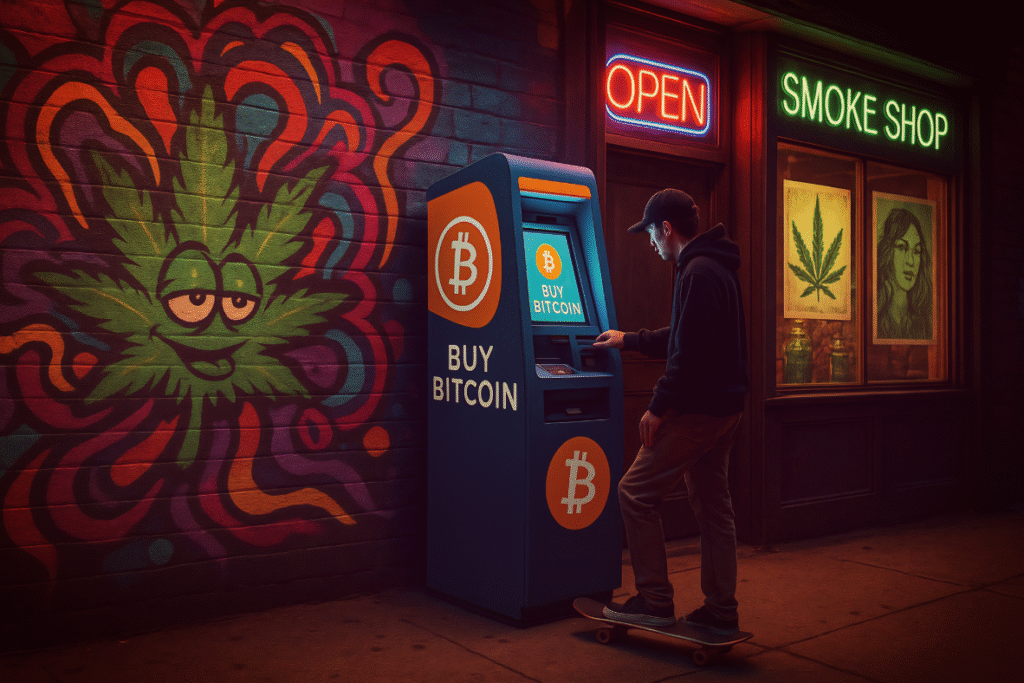
Bitcoin ATMs are starting to pop up around the world, too. While many of these ATMs support more than just Bitcoin, their selection is usually more limited than the online exchanges. They also tend to come with significantly higher transaction fees.
Considering that the price of a single Bitcoin rose from less than $1 in 2010 to well over $100,000 in 2025, it’s easy to see how some of the earliest adopters could have seen substantial profits. Although some think we’ll never see returns like that again, others believe it’s only a matter of time before other crypto coins follow suit.
It’s a Risky Business
Crypto is clearly here to stay. Whether its value will continue to skyrocket or begin plummeting to the ground remains to be seen, but given the resiliency of cryptocurrency thus far, it’s a risk that many are still willing to take.
Interested to learn more about the digital advances within the counterculture industry? Read the other installments of our Digital Takeover series:
V4: Top Tech to Wow Your Customers
V3: Can AI Save You Before it Destroys Us?











